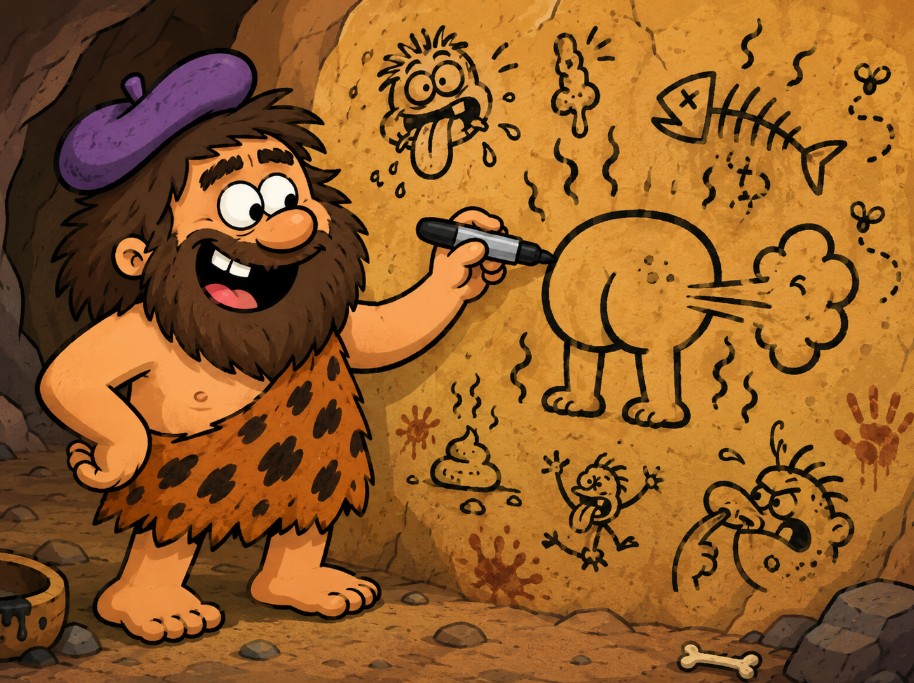
So, why Did Cavemen Paint on Walls?
Ask it plainly and the answers come easy — ritual, hunting magic, territory, boredom, God. But whatever the occasion, the mechanism is the same. A man had something in his head and put it on a wall so it would get into somebody else’s head. Here is the animal. Here is how it moves. Here is what happened to us at the river. The wall held the thought after the man walked away from it.
So ask the question again at every stop along the way.
Why did we carve symbols into stone? Why did we press wedges into clay, invent alphabets, cure hides, mix ink, cast type, coat glass with silver, string copper across a continent, bounce signals off the sky, and lay fiber along the bottom of the ocean?
Why does an engineer in Pennsylvania send a model to a fabricator in Tokyo at two in the morning? Why does a surgeon study an image made by a technician she will never meet? Why does a stranger’s sentence reach another stranger and change the direction of his life?
The answer never changes. We are trying to disperse ideas.
Faster. Farther. With less lost between the thought as it existed in one mind and the thought as it gets rebuilt in another. That is the whole project, and we have been at it since somebody figured out what ochre was for. We keep at it because every gain in communication is a gain in cooperation, and cooperation is the only reason any of this exists.
Along the way we gave stature to the people who advanced the means. The scribes, the engravers, the printers, the photographers, the film editors, the typographers, the musicians, the writers. Every bit of that stature was earned. Those were lifetimes spent learning how to make an idea survive the trip.
And somewhere in all that work we noticed something else. Some of these communications speak so purely that people make them for no other reason. No instruction. No warning. No sale. Just a sentiment that had to be shared, and the sharing of it was the entire purpose.
That is what art is.
Craft is skill with a medium — the pigment, the pen, the plate, the sentence, the note. Craft can be taught, measured, and refined, and a person can spend forty years getting good at it. Art is what happens when the thing being transmitted matters more than the transmission. These two get bundled together constantly, and they are separate things, and keeping them separate is the only way the next part of this makes any sense.
So. Artificial intelligence is advancing communication again.
It is affecting artists. That is unfortunate, and I am not going to pretend otherwise. People who put decades into a craft are watching a machine approximate parts of it in seconds. There will be theft, exploitation, lost income, and an ocean of lifeless output waved around as though it meant something. All of that is real and none of it should be brushed off.
But I have faith in human beings. Real art will always be, because the source of art was never the difficulty of the tool. The cave painter was not an artist because ochre was hard to work with. Ochre was hard to work with. He was an artist because he had seen something and could not keep it to himself.
Now the other side of it.
Imagine you had the chance to stand in that shop in Mainz and set type for the Gutenberg Bible.
Understand what you would be doing. The press is the hinge. It is the reason Western society pulled away from everybody else and stayed away. Not because Europeans were smarter or better, but because for four hundred years they could copy, correct, argue, and distribute ideas faster than any other group on earth. Every improvement compounded. Literacy, then science, then engineering, then empire. A communications head start that nobody else could close.
Nobody closed it. Until now.
That is the thing worth sitting with. AI is the first development since movable type that resets the distribution advantage. The barrier that kept expression behind money, training, time, and physical ability is coming down for a lot of people at once, and it is coming down everywhere at the same time rather than in one shop in one river valley. The field is open again. It has not been open in five hundred years.
I have watched most of my own life get swallowed by this. I remember when the internet was a curiosity, then a utility, then the floor everything stands on. I know what it looks like when a communications technology stops being news and starts being the water. This one is doing it faster than that one did.
Also understand what the press cost. Before it, books were copied by hand, and a good manuscript was a genuine object — concentration, discipline, years of training, beauty that had nothing to do with the words on the page. Movable type took most of that work and most of that living. The calligraphers were not wrong to grieve it.
So here is the question.
If you could go back and set type for that Bible — knowing how far it would travel, knowing what it would set loose, knowing you might slip in some thought that made the following centuries a little less cruel, a little more reasonable, a little kinder to the people at the bottom —
would you still cry for the calligrapher?
Or would you set yourself to work?
We should protect people from exploitation. We should confront the theft of labor, demand attribution and consent and fair pay where those things are possible, and refuse to mistake enthusiasm for innocence. All of that is our job now and we are behind on it.
But the purpose of the book was never to preserve the occupation of copying books.
The wall did not end the spoken story. Writing did not end speech. Printing did not end handwriting. Photography did not end painting. Film did not end theater. Every one of them was accused of making expression less human, and every one of them was followed by more human beings making more things.
The press is open. The field is open. Most of us can reach the wall now.
The only question left is what we put on it.