Double Hull: A Data Center That Breathes Through Its Walls
A Bright Meadow Group concept paper
Observe: Two Resources Going Up the Stack
A data center converts electricity into computation and then into heat, and the heat has to go somewhere. The standard answer spends two resources to move it. Chillers and compressors draw power around the clock, and evaporative cooling towers drink water, much of it drawn from the same municipal supply that fills kitchen sinks. As the buildout accelerates, communities near new campuses have started asking why their drinking water and their grid capacity are being fed into server halls.
The heat itself offers a way out. A server room runs hot day and night, in every season, regardless of weather. That constant heat can drive airflow on its own if the building gives it a path. Pair that path with a second one that runs cold, keep the water on the outside, and the walls do the work a chiller plant does now.
Design: A Building With Two Skins
Double Hull borrows its structure from naval architecture. Ships carry an outer hull and an inner hull with a void between them, so whatever breaches the outer skin stays out of the spaces where people and cargo live. Here the void carries cooling air, and the thing it keeps out is water.
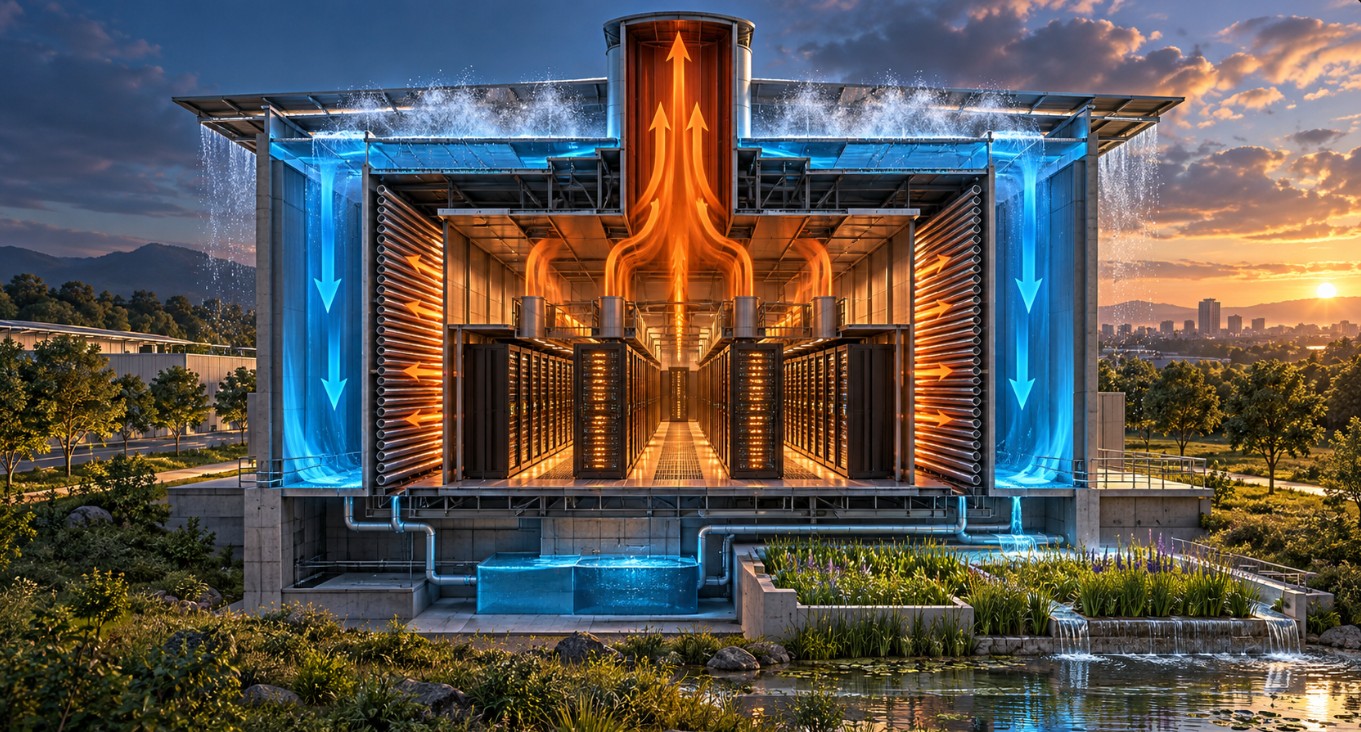
The inner hull. The server hall sits inside a tightly sealed inner shell. Racks exhaust their heat upward through chimney cabinets into a ceiling plenum, and the plenum feeds a tall central stack. Hot air rises through the stack because it weighs less than the air outside, and as it rises it leaves low pressure behind at its base. That draft pulls air through the hall continuously, powered by the heat the servers were going to throw away regardless. When compute load climbs, the column runs hotter and the draw strengthens. The cooling scales with the problem.
The outer hull. Wrapped around the inner shell is a jacket, a continuous cavity running from roof to foundation. At the top, intake air passes through wetted cooling-tower fill and a fine mist. Evaporation chills it, the chilled air grows dense, and it falls down the jacket under its own weight, the same principle that has cooled Persian houses for centuries through the badgir windcatcher. This is the down-leg of The Twin Stack, stretched around the building instead of standing beside it.
The wall as heat exchanger. The inner shell’s wall is the only thing separating cold wet air from warm dry air, so it works like one enormous plate in a heat exchanger. The falling jacket air pulls heat out of the wall from the outside. The room air gives heat to the wall from the inside. Moisture stays in the jacket and never touches the hardware.
A flat wall alone carries limited heat for its size, so the inner face is ribbed, the way a motorcycle cylinder carries fins to shed heat into passing air. Interior partitions dividing the hall are built as jacketed walls as well, each one another cold plate in the room. The more wall area the design puts in contact with room air, the more load the building carries without machinery.
The intake path. The stack pulls air out of the top of the hall, so replacement air has to come in somewhere. Fresh makeup air enters through filtered louvers and travels down sealed channels built into the ribbed inner face of the wall, riding the cold side of the exchanger before it reaches the room. By the time it arrives it has been chilled and stays dry. It enters high, settles into the center of the hall as a cool mass, and sinks toward the rack intakes while the stack draws the warmed air back up. The room turns over as one slow vertical loop, the same way soup circulates in a pot on a burner.
The pressure hierarchy. A negative-pressure room pulls on every crack in its envelope, and a leak in the inner wall would draw moist jacket air inward. Double Hull sets the pressures in order to prevent that. The jacket is vented to its own small exhaust so it runs at slightly lower pressure than the hall, and any seepage flows outward from the dry side toward the wet side. The inner shell is built and tested to cleanroom-grade tightness, and the pressure spread is monitored at sensors around the perimeter.
The Water: None of It Potable
Evaporation needs water, and Double Hull feeds its jacket from sources nobody would drink. Rooftop rainwater harvest collects into cisterns. Treated municipal wastewater, which Google has used to cool its Douglas County, Georgia campus, supplies inland sites. Coastal sites can draw seawater or brackish water for the mist stage, since salt deposits land on the jacket fill and wall exterior, surfaces built to be washed down.
The jacket drains to a sump at its base, and the sump feeds a constructed wetland cell, the same loop The Twin Stack uses. Plants, gravel, and microbial communities treat the blowdown before it returns to the cistern or discharges clean. Evaporative systems carry a known risk of bacterial growth, Legionella among it, so the mist loop runs through UV treatment, the fill is sized for regular flushing, and drift eliminators keep droplets from leaving the jacket.
Other Paths Out: Guideposts Beyond the Mist
The evaporative jacket is one way to chill the cold leg. Heat can leave a building by several vehicles, conduction, moving air, boiling and condensing, and infrared light, and each handoff between them is a place to pull heat without touching a town’s water supply. A few of the paths already proven elsewhere:
At the chip. Liquid gallium alloy, the same interface Sony puts in the PlayStation 5, moves heat off a processor into a copper base far faster than conventional paste. Cooler chips leak less current and run faster on the same power.
Sealed loops. Water held under partial vacuum boils around 40°C, right in a server’s range. In a sealed thermosiphon, heat boils it, the vapor rises on its own to a condenser, and the liquid falls back by gravity. The loop is charged once and circulates for years without consuming a drop.
Walls that catch light. Hot metal radiates infrared across open air. Heat sinks coated to glow strongly in infrared hand heat to the chilled inner walls from across the aisle, so the walls pull heat by air and by light at once.
The ground. A few dozen feet down, the earth holds around 10 to 13°C year-round across much of Pennsylvania. Closed borehole loops and buried earth tubes can chill the jacket without mist, and they perform the same in a muggy August as in a dry one.
Cold water that stays put. Toronto’s Enwave system draws near-freezing water from deep in Lake Ontario, runs it through heat exchangers, and passes it along with none lost. Google cools its Hamina, Finland campus with seawater. Heerlen, in the Netherlands, heats and cools buildings with water in its flooded coal mines. Closed loops borrow the cold and return the water.
The sky. Infrared between roughly 8 and 13 microns passes through the atmosphere to space. Sky-cooling panels, demonstrated at Stanford in 2014 and now sold by SkyCool Systems, shed heat through that gap using no water and no power, even in full sun.
Heat banks and harvest. Phase-change waxes and salts absorb the afternoon peak as they melt and release it overnight. Thermoelectric strips in the hot plenum turn a sliver of exhaust heat into enough current to run the building’s own sensors.
Neighbors. Server exhaust runs 35 to 50°C, the range greenhouses, fish farms, and aquaponic systems need through a northern winter. Stockholm and the Espoo area in Finland already pipe data center heat into homes.
The companies building these campuses sell artificial intelligence as a problem solver, and they have aimed it inward before: Google reported in 2016 that a DeepMind system cut its data center cooling energy by up to 40%. Each path above carries an open materials or control problem. Their engineers can solve for x.
The Power: Walls and a Few Fans
The building has no compressors and no refrigerant. Its electrical load comes from the pumps that lift water to the mist heads, low-speed assist fans in the stack and jacket that trim airflow on still or marginal days, and the controls that manage dampers and sensors. That load sits at or below what a conventional HVAC system spends on fans alone, before a chiller plant adds its share.
The Seasons
Evaporative cooling performs best in dry air and loses ground in humid summers, the same pattern The Twin Stack shows. A desert or high-plains site keeps a wide cooling spread year-round. An Appalachian site has a strong winter, when cold outside air can feed the intake channels directly and the mist can shut off, and a thinner margin during muggy August stretches. On those days the assist fans carry more of the load, ground loops and sky panels can take over from the mist, and operators can raise inlet temperatures toward the upper end of the ASHRAE recommended range for server equipment, which modern hardware tolerates.
The hot leg has no off-season. Servers run at night, in winter, and under clouds, so the stack keeps drawing whether the sun cooperates or not.
Intervene: Where Double Hull Belongs
Desert campuses. Dry climates give the evaporative jacket its widest spread, and they are where data center water consumption draws the sharpest local objection. Clear desert skies also give sky-cooling panels their strongest performance. A building that cools on reclaimed and harvested water answers that objection in its blueprints.
Beside wastewater treatment plants. Treated effluent already flows out of these plants daily. Siting a campus next door turns a discharge stream into a cooling supply and gives the utility a paying customer for water it was releasing anyway.
Reclaimed industrial land. Former mill and mine properties across Pennsylvania carry rail access, heavy power infrastructure, and flat pads. They also carry water that needs treatment before it reaches a stream, and flooded mine workings below them hold cold water a closed loop can borrow. A constructed wetland serving both the building and the site’s legacy water pairs the cleanup with the cooling.
Hulls that already exist. Decommissioned Navy vessels arrive with a double hull built in. The conversion described in Ship to Shore Data can route jacket air through the void between hulls, with seawater feeding the mist and the ship’s own stacks drawing the draft.
The pieces here are old ones. Stack ventilation, windcatchers, indirect evaporative exchangers, constructed wetlands, and double-hull construction each have decades or centuries of operating history, and the paths beside them, from sealed loops to sky panels, have their own track records. Double Hull arranges them so the heat solves its own problem, and the water on the outside stays outside.
Sources
- Google, Douglas County, Georgia data center use of recycled wastewater for cooling
- ASHRAE Technical Committee 9.9, thermal guidelines for data processing environments (recommended inlet range 18–27°C)
- U.S. CDC guidance on Legionella control in cooling towers and evaporative systems
- Google / DeepMind, “DeepMind AI reduces Google data centre cooling bill by 40%,” 2016
- Enwave Energy, Toronto Deep Lake Water Cooling system
- Google, Hamina, Finland data center seawater cooling
- Mijnwater, Heerlen, Netherlands mine water heating and cooling network
- Raman, Anoma, Zhu, Rephaeli, Fan, “Passive radiative cooling below ambient air temperature under direct sunlight,” Nature, 2014
- SkyCool Systems product information
- Stockholm Data Parks district heating program
- Microsoft and Fortum, Espoo-area data center heat recovery partnership
- blueribbonteam.com: The Twin Stack; Data Center Cooling Design; Ship to Shore Data