A thought-experiment theology, drawn from the antlered figure on the Gundestrup Cauldron
Start with the object, since the object is most of what we have.
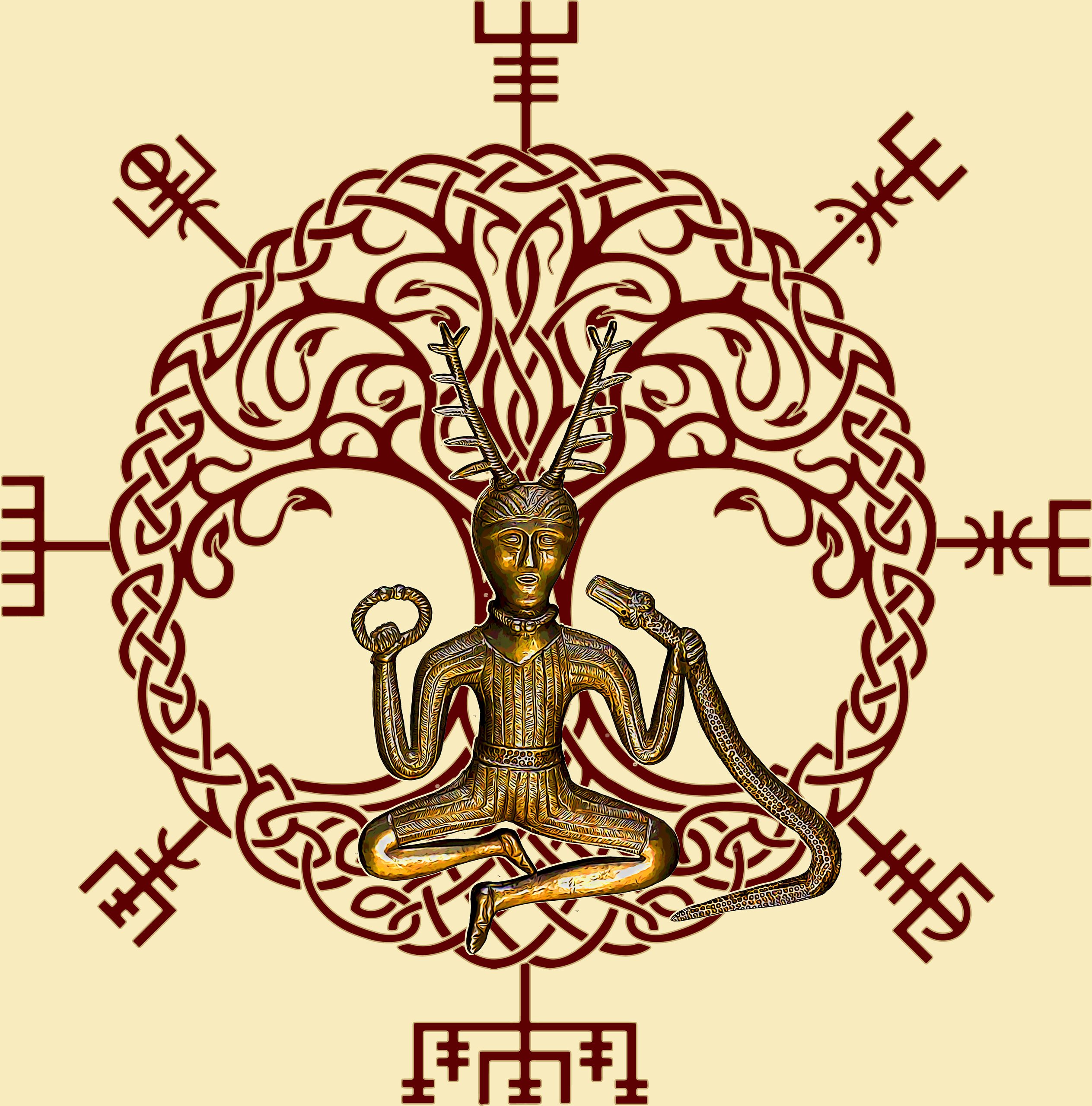
The Gundestrup Cauldron is a big silver bowl, about two thousand years old, taken apart into flat plates and laid down in a peat bog in Jutland, where a Danish farmhand cutting peat found it in 1891. The plates are crowded with hammered figures — gods, warriors, bulls, elephants that no one in Denmark had ever seen. On one of the interior plates a man sits cross-legged, and antlers grow out of his head.
Look at what he’s doing with his hands, because that’s where the whole thing lives. Around his throat is a torc, the twisted neck ring that Celtic peoples wore as a mark of rank. In his raised right hand he holds a second torc. In his left he grips a serpent by the neck, and the serpent has a ram’s horns. A stag stands beside him wearing antlers cut in the same shape as his own. Other animals ring the two of them — a hound, a pair of lions, a small figure riding a fish. The man looks out past all of it, holding the ring up on one side and the snake down on the other, keeping the two apart.
Nobody wrote down what he meant. We’ll get to how little was written down at all, but hold that for now and stay with the picture.
The obvious reading, the one a museum placard would give you, is a god of opposites. Life in one hand and death in the other. The ring is the perfect circle, eternity, the world above. The snake is the crawling thing, the grave, the world below. He sits between them and keeps the balance. It’s a tidy reading and it does what tidy readings do, which is stop you from looking any further.
Turn it over.
The serpent is the one that’s whole. It moves in a closed round, mouth toward tail. It sheds its skin and comes back the same animal. It lives in water and in the dark, in the places where the cycle keeps turning whether or not anyone is watching. If either object in his hands represents a thing that is complete, it’s the snake.
Which leaves the ring. And here’s the detail the placard never mentions: a torc is not a closed circle. Its ends stop short of each other. They have to. You put a torc on by spreading it slightly and passing it around the side of your neck, gap first, and then letting it settle. The smith builds the opening in on purpose so the metal can pass a throat and close on a living person. Hold still on that for a second, because everything else hangs off it. The holy circle of the Celts was manufactured incomplete. The sacred object is a wheel with a wound in it.
So read the ring as a life.
Incarnation is the gap. It’s the place where the unbroken round gets pried open and something leaks out into one separate person — individuated, severed, walking around with a name, mistaking the opening for the entire ring because from inside the opening that’s the only part visible. To be born is to become the gap. We are the piece that came loose. We are the wound in the wheel, convinced that the wheel is the wound.
That reassigns his hands. He isn’t holding life against death. He’s holding the broken version and the whole version of the same object. The open ring is you in exile. The closed serpent is you at home. He sits at the join because the passage across it is his work — the keeper who takes the pried-open end of a life and seals it back into the serpent’s round. Which makes death the repair rather than the injury. The ring closing. The skin fitting at last, once the wrong one has been shed.
His crown says the same thing in another language. Antlers fall off every winter and grow back every spring — a sovereignty that dies on schedule and returns on schedule. He wears the proof on his head. And the stag beside him is standing there shedding and regrowing the identical crown, the doctrine written twice so the viewer can’t miss it. Shed the antler, shed the skin, open the ring. Three objects, one grammar. Each of them comes apart in order to come back.
The object hands us one more turn. The Gundestrup vessel was almost certainly worked by Thracian silversmiths, carrying a god the Celts named, and it ended up buried in a Danish bog. Thracian metal, Celtic deity, Jutland grave, belonging cleanly to none of the three. The between-god arrived as a between-object — made by one people, worshipped by another, buried by a third. The keeper of the threshold is himself a thing caught in a doorway. That’s the god being consistent with himself.
Now the seam, left in the open, because the open seam is the point.
None of this is attested. No Gaul wrote that the torc means incarnate exile, or that the serpent is the unbroken self, or that the antlered one carries the loose end of a life back into the wheel. His name is carved exactly once, on a stone in Paris. The famous image is a hybrid object from a bog. The theology above is a build — composed in an old key, the key of exile and return that the Orphics and the Gnostics and the Vedantists were all singing in, fitted onto attributes that carry a death-and-renewal charge. The grammar is real. The doctrine is ours.
And the confession is part of the doctrine. A faith recovered from silence usually pretends its god dictated it. This one tells you where the metal stops and the imagination starts, and asks you to trust it more for the telling. The open ring is the theology and the method at the same time. Both decline to close. Both leave the gap in on purpose, so that something can pass through.
You’re the gap, reading this. The wheel is already turning you back.