When we wrote up Casey last January, the giant things took the byline, and fairly so — you don’t drive past the world’s largest pitchfork and lead with something else. Roadside town done right covered the pencil, the mailbox, the rocking chair, the wind chime, and a lunch at Richards Farm that earned its ribbon. What that piece left on the table was a photograph I’ve been holding onto since, waiting for a slot where the house could stand on its own instead of playing background to a fiberglass golf tee.
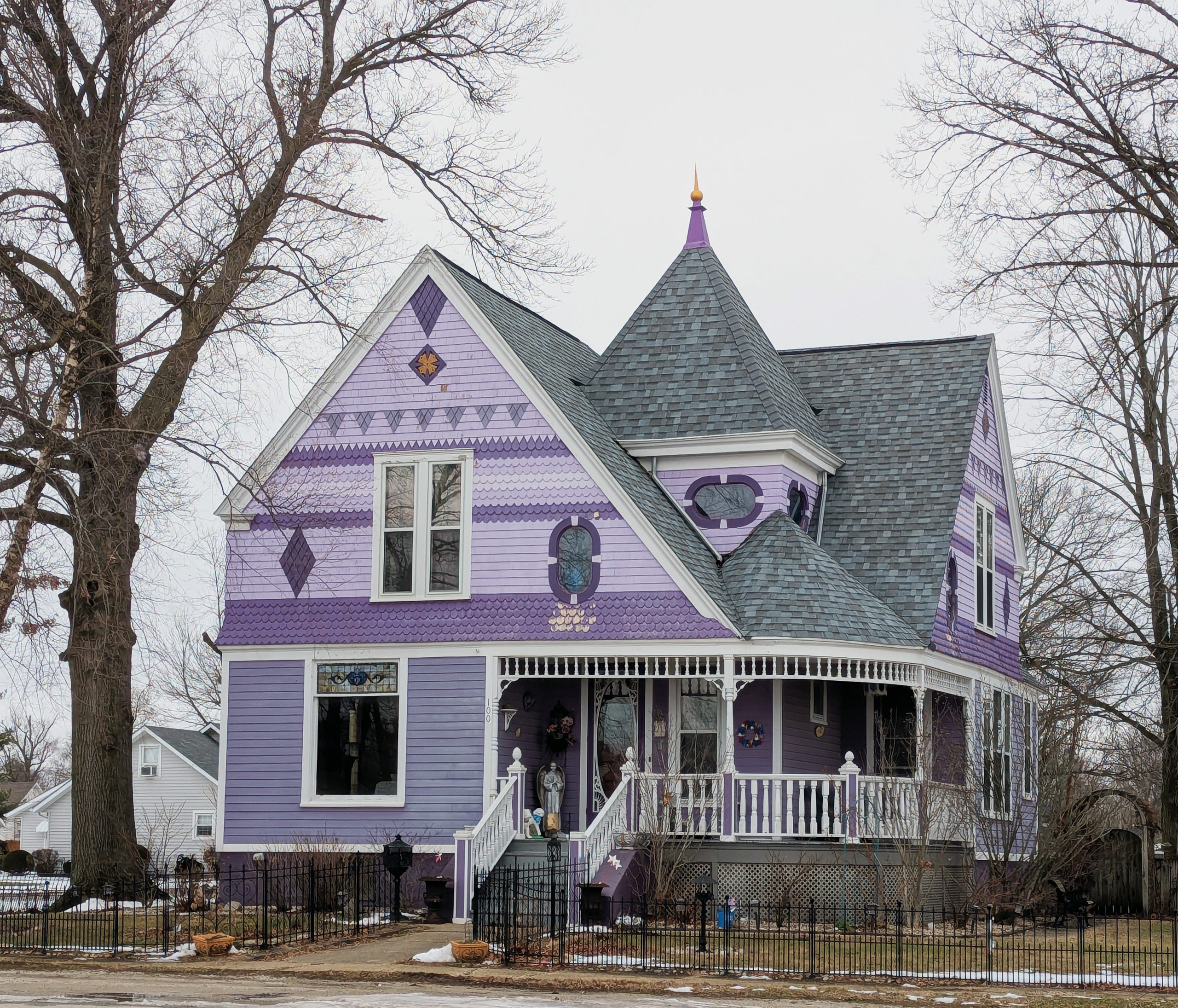
So here it is. A purple Queen Anne on a corner lot, a few blocks off the attraction circuit, doing more with a modest footprint than most restorations three times its budget.
Start with the massing, because that’s what makes this one worth stopping the car for. The house is cross-gabled with a corner tower tucked into the inside angle, and the two street-facing gables read as near mirrors of each other. Same pitch, same width, same diamond appliqué floating in the peak, same banded shingle courses stepping down toward the porch roof. Walk the sidewalk around the corner and the composition barely changes. Most houses have a front and a side; this one has two fronts and treats them as equals, which is exactly the right instinct on a lot where traffic arrives from four directions.
The tower carries a bell-cast conical roof and a slender finial with a gold ball at the tip — the one warm note in an otherwise cool palette, and it does a lot of work catching light on a gray January afternoon. Below it, a small dormer face with paired oval windows sits over the porch like a pair of eyes, and that oval motif repeats across the elevations: framed in molded surrounds on the gable ends, in the tower, in the shingle field. Repeat a shape often enough and it stops being decoration and starts being grammar.
The porch is the part I’d want to sit on. It wraps from the front steps around the tower base and keeps going, carried on turned posts with a spindle frieze running the full length and a fretwork bracket at each corner. Turned balusters, a stepped rail, and a good deep shade line. Gingerbread of this kind gets dismissed as fussy by people who’ve never stood under it, but the porch here isn’t a display case — the wreaths, the statuary on the steps, the odds and ends hung on the wall all say somebody uses it. A porch that greets three approaches and invites all of them is a piece of civic infrastructure as much as it is architecture.
Then the color. Three values of purple, roughly: a lavender field on the clapboard, a deeper violet on the shingle bands and the sawtooth courses, and something close to eggplant on the accent diamonds and the tower cap. White trim holds the whole thing together at the window casings, the gable rakes, and the porch. A gray composition roof keeps it from tipping into candy. Stained glass in the parlor window and again in the small tower opening, so the color scheme continues indoors rather than stopping at the siding.
Whoever chose that palette understood something about polychrome Victorians that a lot of well-meaning owners miss — the pattern already exists in the shingle work, and paint’s job is to reveal it rather than compete with it. Each band of fish-scale gets its own value, each triangle course reads as a separate line, and the eye climbs the elevation the way the builder’s original catalog drawing intended.
The outbuilding at the back of the lot deserves a mention too. Blue, covered edge to edge in stars and assorted found ornament, with an arbor at the gate and a wrought iron fence tying the whole property together. It’s a different key from the main house, but clearly the same hand, and it turns what would otherwise be a detached garage into part of the composition.
Casey put itself on the map with oversized objects, and that strategy worked — the town gets the traffic and the tax receipts to prove it. What this house suggests is that the same impulse runs deeper than the tourist attractions. Somebody on this corner decided their house was worth being interesting, and then spent the money and the ladder hours to make it so. A little more of that in every town would go a long way.