The Johnstown Inclined Plane, Johnstown, Pennsylvania
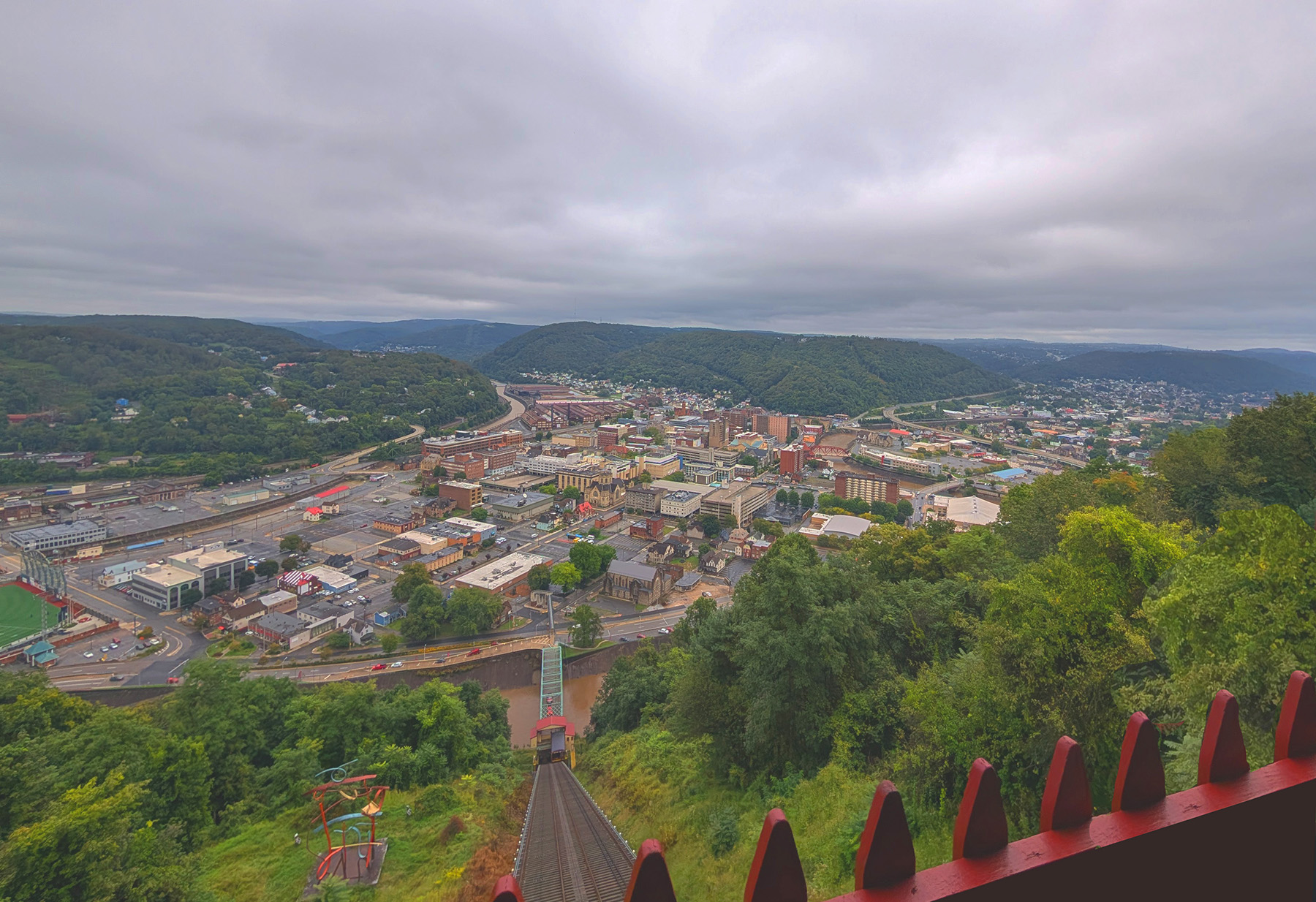
The view on the cover comes at the end of the ride. Downtown sits spread across the valley floor: the ballfield on the left, church roofs and brick blocks in the middle, the old mill buildings strung along the Conemaugh, and the rivers bending out of sight between green ridges. From up here Johnstown looks like a town poured into the bottom of a bowl. That shape explains the machine you just rode.
A town with one direction left
The 1889 flood killed 2,209 people and left a narrow industrial city with very little flat ground to rebuild on. The hilltops had room. Getting a steelworker, a horse, and a wagon up 500 feet of hillside every morning was the problem.
The Cambria Iron Company started building its answer in 1890 and opened it on June 1, 1891. Samuel Diescher designed it. Diescher already had Pittsburgh’s Duquesne Incline to his name, and he later designed the machinery that turned the first Ferris wheel at the 1893 Chicago World’s Fair. Once the incline was running, the hilltop filled in fast. Westmont was incorporated as a borough the next year, making it one of the early streetcar-and-cable suburbs in the country. The incline worked like a staircase for an entire neighborhood.
The numbers
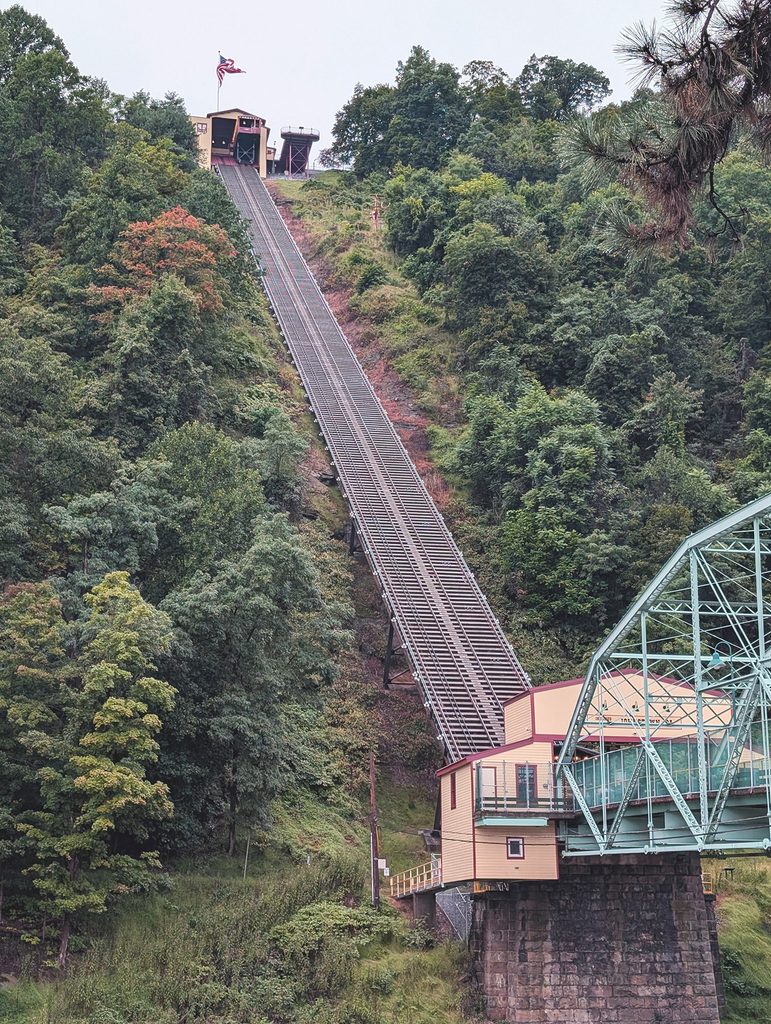
The track runs 896.5 feet and climbs roughly 502 feet. That gives a grade of about 71 percent. Grade is a measure of rise over run, and people sometimes confuse it with degrees. A 71 percent grade works out to roughly 35 degrees, which from the bottom looks a lot like a ladder leaned against a house. Guinness lists it as the steepest vehicular inclined plane in the world, meaning it carries cars and trucks as well as people. The trip takes about ninety seconds.
Two buckets on one rope
The incline is a balanced system. Two cars ride parallel tracks on two cables that wrap the same drum, so as one car climbs the other descends, and they pass each other at the midpoint. Think of the two buckets on an old well rope. The weight of the car going down does much of the work of lifting the car going up, and the motor only has to make up the difference.
That difference can be considerable. Each car weighs about 22 tons empty and is rated to carry another 15.
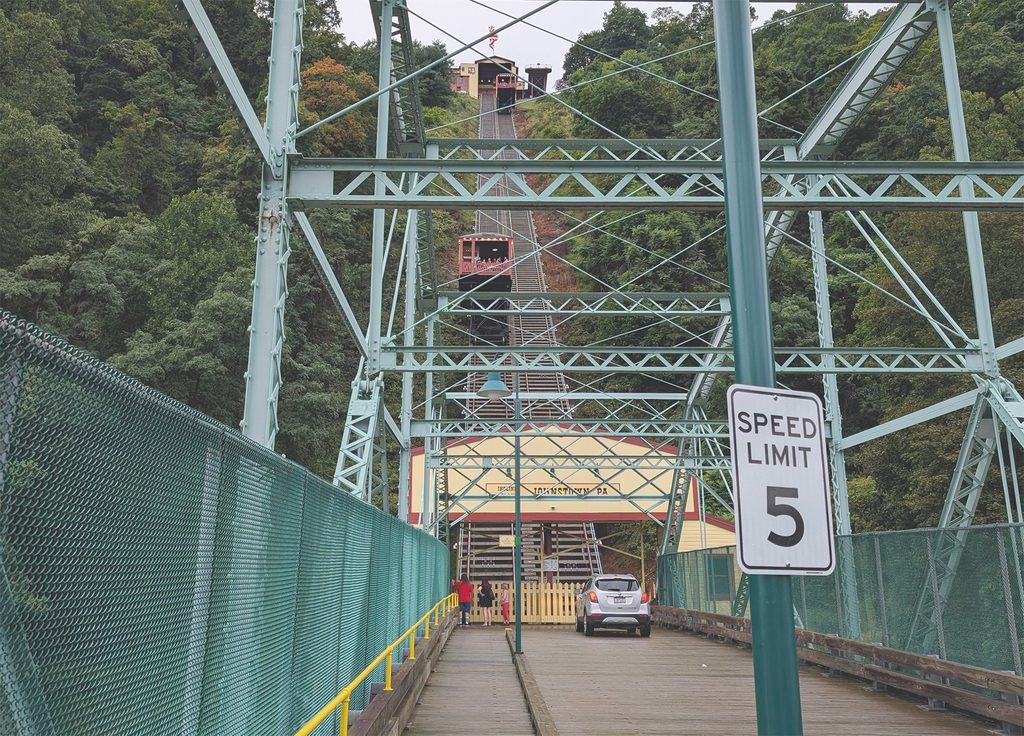
The lower station sits across the Stonycreek, reached by the Inclined Plane Bridge. The bridge opened the same day as the incline in 1891, and it still carries traffic straight onto the car deck. The speed limit on the approach is five miles an hour, which feels about right for driving your car onto an elevator.
The engine room
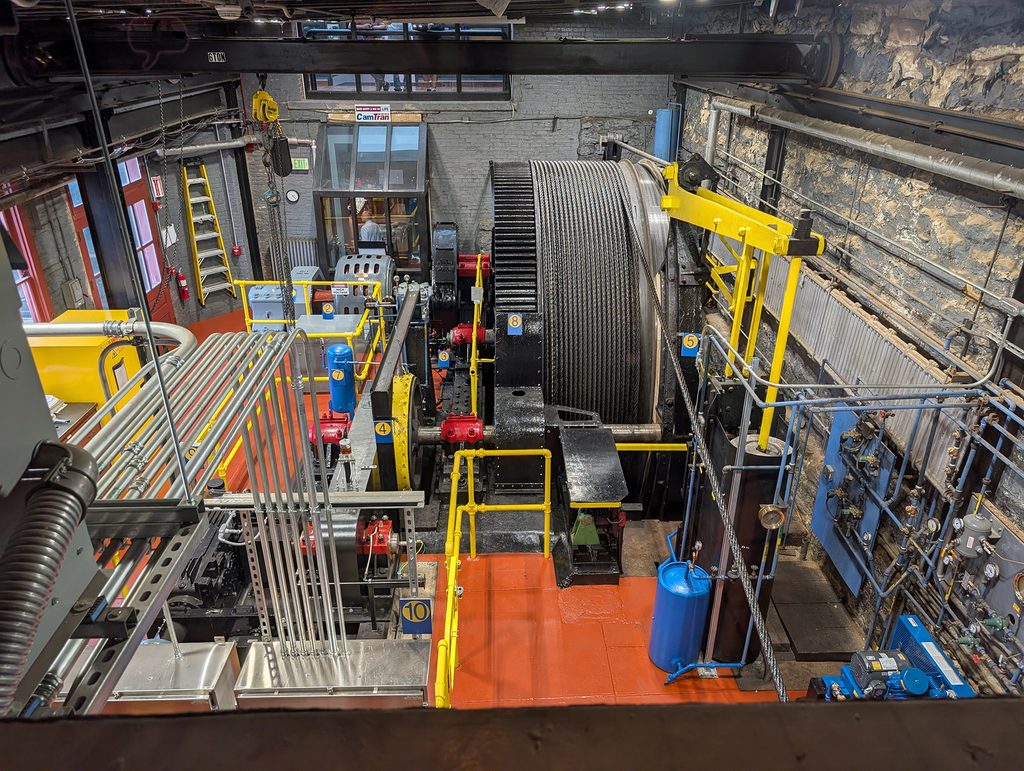
The hoisting machinery lives in the upper station, and it sits turned at a right angle to the tracks. Diescher set it that way to save space on the hilltop, which is why the cables make a turn before they reach the drum.
The drum is sixteen feet across and weighs three tons. Two steel cables, each about two inches thick and a little over a thousand feet long, wind and unwind around it at the same time. The incline ran on steam until January 6, 1912, when the engine was disconnected and replaced with an electric motor, now rated at 400 horsepower. Each cable has an air brake, backed by a dead-man emergency brake tied into the cables.
Standing at the rail over the pit, you can read a century of maintenance in the room. Stone foundation walls, an overhead crane beam stenciled for six tons, fresh safety-yellow guardrails, and numbered placards marking the stops for anyone taking the tour. The blue tanks and gauge-studded piping along the right-hand wall look to be the air side of the braking system.
The cars
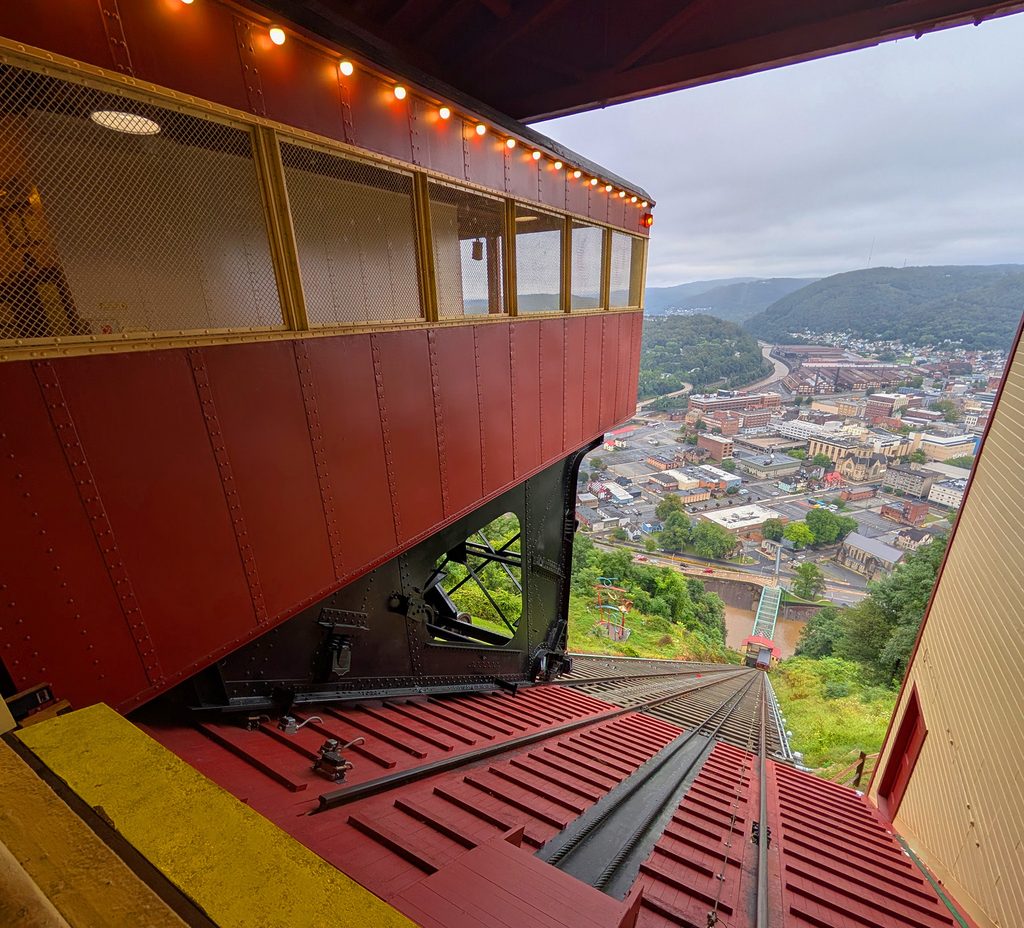
The original cars were double-deckers. Horses and wagons rode the upper deck, passengers rode in a compartment underneath. Twice in the 1920s a spooked horse leapt off the car onto the tracks. The cars were rebuilt as single-deckers in 1921, and those are the cars running today.
This photo shows the trick that makes a vehicular incline possible. The car body sits on a steel frame shaped like a doorstop, tall on the downhill end and short on the uphill end, so the deck stays level on a 35-degree slope. A car rolls on and parks as if it were sitting in a driveway.
A lifeboat on rails
The incline was built partly as a flood escape, and it got to prove it. On March 17, 1936, the rivers came up again. Nearly 4,000 people crowded the approach, the bridge, and boats to reach the lower station and ride to high ground in Westmont. It served the same purpose in the flood of July 1977.
Changing hands
Cambria Iron, and later Bethlehem Steel, ran the incline until 1935, when the company sold it to the borough of Westmont. Ridership had been falling since the automobile caught on around 1919. In January 1962 Bethlehem Steel cut off the power supply and the incline went dark until a renovation that summer. The Cambria County Transit Authority, now CamTran, took it over in 1983 and spent eighteen months rebuilding it from Diescher’s original plans, supplied by one of his descendants. It reopened in 1984.
It went on the National Register of Historic Places in 1973, and the American Society of Mechanical Engineers named it a Historic Mechanical Engineering Landmark in 1994.
Back on the hill
The incline closed in 2021 for what was supposed to be a routine rehabilitation. It turned into five years. Crews found cracks in several strands of one cable, damage traced back to the construction work itself, and an independent review turned up haul wheels that didn’t meet design specifications. Supply chain trouble, foundry closures, and the pandemic stretched the timeline further, and state inspectors sent it back for adjustments to the brakes and safety gate more than once.
It reopened on September 4, 2026, closed for a crazy storm and reopened again September 10, 2026 in CamTran’s fiftieth year. For the first thirty days of operation, rides are free.
Take one. On the way down the city grows back to its real size a block at a time, and by the time the car settles into the lower station you’re back on the valley floor with the river at your elbow, the same place those 4,000 people were trying to get away from.
Sources
- American Society of Mechanical Engineers, “Johnstown Incline” Landmark #180 — asme.org
- Johnstown Inclined Plane, History page — inclinedplane.org
- Wikipedia, “Johnstown Inclined Plane” and “Inclined Plane Bridge”
- Funimag, “Johnstown” (Michel Azma) — funimag.com
- Invention & Technology Magazine, “Johnstown Incline”
- WTAJ, “Johnstown Inclined Plane to reopen following extensive rehabilitation project” (Sept. 2026) and “Historic Johnstown Inclined Plane returns to service after nearly 6 years”
- WJAC, CamTran rehabilitation project updates (Feb.–Sept. 2026)
- Visit Johnstown, “Update on the Johnstown Inclined Plane Rehabilitation Project” (Dec. 2024)