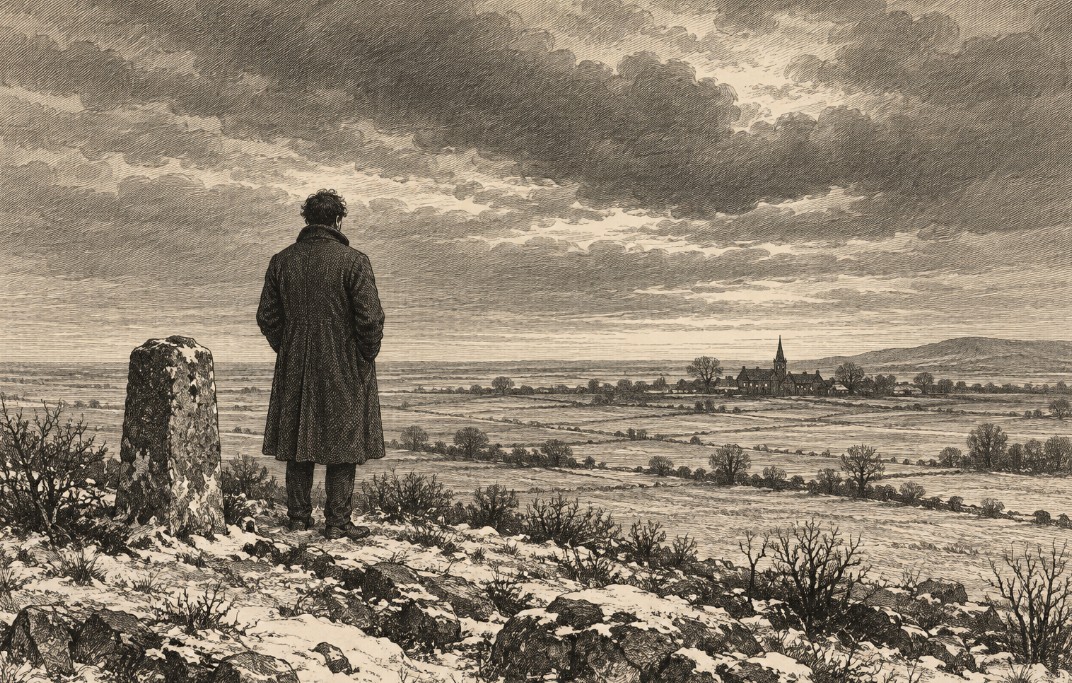
We use the word “outlaw” to mean a person who breaks the law. The older sense ran the other direction. To be outlawed was to be put outside the law’s protection. Your obligations stayed with you. Your standing went. The community hadn’t decided you were dangerous. It had decided you were no longer its concern.
I want to describe a man who arrives at that older condition without a court ever saying a word about him.
Start with him before anything goes wrong.
He’s unusual, and he’s known it since grade school. Big. Strong. Smart enough to see where systems are held together with tape. He’s also missing the receiver that picks up the culture around him. Whatever mechanism makes a person want what the neighbors want, he got a light dose of it. Fashions pass over him. Enthusiasms pass over him. He can watch a consensus form in real time — in a breakroom, in a church basement, on a national scale — and see a thing that formed, with a date on it, rather than the shape of the world.
That has its uses. He’s hard to sell to and hard to stampede. He’ll ask why the policy exists while the rest of the room is already nodding along, which makes him a bad fit for a committee and a decent man to have near a bad decision.
It costs him constantly. The ordinary rewards for going along don’t reach him. He gets no lift from the team winning. He gets no warmth from being in the room. He doesn’t feel the small hit of belonging that comes free to other people when they follow a custom they couldn’t explain. He’s also bad at the mechanics — reading a room, tracking what people mean underneath what they say, knowing when a joke has gone on too long. Childhood sanded that into something permanent. He works around it. He doesn’t fix it.
Which means a man like this has to decide about the rules on the merits. A man who fits in easily follows them the way he takes the same route home, without ever putting it to himself as a question. Our man puts it to himself as a question. Every stretch of cooperation is a call he makes on purpose, reasoned out, with none of the warm feeling that’s supposed to come along with it.
He keeps making the call in favor of cooperation.
Note what he’s turning down. The same traits that make a passable sergeant make a very good confidence man. Size, nerve, pattern recognition, indifference to what the neighbors think. In an economy that pays well for a certain amount of predation, he had the kit for it and the temperament to use it. A man who can see the consensus from outside can also see what it leaves unguarded. He enlists instead. Goes where he’s sent. Comes home and takes a civil service job, which is the least clever thing a clever person can do with himself. Draws a salary. Pays into the system. Services his debt. Shows up in weather that keeps other people home.
Underneath that is a bargain nobody puts in writing:
I’ll act like this society is real, and it will act like I’m part of it.
That bargain is load-bearing for him in a way it isn’t for most people. Others have ballast — family feeling, hometown, church, union, the sense that this is simply how people behave. When reciprocity thins out for them, the ballast holds them steady for a while. He doesn’t carry any. The arrangement is the whole of it. He looked at the deal, judged it sound, and has been paying on that judgment for forty years.
Then, late in his working life, he breaks.
The breaking is the least interesting part. People break. Backs, hearts, minds. Grandmothers knew it and actuaries know it, and the whole apparatus of pensions and hospitals and disability law exists because human beings are not self-sufficient on a permanent basis. A man who gets through sixty years without one bad season is lucky, and luck is a poor thing to design a civilization around.
What tells you about the system is the part after.
While he was strong, useful, and dependable, the people around him knew what to do with him. Now that he’s diminished, awkward, and inconvenient, the whole thing goes transactional in about a week.
His coworkers were cordial with him and no more, so there’s little informal solidarity to draw on. No sign-up sheet circulates. His family finds his weakness embarrassing or expensive and drifts to a comfortable distance. His employer stops seeing the man who gave it decades and starts seeing hours, classification, restrictions, exposure. He asks to come back to the work he did. He gets fewer hours, less money, and a job title he’d have been ashamed of at twenty-five. When he presses the point, the institution spends real money on attorneys to keep him where they’ve put him.
So he says, in whatever words he’s got: I’m still here. Help me get back.
And the machinery answers: No. And you still owe everything you owed when you were healthy.
Sit with the asymmetry for a second.
His earning capacity collapsed. His health collapsed. His standing at work collapsed. His family’s patience collapsed. The mortgage did not collapse. The electric company sent no note saying that thirty years of on-time payment had bought him a soft landing. Interest kept compounding on schedule, because that’s the one participant in this arrangement with no discretion and no memory.
We handle institutional trouble differently. A bank that gambles itself insolvent has liquidity by Monday morning. An airline gets a rescue package. A carmaker gets a federal loan and a seat at the table where the terms get written. A municipality in default gets a state authority and a schedule it can live with. When the wreck is big enough, the case for catching it writes itself — jobs at stake, contagion downstream, damage we’d rather spend on preventing than on cleaning up. We understand that arithmetic fine at institutional scale.
Note where the catching money comes from. Withholding. Payroll deductions. The premiums and fares and deposits of people who clock in. He helped fund the net that caught the bank, one pay period at a time, for forty years. When the same logic turns and points down at him — stabilize him now for a fraction of what his collapse will cost later — the answer comes back in two words.
Pay me.
Which brings me to the question in the title, and it’s a different question than it sounds like.
It isn’t why are you making me commit crimes. That version is a threat wearing an essay’s clothes, and it lets the reader off the hook — file it under angry man, move on to the sports page.
It’s why are you removing me from a civilization I spent my life agreeing to participate in.
People follow rules for a handful of reasons. Fear of getting caught. Believing the rules are right. Feeling like part of the place. Finding that cooperation pays better than the alternative. Trusting that restraint gets returned. Look back at what I told you about him and you’ll see which of those were doing the work. He didn’t feel like part of the place; he decided to act like it. Take away the return on restraint and you’ve taken the load off the only column holding the roof.
Here’s the turn that ought to bother people. The man who was indifferent to the culture went along with it anyway, on principle, for forty years. The reward for that is being informed, at sixty, that he was outside it the whole time and the paperwork is just now catching up.
He is also, and this is the uncomfortable part, still capable. Older, in imperfect health, unemployable at anything near his old wage. Still large, still intelligent, still carrying two decades of training, most of it paid for by the same people telling him good luck with the grocery bill.
I’m making no predictions here. Plenty of men in his position grind it out in a rented room and die with the bill paid. The trouble is that we keep building a chute and then act surprised by what comes down it. We are arranging things so that cooperation stops penciling out for a person, and then leaning on his character to hold the line anyway. That isn’t a policy. It’s a wish.
It’s also expensive. Call it twenty thousand dollars to keep him whole — income replacement for a stretch, medical care, a real return-to-work path, breathing room on the debt. Too generous, somebody says, and the request dies in committee. So he goes down instead. He loses the house. His health worsens without maintenance. The default hits his credit and forecloses the small options he had left. Emergency room instead of a clinic. A shelter bed. Court costs. Maybe, somewhere down the line, a public defender and a cell, which run about forty thousand a year. We’ll spend a fortune on the wreckage as long as no one asks us to spend a modest sum on prevention. Any engineer in the country can tell you why you grease a bearing and shore a bridge and maintain a levee in dry weather. We apply that logic to steel and concrete and call it prudence. We apply it to people and call it dependency.
Here’s where I’d want him to land.
He doesn’t want to be an outlaw. That’s the whole argument. He had his chance at living outside the rules when he was young and strong and angry about it, and he passed. He wore the uniform. He did the work. He paid what he owed to people who didn’t much like him and institutions that never quite knew what to do with him. He is, right now, still trying to hold up his end.
What he can’t work out is why, at the exact moment holding it up got hard, everyone on the other side of the table decided their end was optional.
So the question stands.
Why would you make me an outlaw?
And if the answer is that you never owed him anything to begin with — then what has he been paying into?