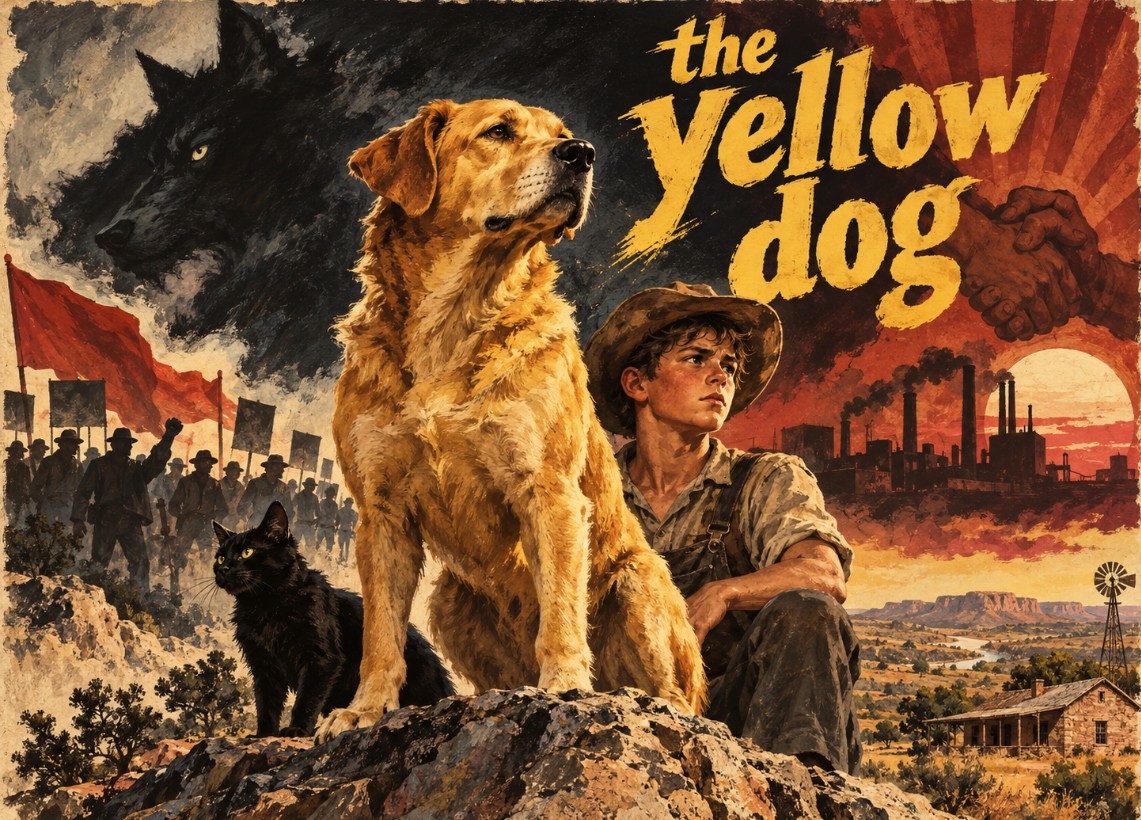
Fred Gipson published Old Yeller in 1956, and Disney put it on the screen the next year. Generations of kids have cried through it as a story about a boy and his dog. Read it with a union card in your pocket and a second story walks out of the brush.
Start with the name. In American labor talk, a yellow dog was a man who would sign whatever it took to get hired, including the yellow-dog contract, a pledge to stay out of the union as a condition of the job. Courts upheld those contracts for decades until Congress made them unenforceable in federal court with the Norris-La Guardia Act in 1932. Twenty-some years later, when Gipson sat down to write, the phrase still had its smell. Calling a man a yellow dog meant he’d sold out his brothers for a day’s wage.
Now the setup. Texas hill country, late 1860s. Jim Coates leaves home on a long cattle drive to Kansas, the working man gone off on the long haul to chase the wage that keeps the place afloat. Before he goes, he puts his fourteen-year-old son Travis in charge. That’s a steward’s appointment in plain clothes: you’re the man here now, hold the line until I get back.
Into this shop wanders a stray. Ugly, yellow, wearing nobody’s brand. The first thing he does is steal the family’s meat. That’s the scab’s opening move. He eats out of the common store, takes what other hands put up, and answers to whoever fed him last. Travis wants him run off. The steward reads the dog right on the first day.
Little Arliss loves him, though. Arliss is the new hire, the kid on probation who hasn’t walked a picket line yet. He sees a friendly fellow willing to work and can’t figure out why the old hands spit when the dog trots by. Katie, the mother, stands in for the membership, the people who have to live with whatever gets decided. She lets the dog stay because he earns his keep. And he does. He takes on a bear to save Arliss. He wades into a pack of wild hogs to save Travis.
Here the allegory gets its teeth. A scab can be useful. He can be likable. Plenty of strikebreakers were hungry men with families of their own, and the bosses counted on that, the way a trapper counts on the bait smelling good.
Then the sickness comes. Hydrophobia moves through the county, through the cattle and the wild things, the company’s poison working its way from homestead to homestead. One night a rabid wolf comes for the Coates place. Yeller fights it off and saves Katie and Travis, and in the fight he gets bitten.
The wolf is the boss’s man, the Pinkerton, the labor spy, the goon with the ax handle. The bite is the deal struck in the dark. Once the dog has tangled with the company and carries its mark, he’s a carrier, whatever his loyalties were the day before. He can’t be trusted around the young ones anymore, because what’s in his blood will come out sooner or later.
So Travis takes the rifle and does it himself. The boy cries and the steward does his job. He doesn’t hand it off to anyone else, and he doesn’t wait for his father to come home and make the call for him. In a union town, expulsion for scabbing worked like its own kind of death: no hall, no brothers, no work when the next contract came through. The man doing the expelling usually knew the man being expelled, and sometimes liked him.
Then Jim comes home, and the returning leadership backs the steward’s call. He brings Travis a horse, sits him down, and tells him life can be hard and that a man can’t let the hard parts eat up the good ones. The local survives.
And there’s a pup. Yeller sired a litter before he died, and one of those pups comes to the Coates house. The scab’s line gets raised inside the family, fed from the same table, brought up right. The son of a strikebreaker can grow up to carry a card.
That’s the story under the story: a boy left in charge while the men are away, a stray who eats the family’s stores and wins over the youngest, a contagion carried in by the company’s wolf, and a steward who loves the dog and shoots him anyway, because the whole house depends on it.
Sources:
- Fred Gipson, Old Yeller (Harper & Brothers, 1956)
- Old Yeller, Walt Disney Productions, 1957
- Norris-La Guardia Act of 1932, 29 U.S.C. §§ 101–115