What the 2026 Nobel Prize in Chemistry says about where to dig next
I learn things I have no use for. I read chemistry I’ll never run in a lab, biology I didn’t study in school, and engineering I’ll build in my head and nowhere else. Then one piece rattles into another, and something shakes loose.
The 2026 Nobel Prize in Chemistry did that to me this week.
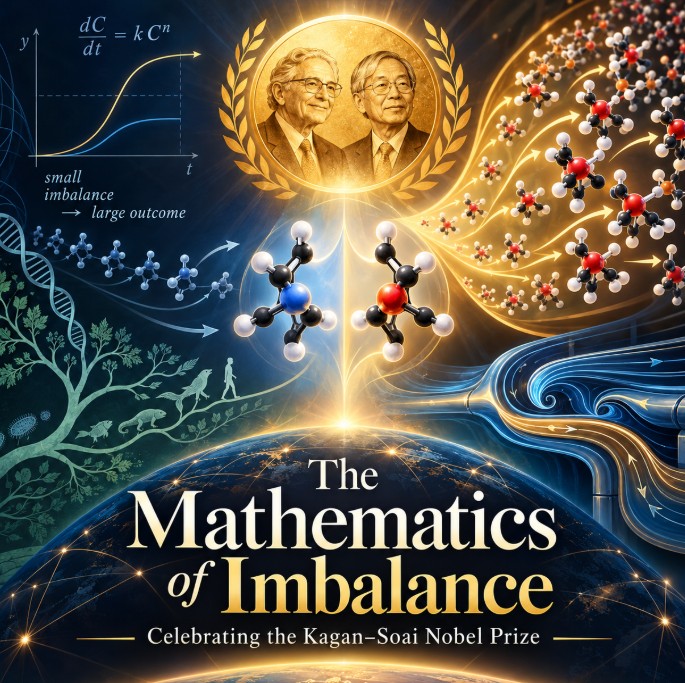
On October 7, the Royal Swedish Academy of Sciences gave the prize to Henri Kagan, a 95-year-old French chemist, and Kenso Soai, a 76-year-old Japanese chemist, for the discovery of nonlinear effects and autocatalysis in asymmetric organic synthesis. Take off the lab coat and that citation describes a small imbalance growing into a big one.
Left hands and right hands
Some molecules come in two mirror-image versions, like your hands. Same parts, opposite arrangement, and no amount of turning makes one sit flat on the other. Chemists call this chirality. It matters in medicine because the left-handed version of a drug can do one thing in the body and the right-handed version something else entirely.
Living chemistry picks a hand and sticks with it. Louis Pasteur put his finger on the puzzle back in the 1800s, and it sat there for more than a century: if ordinary reactions turn out left and right versions in equal amounts, how does one hand end up running the show?
Kagan found a piece of the answer in the 1980s. He showed that a catalyst mixture tilted a little toward one hand could produce a product tilted a lot further. Feed in something like a 75/25 split and you could get out something closer to 90/10. The result outran the ingredients.
Soai took it the rest of the way. In his reaction, the product helps make more of itself. Start with a sliver of extra left-handed molecules, and each round of the reaction tips the next round further, until the batch is close to pure. It behaves like a campfire. One coal catches the kindling, the kindling catches the log, and the fire makes the heat it needs to keep going. The chemistry still pays its thermodynamic bills, so there’s no free lunch here. The surprise is how far a small head start can run once the system feeds itself.
The question underneath
The prize rewards chemistry. What I walked away with is a question: when two sides of a system aren’t equal, what decides whether that difference grows, fades, flips, or settles into something new?
Once I had that question in my pocket, I started seeing it elsewhere. In evolution, a small reproductive edge compounds across generations until the weaker variant thins out of the population. In Tesla’s valvular conduit, the shape of the pipe lets water run easy in one direction and makes backflow trip over itself. In water chemistry, a nudge one way can push a reaction forward or set off chains that put things back the way they were. Different mechanics, different equations, and the same question sitting at the bottom of each.
Give it a field
The tools to answer that question already exist, scattered across departments. Nonlinear dynamics, feedback theory, reaction kinetics, population genetics, fluid dynamics, probability. Each discipline has its own vocabulary for imbalance. A chemist says autocatalysis. A biologist says selection. An engineer says feedback or diodicity. They’re describing cousins who have never been to the same family reunion.
I’d put them in one room. Build the mathematics of imbalance as its own course of study, with a shared language and a working catalog of what imbalances do: amplify, suppress, reverse, lock in, recombine. Teach students to spot the pattern in a beaker, a gene pool, a pipe, and a market, and then teach them where each comparison breaks down. Hand researchers that catalog and let them carry a structure from one field into another to see what it turns up.
Organize the language and the math around a subject, and the subject starts producing. People find each other. Questions that fell between departments get an address.
I feel the same way about water. I’d love to see water studied as a subject in its own right, its interactions across chemistry, biology, geology, and engineering gathered under one roof instead of parceled out as a footnote in each. Water and imbalance have that in common. Each one runs through nearly everything we do, and each one gets studied in pieces.
I’m a guy who reads about this stuff. I can see the outline, and I’ll leave the equations to people trained to write them. Seeing the outline is enough to know the building ought to exist.
Kagan and Soai spent their careers on a question plenty of people would have filed under curiosity, and they showed that small inequalities can decide big outcomes. I’d like to see somebody take the hint and build the department.
Sources:
- NobelPrize.org, “Nobel Prize in Chemistry 2026” summary and press release, October 7, 2026 — https://www.nobelprize.org/prizes/chemistry/2026/
- Al Jazeera, “Henri Kagan, Kenso Soai win Nobel chemistry prize for ‘mirror image’ work,” October 7, 2026 — https://www.aljazeera.com/news/2026/10/7/henri-kagan-kenso-soai-win-chemistry-nobel-for-mirror-image-breakthrough
- South China Morning Post, “Kagan, Soai win Nobel Chemistry Prize for solving chemical asymmetry puzzle,” October 7, 2026