Tie the country back together.
This page collects our work making the case for a national high-speed rail network.
I have pushed for high-speed rail for a long time, and my reasons are simple. A country this size needs a faster way to move people between its cities. Electric trains use less energy per trip than cars or short-hop flights. And each long drive that moves onto a train is one less car wearing down the interstate.
The series started small, with Pennsylvania. The Keystone Network sketched a state-scale system built one piece at a time. The Lone Star Junction moved the pin to Texas and argued that a finished Dallas–Houston–San Antonio triangle ties the knot for a hemispheric network. The Continental Spine pulled the strings outward from there. It lays out a federal network running north to Chicago, out to both coasts, and across the borders into Canada and Mexico. The universities get wired in along the way, so a researcher in Austin can sit in on a seminar in Lawrence and be home for dinner. More legs are on the way.
The maps leave plenty of towns off, and that’s on purpose. We want to start a conversation. Leave a town off a map and the people who live there will tell you about it. If yours is missing, tell us where the line should bend.
There’s a second thread running through this page. America had passenger trains once. The freight railroads squeezed them off the track to protect the freight money, and the public paid for the highways and airports that took their place. Some of the pieces below dig into who owns the corridors, what they charge to cross them, and how the public could take them back.
Below you’ll find the network proposals, the history behind them, and a few side trips along the rails. Pick a line and ride it.
- Second Shift
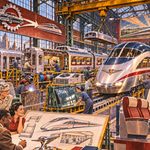 The Automaker’s Case for High-Speed Rail A Bright Meadow Group look at the industrial build-out behind a national rail network. The Keystone Network, The Lone Star Junction and The Continental Spine drew the
- Two Lanes to Anchorage
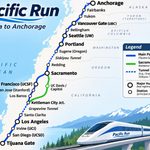 A Bright Meadow Group analysis in the Continental Spine series Stand on an overpass above I-5 at rush hour in Los Angeles and you’re looking at the Pacific Coast’s economy stuck in a
- The Continental Spine
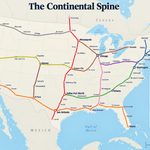 A Bright Meadow Group sketch of a federal high-speed rail network, built outward from the Texas junction Lone Star Junction put a pin in Texas and called it the knot in the continent’s
- The Lone Star Junction
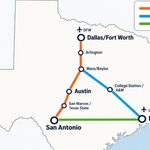 A Bright Meadow Group look at the Texas T-Bone and the case for a hemispheric rail hub Put a pin in a map of the Americas where Texas sits and look at what
- The Keystone Network
 High Speed Rail for Pennsylvania An Incremental, State-Scale High-Speed Rail Framework for the Commonwealth Some ideas feel too big until you shrink them down to their real size.High-speed rail is one of those