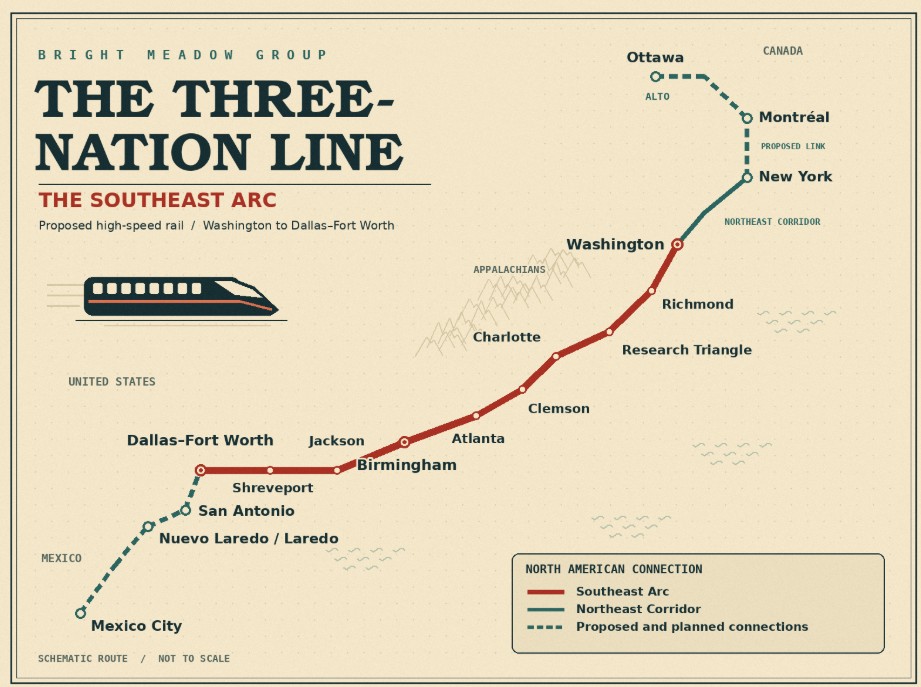
A Bright Meadow Group look at the Southeast Arc, Washington to Dallas-Fort Worth along the foot of the Smokies
The Continental Spine named Texas the knot in the continent’s bow tie and Washington the seat of the power that would pay for the strings. This piece draws the line between them. The Southeast Arc runs from the capital down through the inland South, along the Piedmont below the Smokies, to Dallas-Fort Worth. It ties the wealth and power of the East Coast to the international hub in Texas. Paired with a line from New York to Montreal, it does something no stretch of American track has done: it puts Mexico, the United States and Canada on one high-speed network.
OBSERVE
Washington and Texas sit about 1,300 miles apart, and today that trip means an airport or two days of driving. The cities in between, Jackson, Birmingham, Atlanta, Charlotte, Raleigh-Durham and Richmond, are linked to each other and to the capital by interstate and by flights through Atlanta. They’re the South’s inland cities, the ones the Gulf Coast line in The Great Connection doesn’t reach. A lab in Durham and a lab in Birmingham sit a day’s drive apart.
The ground cooperates. The Smokies rise on the Tennessee–North Carolina line, and the route runs along the Piedmont below them, the rolling country at the foot of the mountains. Interstate 85 follows that ground from Petersburg through Charlotte to Atlanta, and Interstate 20 runs from Atlanta west through Birmingham and Jackson to Dallas. The line gets the easy footing at the base of the range without climbing it, the way a creek follows the bottom of a ridge.
Part of the corridor is already under construction. North Carolina and Virginia are rebuilding the old S-Line between Raleigh and Richmond with federal money. Norfolk Southern runs the main freight line from Washington through Charlotte and Atlanta toward Birmingham, and Norfolk Southern is the railroad Union Pacific is asking the Surface Transportation Board to absorb.
The neighbors are building too. Mexico is laying track toward Nuevo Laredo. Canada is planning Alto, a high-speed line linking Toronto, Ottawa, Montreal and Quebec City. Both countries are reaching toward the border, and the United States holds the middle of the map.
DESIGN
The route.
Washington – Richmond – Research Triangle (Duke, UNC, NC State) – Charlotte – Clemson – Atlanta (Georgia Tech, Emory) – Birmingham (UAB) – Jackson – Shreveport – Dallas-Fort Worth
Alignment. The line follows the Continental Spine’s rules. It runs in the interstate median on the straight stretches of I-85 and I-20, and on a dedicated track pair beside the Norfolk Southern main line where the railroad runs better. It takes a new alignment through the Piedmont’s tighter curves and into the city centers.
The crossings. At Dallas-Fort Worth the Arc meets the Plains Spine and the Texas triangle. At Birmingham it crosses the Crossroads Line from Chicago. At Washington it meets the Northeast Corridor.
The triple connection. The Arc and the line from New York to Montreal open together. On that day a delegation can board in Mexico City, ride north through Laredo and Texas, take the Arc to Washington, continue up the Northeast Corridor to New York and on to Montreal, and connect to Alto for Ottawa. Three nations and three capitals sit on one set of rails. A trade summit can travel the continent at ground level, through the towns its agreements touch, the way presidents once rode the whistle-stop circuit.
The inland South. The cities between the capital and Texas stop being stopovers on the way to somewhere else. Atlanta’s universities sit a short ride from the Research Triangle. Birmingham and Jackson connect to Washington and Dallas without a flight. The minds along the line move as easily as the money already does.
INTERVENE
- Write the Arc and the New York–Montreal line into the National High-Speed Rail Act as a single package: the North American Connection.
- Open the border tables with Mexico and Canada around that package. Shared standards for gauge, power and signals, joint customs at the gates, and through-tickets from Mexico City to Ottawa.
- Put Norfolk Southern main line access on the list of merger conditions. The Arc’s best freight-side corridor belongs to the railroad Union Pacific wants to absorb.
- Build on what’s already moving. The S-Line between Raleigh and Richmond becomes the first finished segment of the Arc.
- Let the ribbon cutting land when it lands. The goal is for the three nations to connect together, and the line is built to that goal rather than to a date.
Sources
Blue Ribbon Team, The Continental Spine: https://blueribbonteam.com/blog/2026/10/21/the-continental-spine/
Blue Ribbon Team, The Lone Star Junction: https://blueribbonteam.com/blog/2026/10/20/the-lone-star-junction/
Surface Transportation Board, UP–NS environmental review, Docket FD 36873: https://www.stb.gov/upns-eis-fd36873/
Railmarket, STB accepts Union Pacific–Norfolk Southern merger application: https://railmarket.com/news/business/57579-us-surface-transportation-board-accepts-union-pacific-norfolk-southern-merger-application