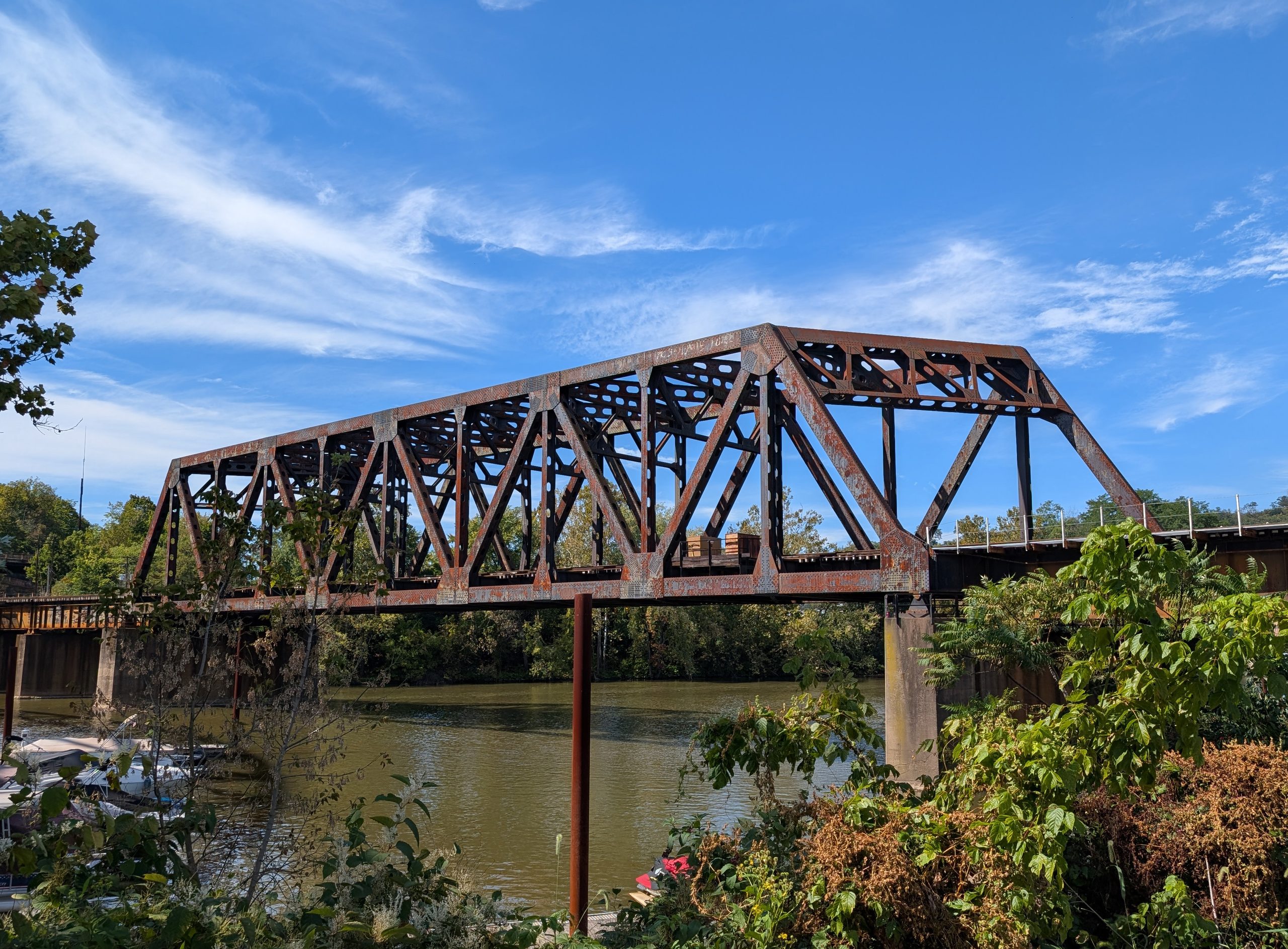
Most people who cross onto Neville Island use the Fleming Park road bridge and never give the railroad trestle beside it a second look. That’s the one in the photo. Railroaders know it as the PC&Y bridge, short for the Pittsburgh, Chartiers & Youghiogheny Railway, and it has been carrying freight over the back channel of the Ohio River since 1894.
The PC&Y itself was a small road with big partners. It was formed on October 26, 1881, and ran from McKees Rocks up the Chartiers Valley. Within about a decade it caught the eye of two much larger railroads. The Pittsburgh & Lake Erie bought a half interest in 1892, and the Pennsylvania Railroad held the other half. A 1923 Pittsburgh planning survey described the PC&Y as operating as its own company while being jointly owned by those two rivals. A short line shared by competitors was a common arrangement in Pittsburgh’s crowded river bottoms, where nobody could afford to build a duplicate track along every bank.
Neville Island gave the PC&Y a reason to cross the water. The island filled up with heavy industry, and by the 1920s the line was hauling tinplate scrap from Pittsburgh’s Federal Street station out to the island. During the Second World War, traffic to the Dravo shipyards on Neville Island got so heavy the county threw up a temporary wooden road bridge in 1942 to handle it.
The back channel is the quiet side of the river. The Ohio’s lock and navigation channel run along the north side of the island, so the back channel carries no towboat traffic and bridges over it had no tall clearance requirements to meet. That’s why this bridge sits so low on its piers, close enough to the water that the marina below feels like it’s tucked underneath.
The bridge crosses the channel at roughly a 40-degree angle, which stretches its over-water length to about 850 feet, even though the channel is narrower than that. As it stands today, it runs from the Fleming Park side as a short deck girder span, then a 280-foot camelback Pennsylvania-Petit truss, then a 260-foot subdivided double Warren truss, followed by two 140-foot girder spans reaching the island. The island end originally had trusses too. They were replaced with girder spans sometime after the 1940s.
The span in this photo is the double Warren. A Warren truss is built from diagonals that zigzag down the length of the bridge, forming a chain of triangles. A double Warren lays two of those zigzags over each other, offset, so the diagonals cross in a lattice of X’s. The verticals you see between them break each panel into shorter sections, which lets the floor beams carrying the track hang at closer intervals. More triangles, more paths for the load, and shorter pieces of steel that are less likely to buckle. The oval holes running along the members are perforated cover plates. A built-up steel member is a box, and those openings let workers reach inside to drive rivets and paint the interior, while trimming weight.
The PC&Y name outlived the PC&Y. The line later belonged to the Pittsburgh Industrial Railroad, which was sold to the Ohio Central. Today a single track crosses the bridge, linking the chemical plants on the industrial end of Neville Island to the Pittsburgh & Ohio Central mainline. The paint has mostly given up and the rust has taken over, but the trains still come. A bridge built when Grover Cleveland was in his second term is still doing the job it was built for, over a channel most of the city forgets is there.
Sources:
- pghbridges.org, PC&Y RR Fleming Park Bridge
- pghbridges.com, Fleming Park Bridge (1894 and 1955 pages)
- Wikipedia, Pittsburgh, Chartiers & Youghiogheny Railroad Bridge
- Pittsburgh Press, “Freight Rate Cut,” June 27, 1927 (via Wikipedia)
- pghbridges.com, Railroad History, Pittsburgh Plan, 1923
- Bridgeville Area Historical Society, “Bridgeville Railroads One Century Ago”
- trainweb.us, Pittsburgh & Lake Erie corporate history
- Industrial Scenery blog, P&OV and Fleming Park Bridges over the Back Channel