Interdependence, Energy, and the Architecture of Separation
From thirty thousand feet on a clear night, a continent looks like a nervous system. Cities glow where energy pools. Interstates run between them in bright threads, white headlights streaming one way and red taillights the other, like blood moving through an artery under the skin. As the plane descends, the pattern changes. The suburbs branch out into cul-de-sacs that end in small sealed bulbs of light, each one a capillary with no return path. Energy flows in, and very little flows back out.
An ecologist would recognize that shape. It is what a fragmented habitat looks like.
What Flows
Howard Odum spent his career tracing energy through living systems: sunlight into leaf, leaf into grazer, grazer into predator, and decay returning what is left to the soil. His central observation was simple. Systems that capture energy and keep it circulating tend to persist. Systems where energy leaks away, or gets hoarded by a single node, tend to collapse.
Human communities run on flows too. Food, labor, money, and attention move through them, and trust holds the rest together. Trust lowers the cost of exchange. A neighbor you know will lend you a ladder on a handshake. A stranger wants a deposit, a contract, or a lawyer. When trust drains out of a place, each exchange starts costing more, and people start doing without.
Trust grows the way soil does: slowly, through repeated contact, in places where people pass close enough to each other to exchange something. Remove the contact and the soil thins.
Fragmentation
Road ecologists have watched this happen to forests for decades. A highway cuts through a stretch of woods. On paper, the forest is still there, minus a strip of asphalt. In practice, the deer, salamanders, and black bears on either side stop mixing. The populations shrink, their genetic diversity narrows, and each half becomes more fragile than the whole ever was. Nobody had to remove a single tree from the remaining forest to weaken it. The separation was enough.
In the middle of the last century, American cities did the same thing to their own neighborhoods. Interstates were routed through Black and immigrant districts that had stood for generations. Redlining maps drew boundaries that lenders enforced for decades. Zoning codes made it illegal to put a corner store, a duplex, or a café within walking distance of a house. The car became the only membrane between the sealed bulbs.
Time got fragmented along with land. Shift work splits a crew into people who never overlap, who know each other’s names from the schedule and nothing else. Third places, Ray Oldenburg’s term for the barbershops, taverns, diners, and front stoops where people gathered without needing an appointment, have closed or been replaced by spaces that charge admission by the hour.
It doesn’t take much keeping people apart to keep them apart. Unfamiliar people don’t trust. The psychologist Gordon Allport documented this in 1954: prejudice falls when people from different groups spend time together as equals working toward shared ends, and it hardens when they don’t. Distance does its own work. A wall only needs to stand long enough for the people on each side to forget what the other side looks like.
The Monoculture and the Driver
A cornfield is a lovely sight in August, row after row of identical green. It is also a dependent system. A monoculture cannot feed itself, defend itself, or rebuild its own soil. It needs fertilizer, herbicide, pesticide, and someone driving a tractor up and down the rows. That dependence makes it easy to manage, and it ties the field to whoever sells the inputs.
A population kept apart behaves the same way. Each household stands in its own row, connected upward to its employer, landlord, lender, and grocer, and connected sideways to almost no one. The owners have learned to manage that field with psychology, physical barriers, and the twin whips of housing and nutrition. People get driven like cattle, from the bedroom to the car to the shift and back, and the separation keeps them from noticing how many others are walking the same path.
A polyculture works differently. Permaculture designers build plant guilds where a nitrogen-fixing shrub feeds its neighbors, a deep-rooted plant pulls minerals up from the subsoil, a groundcover holds moisture, and flowers draw in the insects that keep pests in check. Each plant does better because of the others. The system regulates itself and needs far less outside input. It also needs far less management, which is why managers have little use for it.
A high level of cooperation keeps the world turning. Cooperation between neighbors and herding by a driver produce very different systems, though, and the second one only works as long as the cattle stay strangers to each other.
The Edge
Permaculture has a principle called the edge effect. Where two ecosystems meet, like forest and meadow or pond and shore, life concentrates. The edge gets species from both sides plus species that live nowhere else. A pond’s shallow margin, where cattails meet open water, can support more life per square foot than either the deep water or the dry bank.
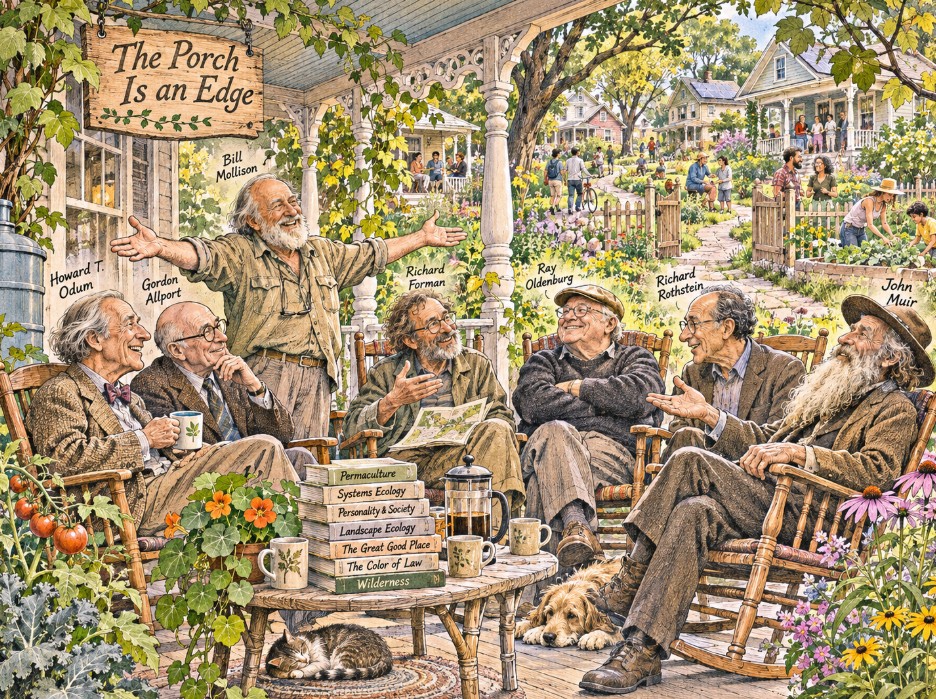
A front porch is an edge. It sits between the private house and the public street, belonging fully to neither. A person on a porch can be seen, greeted, invited, and drawn into conversation without either party committing to anything. Stoops, sidewalks, shared fences, and the bench outside a corner store all work the same way. They are the shallow margins of a community, and they are where a lot of its life used to happen.
Those edges can be rebuilt without anyone’s permission. A porch light left on, a pot of coffee, a few extra chairs, a speaker playing something worth stopping for. Turning a porch into a third space requires no zoning variance, no grant, and no capital.
Corridors
When road ecologists want to repair a fragmented forest, they build corridors: a strip of trees connecting two woodlots, a culvert big enough for a fox, an overpass covered in soil and shrubs so the deer can cross the highway without touching it. The corridors don’t need to be wide. They need to exist, and the animals need to use them.
People build corridors with food, music, and time spent together. A block party. A community garden where the tomatoes get shared over the fence. A potluck that mixes the folks from day shift with the folks from nights. Dancing in the street on a warm evening, and singing loud enough that the next block wanders over to see what’s happening. Eating together, and enjoying the sun on our faces together.
Voting draws on the same muscle. The obstacles placed between a citizen and a ballot box, like limited hours, distant polling places, and long lines on a workday, work just like the obstacles placed between neighbors. Getting past them is a physical act. You walk out of the bulb and go meet the rest of the system.
In an aquaponic loop, fish and plants share the same water. The fish produce waste, bacteria convert it, the plants absorb it, and the cleaned water returns to the fish. Separate them into different tanks and each one starts drowning in its own byproducts: the fish in ammonia, the plants in starvation. Neither one is the problem. The separation is the problem.
From Above, Again
Picture the night view once more, from a plane circling over Johnstown or any town like it. Imagine the sealed bulbs at the ends of the cul-de-sacs starting to connect, a porch light here, a string of patio lights there, small bright threads running between houses that used to sit dark to one another. Picture the capillaries finding their return paths, so energy that once flowed in and stopped starts moving through again, from neighbor to neighbor, out to the street, back home.
Humankind was not meant to be driven like cattle. We are a polyculture, built over hundreds of thousands of years for edges, shared fires, and the long conversation that happens when people gather and stay. To keep from being controlled, we have to stop distrusting and hating each other over each difference. We have to see each other and talk. We have to meet in the street, gather, and become a community whether the owners like it or not.
John Muir wrote that when we try to pick out anything by itself, we find it hitched to everything else in the universe. The owners have spent a long time trying to unhitch us. The work in front of us is reconnecting.
Sources
- Allport, Gordon W. The Nature of Prejudice. Addison-Wesley, 1954.
- Forman, Richard T. T., et al. Road Ecology: Science and Solutions. Island Press, 2003.
- Mollison, Bill. Permaculture: A Designers’ Manual. Tagari, 1988.
- Muir, John. My First Summer in the Sierra. Houghton Mifflin, 1911.
- Odum, Howard T. Environment, Power, and Society. Wiley-Interscience, 1971.
- Oldenburg, Ray. The Great Good Place. Paragon House, 1989.
- Rothstein, Richard. The Color of Law. Liveright, 2017.