Name’s Wright. Mister Wright if were doing business.
I want to talk about your health plan. I sat across the bargaining table from that plan for the better part of thirty years. I know what it costs, who pays for it, and what the company gets for its money.
Start with a question for your boss. Ask him what the health plan costs him. He’ll tell you. He’ll name the number per head, tell you how much it jumped at renewal, and tell you how the broker came back with a figure that put a crease in his forehead.
Then ask him whether he’d back Medicare for All, which would take that bill off his desk for good.
Watch his face.
When a man pays more than he wants for something and still fights to keep paying for it, he’s buying something besides what’s on the invoice. My father carried bags for a living. He could tell you what was in a suitcase by how a man held the handle.
The Bargaining Table
Contract after contract, I watched the same thing happen. We’d fight for a raise, win it, and then the premium increase would come along and eat it. A dollar an hour more on paper, sixty cents more in the pocket, and the rest went to the insurance company. The men would ask me where their raise went. I’d show them the line on the stub.
The numbers haven’t gotten kinder. KFF’s 2025 employer survey put the average family premium at $26,993 a year. The worker paid $6,850 of that out of his own check. At smaller shops, the worker’s share ran closer to $8,900.
That $6,850 hardly changes with your pay. Measure it twice.
A custodian making $38,000 hands over about 18 cents of his dollar. A vice president making $250,000 hands over less than 3.
Same plan and same card in the wallet. The man running the floor machine pays six times the share of the man in the corner office.
Two Plans Under One Roof
Except the man in the corner office often isn’t on the same plan.
Insurers sell what they call executive medical reimbursement policies. They sit on top of the regular group plan and pay a chosen few back for the deductibles, the co-insurance and the dental work that the rest of the crew pays out of pocket. The sales pitch says the employer gets to pick who’s covered. Add the executive physicals and the concierge doctor, and you’ve got two health systems inside one company. One is for the people the company wants to keep. The other is for the people it figures it can replace.
Scale that up and you’ve got the whole country.
Folks with money show up at the doctor already healthier. They’ve had better upkeep for longer, and better-paying insurance comes in the door with them. The private hospitals that serve them run lean. The county hospital runs on Medicaid rates and charity care, and it takes whoever comes through the door. That includes the poor and the people with nowhere else to go, and they arrive starting from a different place, long before anybody talks about how they come out the other end. That hospital can’t turn a soul away.
The Tool the County Doesn’t Have
Here’s where the company holds a tool the public hospital lacks.
When a worker’s health turns expensive, whether it’s the bad back, the sugar, or the kid in and out of the emergency room, the company can write him up for attendance, run out his leave and let him go. Once he’s off the payroll, he’s out of the risk pool. His bills land at the county hospital and on Medicaid, and the taxpayer picks up the cost the company set down.
In the Rangers, we swore we would not leave a fallen comrade behind. Some outfits leave a man behind the first time his knee goes, and then they send the bill to his neighbors.
The county has no door to show him out of. So the cost lands on the one system that’s required to carry it.
The Leash
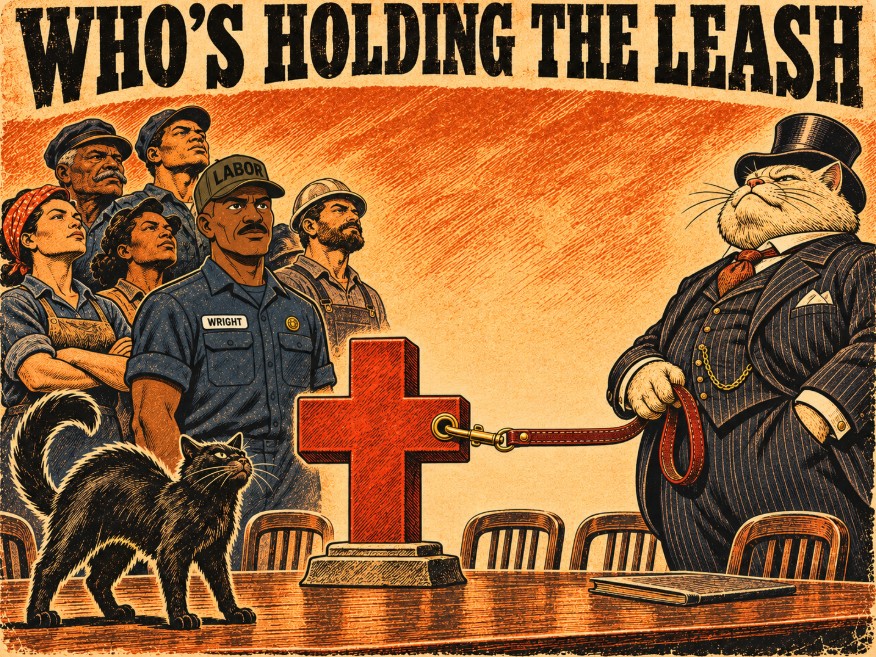
When coverage is tied to the job, quitting becomes a medical gamble. A worker with a sick wife doesn’t bargain hard. He doesn’t walk out on a bad foreman, and he doesn’t start the business he’s been sketching on lunch-break napkins. The boss pays twenty thousand a head and gets a crew that thinks twice before standing up straight.
Measured that way, the premium is a bargain, and he knows it.
Cut It Loose
I’m on Medicare now, and I’ve got my military coverage beside it. I’ve stood on both sides of this line. The coverage that follows the man has treated me better than the coverage that followed the job.
Medicare for All cuts the leash. Your coverage follows you from job to job, through a layoff, and into the business you finally get up the nerve to start. With one pool and the whole country in it, the healthy carry part of the weight of the sick and the well-off carry part of the weight of the poor. That’s what insurance was supposed to be from the start. The county hospital stops being the place where expensive patients get dropped, because there’s no cheaper pool left to drop them from.
So who comes out behind? The people whose advantage depends on having their own separate line. The billionaire would pay into the same pool as the night-shift janitor, at a rate tied to what he earns. He’ll be fine. For once, he’ll have paid his share, same as the rest of us.
Respect is the first safety rule. That applies to the man at the top of the org chart, same as the man at the bottom.
Next time your boss tells you Medicare for All costs too much, remember that he’s already paying. He likes what he gets for it.
Check your measure, then check your motive.
Now you know, Jack.