Run it. Here it is:
Johnstown Municipal Gardens
A Living Garden, A Working Machine, A New Kind of Civic Infrastructure
Bright Meadow Group
Every city eventually reaches the same crossroads.
You can build infrastructure that hides from people—pipes underground, treatment plants at the edge of town, systems designed purely to function. Or you can build infrastructure that people walk through, photograph, and remember.
The first kind keeps a city alive.
The second kind makes a city worth visiting.
Johnstown has an opportunity to do the second.
The Idea
The proposal is simple on the surface and powerful underneath:
Build a Municipal Garden Conservatory—a large greenhouse garden open to the public—that also functions as a nutrient recovery and greywater polishing system.
Visitors would come to walk through beautiful gardens and glasshouses.
Underneath those gardens, the system quietly performs real civic work: processing nutrient-rich water, growing plants that absorb and clean those nutrients, demonstrating ecological engineering in action.
It becomes three things at once: a tourist attraction, a working piece of city infrastructure, a living science laboratory.
Why Municipal Gardens Work
Cities around the world maintain greenhouse gardens because they are remarkably effective civic investments.
People travel long distances simply to walk through well-designed gardens. Families bring children. Photographers show up in every season. Couples hold weddings. Schools run field trips.
And the funny truth is this: they don’t even have to be the greatest gardens on Earth. They just have to be good.
Even the most critical visitor—someone who drove two hours just to wander around and complain about the plant selection—still bought lunch, took pictures, and told someone about the place afterward.
That is how municipal gardens become economic engines.
But Johnstown Can Go Further
Instead of building a garden that merely consumes water and electricity, Johnstown could build a garden that produces something valuable.
The gardens would function as a layered water system. Water carrying nutrients—whether from greywater streams, stormwater capture, or other urban sources—would pass through several stages: initial biological processing in a controlled bio-refugium area, plant-driven nutrient uptake inside the greenhouse gardens, cleaned water returned to circulation.
Visitors would see elegant ponds, terraces, and lush plantings. What they would not see is that the garden is quietly operating as a living environmental machine.
The Hidden Engine: The Bio-Refugium
The first stage of the system would be located behind the scenes.
This area would not be open to the public. It would function as the biological engine of the facility.
Here, nutrient-rich water enters settling basins and microbial beds where organic material begins to break down. Beneficial bacteria and microbial communities convert complex waste into forms that plants can easily absorb.
In ecological engineering, this stage is often called a bio-refugium—a controlled ecosystem designed to stabilize and prepare water before it enters the visible system.
Once stabilized, the water moves upward into the greenhouse.
The Public Garden
This is where the magic happens.
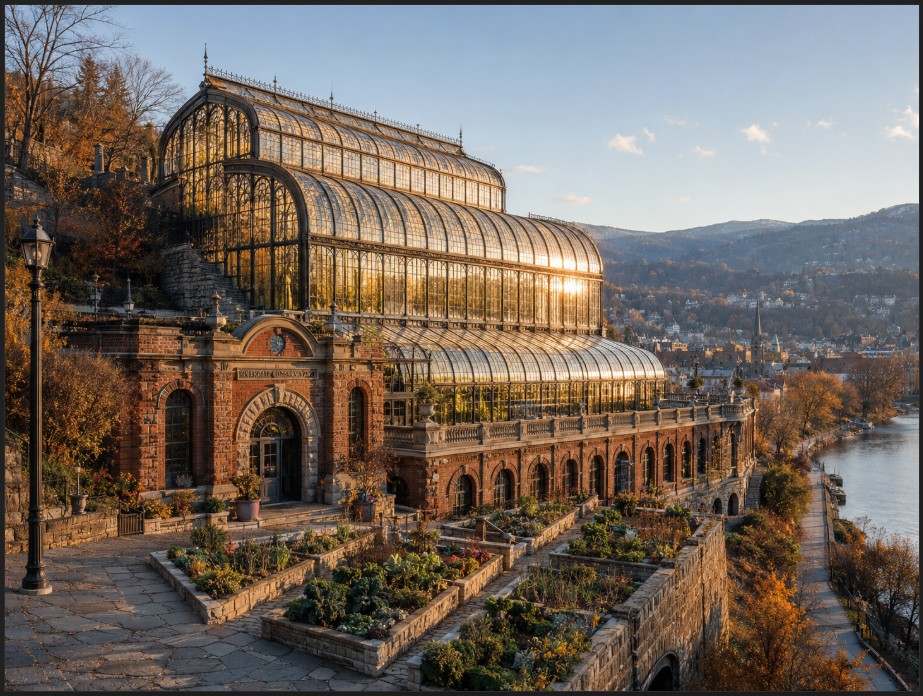
Inside the conservatory, visitors walk through terraced water gardens filled with vibrant plant life. Water flows slowly through channels, pools, and planted beds designed not only for beauty but also for nutrient uptake.
Plants become the working infrastructure. Species with strong nutrient absorption capabilities—wetland grasses, aquatic ornamentals, tropical flowering plants—pull nitrogen and phosphorus from the water as they grow. At the same time, they create the lush visual landscape that people come to see.
The system is both biological treatment plant and botanical attraction. And the visitor experience remains simple: a beautiful place to wander.
Learning Without Feeling Like School
A garden like this also becomes a natural educational space.
Small interpretive displays can explain how wetlands clean water, how nutrient cycles work, how plants and microbes interact, how cities can design infrastructure that works with nature instead of against it.
Schools gain an incredible field trip destination. Universities gain a research site. Visitors gain something rare: a place where infrastructure is not hidden, but understood.
Why Johnstown Is the Perfect City
Johnstown’s identity has always been shaped by water.
The city sits in a mountain valley where rivers converge and where engineering has long been part of everyday life. Flood control systems, dams, and channels define the landscape.
A municipal garden that works with water is therefore not out of character—it is perfectly in character.
Johnstown also has another advantage: it is a mountain city. Cities in mountainous landscapes often develop a habit of stacking functions because space is limited. Terraces, layered gardens, and visible water channels are common design solutions in places from Japan to the Alps.
A greenhouse garden with flowing water, stone paths, small bridges, and terraced planting beds would feel entirely natural here. It would look like it belongs.
Beauty That Works
Too often, cities separate beauty from function. Parks are decorative. Infrastructure is hidden.
This project reverses that pattern.
The garden becomes infrastructure. The infrastructure becomes beautiful. Instead of a facility people avoid, the city gains a place people seek out.
A Year-Round Destination
A greenhouse conservatory also solves a practical problem. Johnstown winters are long.
Outdoor gardens only thrive part of the year, but a greenhouse garden stays alive twelve months a year. Snow outside, tropical warmth inside. A place to walk when everything else is gray.
That alone can make it a beloved civic space.
A Small Demonstration of a Bigger Idea
Beyond tourism and beauty, the garden would quietly demonstrate a larger concept: cities can design systems that capture waste and turn it into life.
Nutrients that normally flow downstream unused become plant growth. Water that might otherwise carry pollution becomes cleaner. The system shows, in a visible way, how urban infrastructure can function more like an ecosystem.
A Garden Worth Visiting
The best municipal gardens share one common trait. They are places where people slow down.
They wander paths. They sit on benches. They take photographs of flowers. They bring visiting friends to see something special in their city.
Johnstown deserves a place like that.
But Johnstown can do something better than simply copying another city’s garden. It can build one that works.
A garden that processes water. A garden that grows life. A garden that teaches. A garden that visitors remember long after they leave the valley.
In the end, the idea is simple:
Build something beautiful. Make it useful. Let the city grow around it.
Bright Meadow Group publishes applied systems thinking through the Cernunnos Foundation network.