I was standing in the grocery store last Tuesday.
Which is a sentence I have started approximately four hundred conversations with, so you know this is going somewhere real.
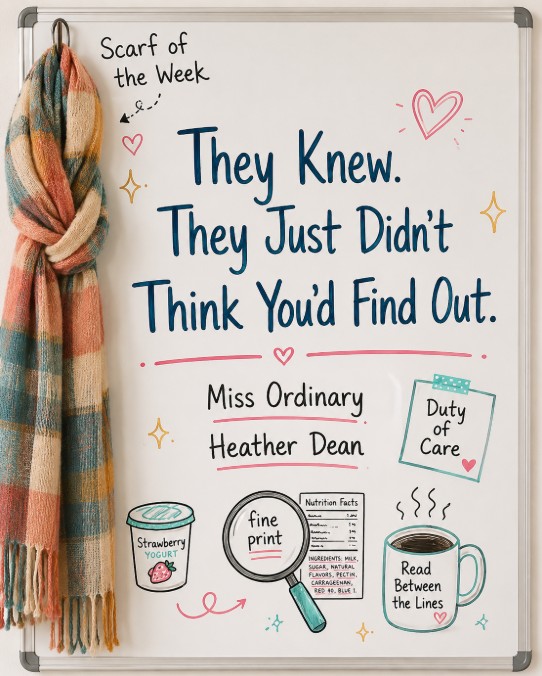
I was standing in the grocery store, reading the back of a yogurt container, and I realized I had been standing there for four minutes and I still could not tell you with confidence whether the thing in my hand was food.
Not because I’m uninformed. I read. I pay attention. I have opinions about ingredients lists that my friends find exhausting.
But somewhere between the third modified starch and the sixth item I couldn’t pronounce, I put the yogurt back and stood there feeling something I’ve been feeling a lot lately.
Not outrage. Not even anger exactly.
Just tired.
Tired of working this hard to find out what’s in the thing I’m about to put in my body. Tired of the fine print. Tired of the terms and conditions nobody reads because they are designed not to be read. Tired of the waiver buried in page eleven that signs away the thing I didn’t know I was signing away.
Tired of being managed instead of informed.
Here’s a thing I learned recently that I haven’t been able to stop thinking about.
There’s a legal principle called the Duty of Care. It’s ancient — Roman law ancient, older-than-this-country ancient — and it says something very simple.
When you hold power over another person’s wellbeing, you have an obligation to exercise that power responsibly. Honestly. With genuine regard for what happens to them.
It applies to doctors. Lawyers. Employers. Manufacturers. Anyone whose decisions land on someone else’s body, health, safety, or livelihood.
And here is the part that stopped me mid-yogurt-aisle.
When a company knows something about their product — something about what it does to you, something about what it contains, something about the long-term effect of regular consumption — and they choose to bury that information in a font size that requires reading glasses and a law degree — that is not an oversight.
That is evidence.
Evidence that they knew. Evidence that they made a choice. Evidence that the information existed and they decided you didn’t need to have it in any form you could actually use.
That is not a gap in the duty of care.
That is a breach of it.
I think about insurance paperwork.
I think about the exclusion clause that was technically present in the document, on page thirty-one, in a subsection titled something like “Additional Conditions Pertaining to Supplemental Coverage Parameters.” Which is not a title designed to be found. It is a title designed to be skipped.
I think about the food additive that showed up in study after study with concerning results, and somehow kept showing up in everything from crackers to children’s cereal while the company’s own internal research sat in a filing cabinet and waited.
I think about the medication where the side effect profile in the consumer handout and the side effect profile in the clinical documentation were — let’s say — acquainted but not identical.
I think about the chemical in the packaging. The one they switched to after the last one became controversial. The one that is currently in the packaging of approximately everything, including the container my lunch came in, and about which the publicly available safety data is — let me find the right word here — thin.
I’m not a scientist. I’m not a lawyer. I’m a woman with a mug and a moderate scarf collection and a developing awareness that I have been asked, repeatedly and systematically, to make informed choices while being systematically deprived of the information required to make them.
That is not a coincidence.
The Duty of Care doesn’t require malice.
This is the part I find almost more unsettling than if it did.
The legal standard isn’t whether a company intended to harm you. It’s whether they knew — or reasonably should have known — that their product, their practice, their ingredient, their policy could cause harm, and whether they took reasonable steps to prevent it or at minimum to tell you about it.
Obfuscation counts.
A twelve-page terms and conditions document is not disclosure. It is the appearance of disclosure. It is the legal equivalent of telling someone something in a language they don’t speak and then noting for the record that you told them.
An ingredients list that requires a chemistry degree to interpret is not transparency. It is the performance of transparency.
Internal research that contradicts the public-facing safety claims, filed somewhere it will not be easily found — that is not an accident of organization. That is a paper trail. And what it documents is not the absence of knowledge.
It documents the presence of it.
I’m not asking for perfection. I’m not asking for a world without risk or a product that comes with a guarantee of immortality.
I’m asking for the same thing the law asks of everyone else in a position of comparable power over someone’s wellbeing.
Reasonable care. Honest disclosure. The genuine effort of someone who actually thought about what might happen to the person on the other end of their decision.
The food companies and the chemical companies and the insurance companies and the pharmaceutical companies are not small actors navigating an uncertain world. They have research departments. They have legal teams. They have decades of internal data. They know what is in their products. They know what their products do.
The fine print is not evidence of their uncertainty.
It is evidence of their knowledge.
And when you have knowledge of a foreseeable harm and you choose the fine print over the plain truth — that is the definition of a breach.
I put the yogurt back.
I found something with five ingredients I recognized and went home and made coffee, which is either my solution to everything or my coping mechanism for everything, and honestly at this point I’ve stopped trying to determine which.
But I kept thinking about those four minutes in the aisle.
About how much time ordinary people spend every week trying to decode what should have been told to them plainly. About how much of our collective exhaustion is just — this. The labor of navigating systems that were designed to be navigated by people with more resources, more time, more expertise than most of us have on a Tuesday afternoon in a grocery store.
That labor has a cost. And the people imposing it knew that too.
We don’t need to be angry to name it.
We just need to know what it’s called.
It’s called a breach of duty.
And ordinary people deserve better than that.
Stay clean. Stay kind. Stay caffeinated.
— Heather
Heather Dean writes Miss Ordinary for the Blue Ribbon Team.