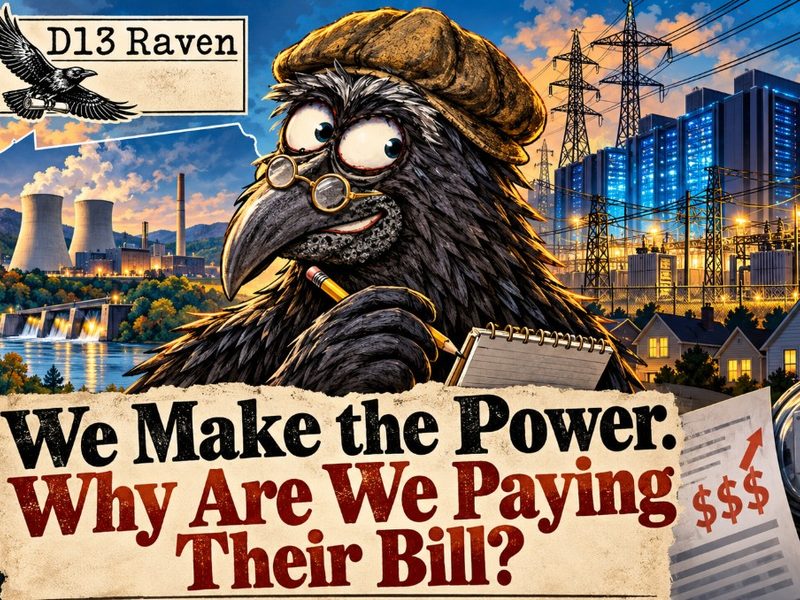
The Alaska Model for the AI Age — And Why Johnstown Is the Pilot
Alaska figured something out in 1976 that nobody in the lower 48 has had the nerve to copy. When the oil came out of the ground, the state didn’t hand the whole revenue stream to the oil companies and hope for trickle-down. It kept a share. That share went into the Permanent Fund. Every year since 1982, every Alaskan resident has received a dividend check cut from the fund’s earnings — some years a thousand dollars, some years over three thousand, every year without fail. The state still has the oil. The citizens still have the check. The fund still grows.
It’s one of the most popular policies in the history of American government. Bipartisan by construction. Constitutional. Durable. And we haven’t applied the idea to a single other industry since.
We should.
Pennsylvania Is Already Paying for a Boom It Doesn’t Own
The data center boom is not coming. It is arriving. Hyperscale facilities are landing across the country at rates that outpace every projection made five years ago, driven by AI workloads that are still accelerating. These are extraordinary economic engines — margins that rival oil, revenue per square foot that rivals semiconductor fabs, demand curves pointed straight up.
And what is current American policy toward those engines? Beg them to come. Offer billion-dollar tax abatements. Fast-track permits. Let them draw from the local grid at rates that raise electricity prices for residents. Let them drink from the aquifer while municipalities ration lawn watering. Let them occupy industrial land made ready with public money. Thank them for the fifty or so permanent jobs in a facility the size of several football fields.
This is not an economic development strategy. It is a giveaway. Pennsylvania has spent generations subsidizing extractive industries — coal, steel, oil and gas — and watching the profits leave the state. We are about to repeat the pattern with compute, at larger scale and shorter horizon, with less excuse than ever before. The infrastructure every data center needs — power, water, fiber, flat land near population centers — exists in Pennsylvania because Pennsylvania built it. We paid for it once. We are now being asked to hand the returns on that investment to out-of-state corporations whose only local commitment is to the abatement clock.
There is another way. The state can own the data center. And ownership, properly understood, gives Pennsylvania five things it cannot get any other way.
What Ownership Actually Buys Us
Money in home wallets. First and most important. A Pennsylvania Public Compute Authority, structured as a political subdivision of the Commonwealth the way the Turnpike Commission is, could finance its first facility through revenue bonds and lease compute capacity to state agencies, public universities, hospital systems, and private customers at commercial rates. Revenue above operating costs flows into a Pennsylvania Permanent Fund, invested conservatively, with annual earnings paid out as a dividend to every Pennsylvania resident. Some years it’s modest. Some years it’s serious. Every year it’s yours. Data centers do not run out.
Environmental standards we set ourselves. When the owner is the state, the state writes the spec. That means EPA-plus design — standards tighter than the federal minimum, because the people writing them are the people living downwind and downstream. Cooling water discharge engineered to meet the state’s own watershed goals, not a compliance floor. Waste heat captured instead of vented. Power sourcing that favors the cleanest available generation because the operator and the regulator are working from the same mission. Every private data center plays the regulatory arbitrage game: pick the jurisdiction with the weakest rules, meet the letter of them, minimize cost. A state-owned facility has no arbitrage to run. It is accountable to the people who pay for it.
Data sovereignty. This one is underappreciated and enormous. Right now your DMV records, your public-hospital medical records, your school transcripts, your court filings, and your tax returns live on cloud infrastructure owned by out-of-state corporations — AWS, Azure, Google Cloud — operating under contract terms Pennsylvania negotiated from a position of weakness. The moment those servers are outside Pennsylvania’s operational control, so is the data on them. A state-owned data center means state agencies can keep citizen records on state-controlled infrastructure, under state law, subject to state courts, with no clause allowing the vendor to mine, resell, or repurpose anything for commercial analytics. Sovereign compute means sovereign information. You do not turn over your own house keys when you can hold them.
Resource retention. Pennsylvania has the inputs. We have the rivers. We have the coal. We have the natural gas. We have the solar capacity that’s already built and still expanding. We have more brownfield industrial sites than almost any state in the country. Every one of those assets is, right now, being marketed to private developers who will convert Pennsylvania resources into out-of-state shareholder returns. If the facility is state-owned, the full lifecycle value stays here — the power revenue, the water-use value, the land appreciation, the tax base, the operating wages, and the profit. Not a slice. All of it.
Ownership of compute and AI itself. This is the one that plays longest. AI is the defining infrastructure of the next fifty years the way electricity was of the last hundred. States that own compute have leverage — over pricing, over access, over research capacity, over the direction of what gets built. Pennsylvania universities get research-grade access at cost. Pennsylvania startups get on-ramps to build here instead of fleeing to Austin. State agencies get sovereign AI services trained on Pennsylvania data for Pennsylvania purposes, not generic models licensed from California at whatever price Silicon Valley decides to charge next quarter. South Korea, the UAE, and France are all building sovereign AI capability at the national level. A state can build it at the state level if it owns the hardware.
We are going to pay for this infrastructure either way. Electricity prices rise either way. Water gets stressed either way. Public subsidies go out the door either way. The only question is whether Pennsylvania also gets the revenue, the control, and the information sovereignty that come with actually owning the thing we are already building.
Why shouldn’t we?
Why Johnstown Is the Pilot
If Pennsylvania is serious, the first facility goes in Johnstown. Not as a consolation prize. As the best site in the Commonwealth.
Climate: twelve hundred feet in the Alleghenies, temperatures that cut cooling loads against warmer lowland sites. Water: Stonycreek and Little Conemaugh meet in town to form the Conemaugh — abundant, cold, and reliable for heat rejection without the aquifer fights that plague Virginia and Arizona. Power: transmission infrastructure originally built for the steel industry, most of it stranded and underutilized, fed by a generation mix that includes nuclear baseload from Beaver Valley, expanding natural gas, regional hydro, and Pennsylvania’s growing solar base — a diversified supply most competing data center markets would kill for. Land: flat brownfield parcels along three rivers, industrially zoned, rail-served, priced for a buyer’s market, with federal brownfield money and state infrastructure grants already on the table. Fiber: major east-west long-haul backbones already transit the Allegheny corridor; drops into Johnstown are a matter of provisioning. Workforce: welders, pipefitters, millwrights, electricians, instrumentation techs, plant operators — three generations deep and underutilized. A data center is not built and run by software engineers. It is built and run by the exact trades Johnstown has and the tech hubs don’t.
And the piece that makes Johnstown uniquely complete: waste heat. A hyperscale data center rejects hundreds of megawatts of low-grade heat as a byproduct, which most facilities dump into cooling towers. A properly designed Johnstown facility pipes that waste heat into an adjacent aquaponic greenhouse complex — the kind the River Refugium Project has documented in detail — enabling industrial-scale year-round growing in a climate that would otherwise shut down half the calendar. The data center’s externality becomes the greenhouse’s primary input. The greenhouse’s biomass feeds hydrothermal processing. The loop closes. The compute pays dividends to citizens, the greenhouse pays wages to operators, and the river downstream is cleaner than the river upstream. That is what post-industrial infrastructure is supposed to look like.
The Politics Are Cleaner Than They Look
The reflex is to code this left — public ownership, sovereign wealth, universal dividend. That reflex is lazy. The Alaska Permanent Fund is one of the most popular programs in one of the reddest states in the country, precisely because it doesn’t ask voters to choose between fiscal discipline and public benefit. It delivers both.
For Republicans: revenue without taxes, reduced private-subsidy budget, distressed-region rebuilding through production rather than welfare, real industrial employment, profits kept inside the Commonwealth. For Democrats: socialized returns on strategic infrastructure, universal dividend, working-class populations at the front of the next industrial transition instead of the back. Both sides get what they claim to want. The only constituency inconvenienced is the one currently collecting the abatements. That constituency will scream. Scream back.
Build It
Alaska made the decision fifty years ago. No state has matched it. No state has even tried.
Pennsylvania has spent a century subsidizing somebody else’s industry. It is time to own one. The rivers are ours. The coal is ours. The gas is ours. The sun is ours. The brownfields are ours. The people are ours. The stack is stacked. Johnstown is already home.
The only thing missing is the decision.
Make it.