The Orange Creek Problem: River Refugium for Acid Mine Drainage
When polluted water can’t support its own cleanup biology, you have to prime the pump.
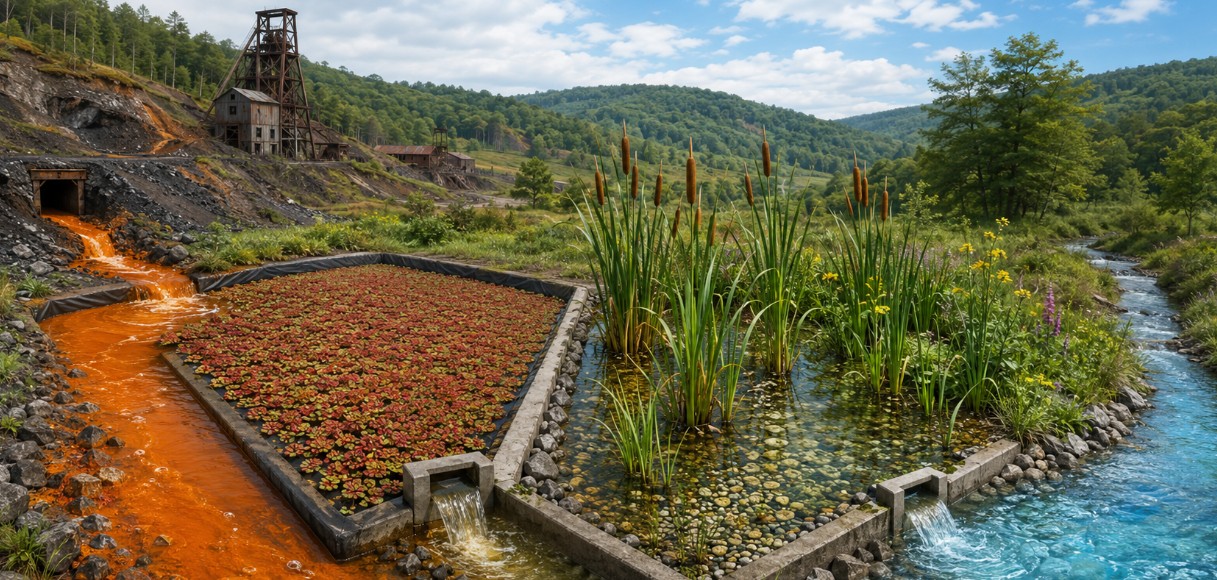
Anyone who’s driven through Cambria County, or Somerset, or Indiana, has seen the orange creeks. The water runs the color of rust because that’s what it is — dissolved iron oxidizing out of solution where the seep hits open air. Acid mine drainage. AMD. The signature of every old patch town in western Pennsylvania, and the reason a few thousand stream miles in this state still fail water quality standards eighty years after the mines closed.
The standard treatment for AMD is passive: limestone beds to raise the pH, settling ponds to drop the metals out, constructed wetlands at the back end to polish whatever the chemistry didn’t catch. It works, mostly. It’s cheap, mostly. But it hits a wall, and the wall has a name: nitrogen.
The bootstrapping problem
Wetland plants — cattail, bulrush, sedge — do the polishing work in a constructed AMD treatment system. They take up residual metals, they support the microbial communities that finish the cleanup, they hold the substrate together. But they’re plants. They need nitrogen to grow. And AMD water, by the time the pH has been corrected and the iron has dropped out, has almost no biologically available nitrogen left in it. The metals scavenged whatever was there.
So you have a chicken-and-egg problem: the biology that finishes the cleanup needs nutrients to establish, and the water doesn’t have the nutrients to support the biology. Conventional designs work around this by trucking in fertilizer, or by accepting a slow, sparse plant cover that takes years to fully establish. Neither is a good answer. The first is expensive and doesn’t compose with the larger system. The second leaves the water half-cleaned for a long time.
This is a bootstrapping problem, and it has a bootstrapping solution.
Priming the pump
The River Refugium approach is staged. Limestone first, settling second — conventional moves both. Then a stage that AMD designers don’t usually include: a nitrogen priming bay seeded with Azolla.
Azolla is a free-floating aquatic fern. In the cavities of its leaves it hosts Anabaena azollae, a cyanobacterium that fixes atmospheric nitrogen the same way Rhizobium does in legume root nodules. The fern provides the carbohydrate, the cyanobacterium provides the nitrogen, and together they pull N out of the air and put it into the water column at rates between 100 and 300 kilograms per hectare per year. It’s been used in rice paddies for fifteen hundred years. It doubles its biomass in under a week under good conditions. And — this is the part that matters here — it doesn’t need nitrogen already dissolved in the water to do its work. It makes its own.
That property is exactly why Azolla isn’t the headline plant in the main RRP framework. For cleaning nitrogen-rich water — agricultural runoff, treated effluent, the standard RRP case — you want a hungry uptake machine, and duckweed wins on extraction rate because it strips dissolved N straight out of solution. Azolla, fixing from the air, mostly ignores what’s already there. In a rich stream that makes it a slow performer. In a starved stream it makes it the only plant that can get a foothold.
Same plant, different job. This is the systems point. The RRP roster isn’t a competition for the best general-purpose species — it’s a library of organisms each optimized for a different water profile. Duckweed strips. Azolla fixes. Cattail polishes. Each stage of the cascade picks the plant whose biology matches the chemistry of the water arriving at it.
Closing the loop
Azolla’s job in this design isn’t permanent residence. It’s a priming stage. As it grows, it builds nitrogen into the water column — partly through senescent biomass decaying in place, partly through harvest and partial return. Once the N concentration in the outflow is high enough to support conventional wetland plants, the downstream stages can establish, and the system transitions to its steady-state configuration.
The harvested Azolla biomass doesn’t get composted off-site. It goes into the same back-end infrastructure that handles every other contaminated biomass stream in the framework: hydrothermal carbonization or liquefaction. Metals that the plants absorbed end up concentrated in the hydrochar fraction, where they can be recovered or stabilized for disposal. Nitrogen comes back out the aqueous phase as ammonia and nitrate, recyclable as a clean fertilizer input.
What started as orange water exits the system as clean water, recovered metals, and usable nitrogen. The pollution didn’t disappear — it got sorted into fractions you can do something with.
Why it matters here
Western Pennsylvania has thousands of miles of streams impaired by AMD, and the standard treatment toolkit has been the same for forty years. It works at the level of “the water is no longer actively poisoning the next creek down,” and it stops there. The opportunity the River Refugium framework opens is to treat AMD not as a waste problem to be passively contained, but as a feedstock for a productive system. The orange creek becomes the head of a cascade. The cascade produces clean water at the bottom, and along the way it produces biomass, recovered metals, and fertilizer.
This isn’t speculative biology. Azolla in rice paddies is a 1,500-year-old technology. Limestone treatment of AMD is a 50-year-old technology. Hydrothermal processing of wet biomass is a 20-year-old technology that’s finally getting deployed at scale. The new move isn’t any one of these — it’s the stack.
The water doesn’t have to stay orange.