When the Rules Were the Only Thing Standing Between Them and the Dark
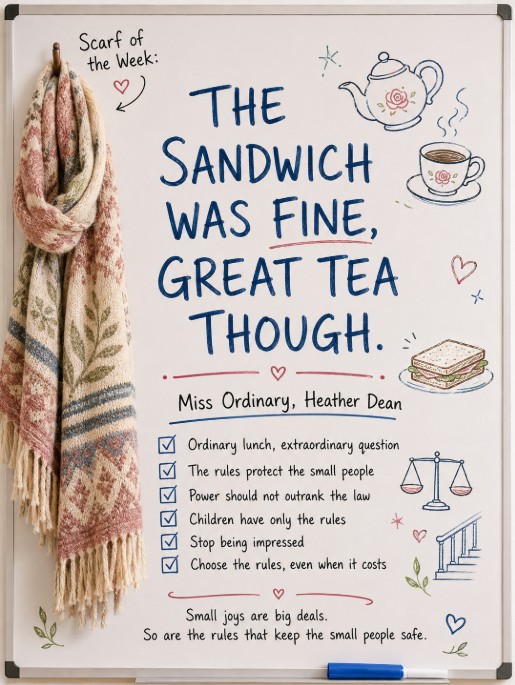
Wednesday. Lunch. The sandwich is fine. The Fortnum & Mason Rose Pouchong is genuinely lovely — floral and warm, the kind of tea that makes you feel like the world is more civilized than it probably is.
I’ve been staring at the same news story for twenty minutes.
I don’t usually write about things like this.
You know me. Small joys. Good light. Scarf weather. The way a really excellent cup of tea can make a difficult morning feel survivable. That’s my lane, I love my lane, and I’m not ashamed of it.
But I’ve been sitting here trying to eat this sandwich — it’s fine, a perfectly adequate turkey sandwich, nothing to write home about — and I keep coming back to the same thought, turning it over like a stone I can’t put down.
Someone reported it.
More than once. In more than one place. To more than one person who had the authority and the responsibility to do something about it.
And nothing happened.
That’s the part that won’t leave me alone today. Not the evil itself — the evil is real and enormous and I’m not going to pretend otherwise. The part underneath it. The reason it got to go on as long as it did.
Someone had more pull than the law. And the law looked away.
I read a piece a colleague wrote a while back, about law and power — about which one we actually believe in when the moment of truth shows up at the door. I’ll put his argument the way I understood it, which is probably softer than he’d put it: the rules aren’t there to make powerful people comfortable. They’re there to hold them still. They’re the railing on the staircase — boring, until the second you’d fall without it.
I thought about that abstractly when I read it. I’m not thinking about it abstractly anymore.
Because the thing I keep reading about isn’t really a failure of the law as an idea. It’s a much smaller, much more human thing. People who could have done something looked at who they’d be doing it to, and decided it wasn’t worth it.
He didn’t have to break the rules. He knew everyone. He was at the dinners. He was friends with the people whose whole job was to tell him no — and it turns out it is very, very hard to tell a friend no, especially a useful one. So the reports came in, and somehow there was always a reason they went nowhere.
And children paid for that.
I want to be careful, because I’m not a political person and I’m not trying to become one in the middle of my lunch. This isn’t about party, or sides, or whose week it ruins.
It’s simpler than that, and worse.
The rules exist to protect people. That’s the whole thing. That’s the entire point of them. They stand between the people who have nothing and the people who’d happily use everything they have to take advantage of them. They exist precisely because power, left alone, doesn’t behave. It doesn’t have to break a single rule. It just knows the right people, and waits.
We all know this. We know it the way you know something cold has come into a room before anyone names it.
What I can’t shrug off — sitting here with my adequate sandwich and my genuinely excellent tea — is the cost of knowing it and doing nothing anyway. I’m going to write his name exactly once, because you deserve to know I’m not hiding behind vagueness: Epstein. And then I’m not going to say it again, because I don’t want it in my mouth more than it has to be, and because the name was never the point. The point is what the case made impossible to keep ignoring. We’d gotten impressed. We’d started to believe, without ever deciding to, that the rules were for ordinary people and the truly remarkable lived a little above them.
The rules were supposed to be the stronger thing.
That isn’t naivety. That’s the design.
There’s an older, uglier way for the world to run — the one that creeps back the second we stop watching — where whoever has the most leverage in the room simply decides what happens, and the only real question is who has the power to decide. That arrangement is bad for almost everyone.
It is catastrophic for children.
Children have no power. No leverage. They can’t call in a favor or hire a lawyer or make anyone regret crossing them. They have exactly one thing standing between them and the people who’d hurt them, and it’s the rules — applied fairly, by people who believe the rules matter more than whoever happens to be standing in the room.
When that belief gets thin, children are the first ones left holding nothing.
That’s not a theory. That’s the thing that happened, over and over, for years.
And I think the reason it could happen — underneath all the official failures — is that we’d stopped believing, without ever saying it out loud, that the law was supposed to win.
I’m an ordinary person. I believe in the rules.
I don’t know how to fix the big things, and I’m not going to pretend I do. I write about scarves and tea and the small triumph of a well-organized Tuesday, and I think that has value, and I’m going to keep doing it.
But there’s one thing I think ordinary people — the ones who aren’t connected, aren’t powerful, aren’t working the angles — can actually do.
We can stop being impressed.
We can quit treating the rules as the annoying thing in our way and start seeing them for what they are: the only thing standing between the smallest people and everyone who’d like to help themselves to them.
We can mean it when we say the rules are for everyone. Not as a nice line. As something we’ll hold to when it’s inconvenient — when the powerful person is one of ours, when holding the line costs us something.
Because a law that only applies to ordinary people is not a law.
The tea’s still warm. The sandwich is gone — it was fine. It did its job.
I keep thinking about those reports. The ones that went somewhere and came back as nothing. Somewhere, someone weighed the rules against the power in the room and made a choice.
We’re all making that choice, in smaller ways, more often than we’d like to admit. And I think the most ordinary, unglamorous, important thing a person can do is keep choosing the rules — over and over, in the small moments no one will ever clap for.
Not because it’s glamorous.
Because it’s the only thing that was ever really on our side.
Small joys are big deals. So are the rules that keep the small people safe.
— Heather
Heather Dean writes Miss Ordinary for The Blue Ribbon Team. Stay clean, stay kind, stay caffeinated.