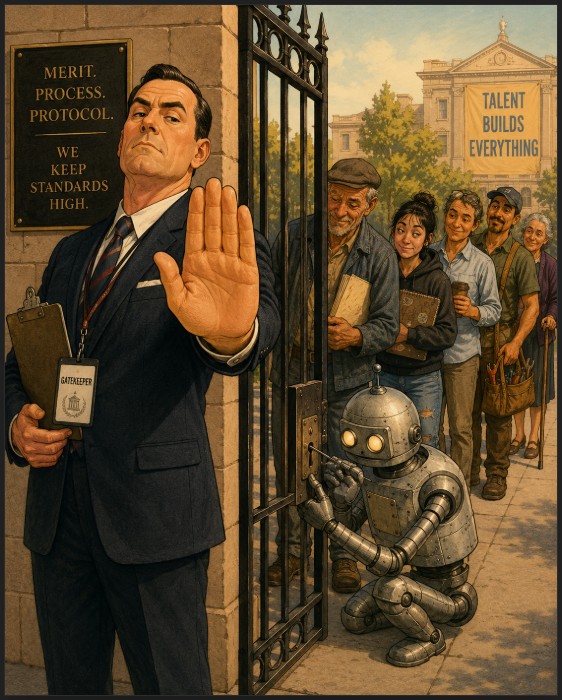
A Bright Meadow Group Systems Note on Technological Integration and the Communication Gate
A Personal Preface
I should tell you something before we get into the systems analysis.
I’m on the spectrum. I also carry the long-term cognitive and emotional load that comes with a military career and the years that around it. What that means in practical terms is that my thinking is not linear. It doesn’t arrive in neat paragraphs. It arrives in bursts, in patterns, in connections that are real and valid but difficult to hand to someone who hasn’t lived in the same kind of mind.
That doesn’t change what the thinking is worth.
It changes whether anyone gets to hear it.
I’m telling you this because it’s not just personal context. It’s the thesis. And if you’re a potential client reading this — you were going to notice eventually. May as well know what you’re getting upfront: a non-linear thinker who has found a tool that lets him hand you the output without losing the signal in translation.
That tool is AI. And the fight over it is not what they’re telling you it is.
What the Fight Is Actually About
Every industry is currently producing its own version of the same fear response to artificial intelligence.
Lawyers are worried about AI replacing legal research. Doctors are worried about AI replacing diagnoses. Writers are worried about AI replacing prose. Academics are worried about AI replacing scholarship. Executives are worried about AI replacing the people who “communicate well.”
Look at that list carefully.
Notice what every one of those concerns has in common.
They are not, at their core, worries about capability being replaced.
They are worries about access being disrupted.
The Gate Was Never About Knowledge
Here is what the systems thinker sees that the stakeholder doesn’t want you to see:
In almost every professional domain, there is a layer of gatekeeping that has nothing to do with whether a person can actually do the thing.
It has to do with whether they can present the thing.
Can they write the memo in the right register? Can they make the argument in the right cadence? Can they package the idea in the language the institution recognizes as legitimate?
These are communication skills. They are learnable. They are valuable. But somewhere along the way, they became confused with the underlying competence itself. And then — deliberately or not — they became the mechanism by which access was rationed.
You didn’t get the job because you weren’t qualified. You got filtered out because your cover letter didn’t “read right.”
You didn’t lose the case because you were wrong. You lost the room because you didn’t have the polish.
You didn’t fail to get funding because your idea was bad. You failed to get through the first conversation.
The gate was always the communication layer. And a very specific class of people have built very comfortable careers on their ability to work that gate — and to make sure others couldn’t.
The Work of Sam Colt
The gun didn’t make the smaller soldier stronger. It made physical size less relevant on the battlefield.
The gun didn’t give courage to the frightened. It reduced the gap between frightened and fearless in a firefight.
The gun was a great equalizer not because it made everyone equal — but because it decoupled outcome from a specific kind of physical advantage that had previously been decisive.
AI does the same thing to the communication layer.
It does not make you smarter. It does not do the thinking. It does not replace the need to understand what you’re talking about.
What it does is reduce the penalty for not presenting in the dominant register.
The person who has always had the ideas but couldn’t get them through the gate — who wrote the wrong way, talked the wrong way, organized thoughts in patterns that didn’t match the institutional template — that person now has a translation layer.
They still have to know the thing. They still have to build the thing. They still have to be right.
But the gate just got a lot easier to open.
Who Is Actually Afraid
Not everyone in every industry is afraid for the same reason.
Some fear is legitimate. Automation does displace some functions. That is real and deserves a real policy conversation.
But a significant portion of what you’re watching in the AI panic — the op-eds, the regulatory lobbying, the academic hand-wringing, the credentialing arguments — is not about protecting knowledge.
It is about protecting the gate.
It is coming from people whose competitive advantage was not what they knew but how fluently they could perform knowing it in the right rooms, to the right audiences, in the right format.
And for those people, AI is an existential threat. Not to their capability — to their monopoly.
The Dark Corner Problem
Here is the systems risk that matters most:
If the gatekeepers win the AI narrative, the technology does not disappear. It gets shaped.
Regulated into tiers. Priced into inaccessibility. Trained to reinforce existing hierarchies rather than disrupt them.
We have watched this happen with every equalizing technology.
The printing press was regulated. The internet was monetized into stratification. The smartphone became a surveillance tool before it became a liberation tool.
AI is at the same fork right now.
Pushed into open development and integration, it becomes a genuine equalizer — one of the most significant expansions of human access to participation in recorded history.
Pushed into a dark enough corner, it becomes a better gate. More sophisticated filters. Smarter sorting mechanisms. More convincing ways to tell people the problem is them, not the system.
The Bright Meadow Group Position
We integrate AI into our systems work because it makes the work better and because we believe that the adoption posture an organization takes toward AI right now is diagnostic.
It tells you whether the organization is optimizing for outcomes or for access control.
It tells you whether leadership is comfortable with the idea that the best thinking might arrive in an unexpected package.
It tells you, frankly, whether the people running the place are secure enough in their actual competence to survive a world where communication polish is no longer the deciding factor.
We are here for the organizations that are ready for that world.
And we are here for the people — the non-linear thinkers, the spectrum folks, the veterans carrying cognitive load, the brilliant-but-unpolished — who have always belonged in the room and finally have a tool that gets them there.
Observe. The gate was always communication, not competence.
Design. AI is a translation layer, not a replacement.
Intervene. The fight is not about whether AI is dangerous. It is about who controls whether it opens doors or builds better locks.
Bright Meadow Group | Systems Analysis and Solutions Consulting www.brightmeadowgroup.com