In January of 1991, a half wit comedy actor stood up in a ballroom at the Grosvenor House Hotel and explained creativity to a room of managers. The talk went out by satellite to a global audience. Video Arts had hired John Cleese to do it, which tells you something about what the corporate world thought it was missing and where it expected to find it.
The talk holds up. What Cleese lays out is a distinction between two mental states he calls the closed mode and the open mode.
The closed mode is where we spend our working hours. It is purposeful. Slightly anxious. There is a task, the task has a deadline, and we are moving through it with the pleasant tension of someone getting things done. It is an efficient state and a necessary one. You want your surgeon in it.
The open mode is the other one. Relaxed, expansive, less purposeful, and marked by a willingness to sit with a question you have not answered yet. This is where new ideas come from. Cleese is drawing on research suggesting that the more creative people were not smarter or better trained than their peers — they had simply developed a habit of staying with a problem longer before closing it out.
That last part is the hinge, and it costs something. Sitting with an undecided question is uncomfortable. Deciding brings relief. So we decide early, feel productive, and move on. The discomfort of not-knowing is what pushes us back into the closed mode, over and over, and the closed mode feels like competence the entire time.
Cleese lists the conditions the open mode requires. Space. Time. A boundary on that time, so you sit through the discomfort instead of bailing at the first itch. Confidence. And humor, which he identifies as the fastest route from one mode to the other.
Notice what those conditions have in common. They are the exact things a person working two jobs, or one job and a commute, does not have.
The part where I get suspicious
Here is where my mind went, and I will show my work.
If the open mode requires unstructured time, and unstructured time is the one resource working people have been steadily relieved of, then busyness starts to look less like a byproduct of modern life and more like a mechanism.
Keep the herd moving and it does not graze. Keep the army marching and it only looks at the soldier in front of it. Give people a task, then another task, and they do not look at the horizon. Language barriers used to keep populations from comparing notes. Cultural division is the tool that is used now. Time poverty may do it better than either, because it does not require the subject to be hostile toward anyone. It only requires him to be tired.
You can feel the pull of this line of thinking. It has the shape of the good conspiracies. It sits right next to fluoride in the water supply and aluminum in the deodorant and caffeine served in a lined can — the lining, of course, being the tell.
I enjoy that neighborhood. I have spent time there. I could spend the rest of this column there, building the case out, and some of you would come with me.
But I noticed something about the trip. It takes hours. And at the end of it I am holding a very detailed map of a room I am still standing in.
The better question
Because there is a question underneath.
Why do we spend the energy asking what they are doing to us?
That question has a hidden feature, which is that it takes time to answer and the answer changes little. You can spend a productive decade mapping the mechanism. You will be correct and you will still be tired.
The question that pays is smaller and less satisfying: what are we doing?
Because here is the uncomfortable finish to the Cleese argument. Hand someone a free evening and watch what happens. A good portion of us will fill it with structured distraction inside twenty minutes. Not because anyone made us. Because an unfilled hour puts you alone with an open question, and the open question is uncomfortable, and there is a device in your pocket engineered to relieve exactly that discomfort. The busyness is partly self-administered. We are participants in it.
Which is good news, oddly. A thing you are participating in is a thing you can stop.
The practice
I am not proposing a program. A program would be a task, and a task is the closed mode wearing a costume.
I am proposing time devoid of task.
Not a hobby. Not a game with rules and a score. Not a productivity ritual with an app attached. Set aside a block — call it ninety minutes, call it whatever you can protect — and enter it with no deliverable. Refuse to have anything you have to do. Let your attention wander toward whatever it wanders toward. Sit with the boredom that shows up around minute fifteen, because that boredom is the withdrawal symptom and it passes.
Then do it again next week. The regularity matters more than the length.
That is the intervention. It is unglamorous and it will feel unproductive on somebody else’s scoreboard, which is roughly the point. You are not escaping a conspiracy. You are declining a scoring system that was going to grade you poorly regardless.
Whether anyone designed this or whether it assembled itself out of a hundred million reasonable quarterly decisions, the exit is the same door.
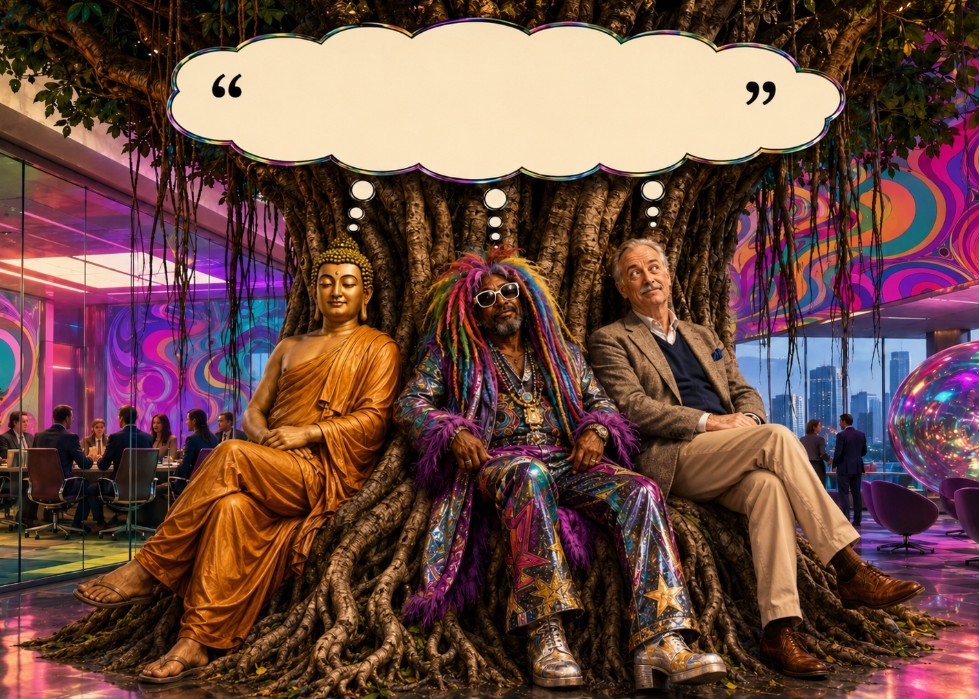
Free your mind so your ass can follow.
I think Gotama Siddhartha said something like that.