The first piece argued that the sky was a tool before it was a god — a calendar and a compass printed on the ceiling, free to anyone who lived under it. This one is about what that tool was for, and the answer turns out to be the oldest survival question there is: how did people live through an ice age on a continent that was actively trying to kill them?
Start with the timeline, because it’s the whole key. The oldest hard evidence of people in the Americas, the footprints at White Sands, now sits around 21,000 to 23,000 years old — placing humans in North America during the Last Glacial Maximum, the coldest, harshest stretch of the whole epoch, thousands of years earlier than the long-assumed thirteen-to-sixteen-thousand. Sit with what that means. These weren’t people who wandered in after the thaw and found a garden. They walked into the freezer while the freezer was running. They were here for the worst of it. And they didn’t just endure it — they spread across two continents, top to bottom, and were still here, thriving, when the ice finally let go thousands of years later. ScienceDaily
That is not a small thing to pull off, and we almost never ask how. The standard picture is grim and passive: small bands clinging on, getting lucky, slowly drifting south as the glaciers retreated. But you don’t populate two continents by clinging on. You don’t survive the Last Glacial Maximum by luck repeated for ten thousand years. Luck doesn’t repeat. Method repeats. There had to be a system — something teachable, portable, and reliable enough that a band could bet their children’s lives on it every single season. And I think the system is the thing the first piece described, only now you can see what it was solving.
The ice age didn’t make the world uniformly cold. It made it moving. The edges of the habitable zone shifted with the seasons and the centuries — the green retreated and advanced, the herds tracked the green, the good country was never in the same place two generations running. In a world like that, the fatal mistake isn’t the cold itself. It’s staying. Stay through a hard winter in a place that’s tipping over the edge and you die where you stand. The animals that made it were the ones that moved with the conditions, and the humans who made it were the ones who could read the conditions early enough to move first — before the food was gone, not after.
That’s the survival problem the sky-clock solves, and it’s why it had to be invented. A band needs to know when the season is turning and where the warmth is going, and it needs to know it weeks ahead, while there’s still time and strength to walk. You cannot run that calculation off memory or weather, because by the time the weather tells you, you’re already too late and too weak. You run it off the sun and the stars, the only signals that arrive on schedule and never lie. The noon sun’s height gives you the season and your latitude. The stars rising at dusk give you the month. A fixed marker on the high ground — a stone set to catch the solstice, a sightline aimed down the valley — turns that reading into something a whole community can share and a stranger can inherit. The instrument doesn’t just keep time. It says go now, and go that way.
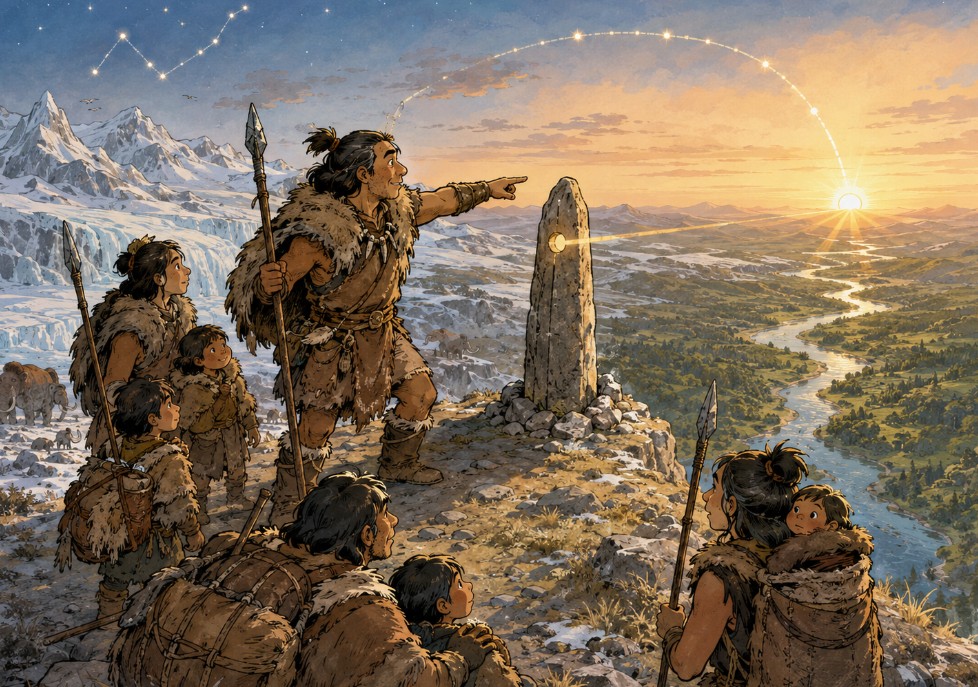
So picture the same scene from the first piece, but understand the stakes now. A band leader stands on the high ground at first light on the longest day. The sun climbs to its apex, higher than it will stand all year, and drops at dusk into the marked notch. He reads the signal his grandfather set there: the season has turned, the southern country is greening, the window is open. From that watershed he needs no map — he follows water. One river feeds the next, the last spills to a coast, and the coast runs unbroken toward the warm country. The marker told him when. The river tells him where. And every band that could read that signal and act on it lived to teach it to the next one. Every band that couldn’t, didn’t. That’s not a story about wandering. That’s a culture of migration — a deliberate, calendrical, taught survival discipline, and the markers are its hardware.
This is why the same idea keeps reappearing on its own. When these people finally stopped moving and raised permanent earthworks, they built the exact same instrument again. The mounds at Anderson, Indiana, an hour up from where I grew up, are sun-clocks: the Great Mound’s embankment aligned to the winter solstice sunset, a companion enclosure to the summer solstice, the circular mound to the equinox sunrises, with posts tracking star-risings like the Pleiades. Built by the Adena around 250 to 160 BCE and used into the Hopewell era — thousands of years after the walking stopped, and they still built the clock. You don’t carry an idea that far, that faithfully, unless it once saved your life on a schedule. The earthworks are the fossil of the survival method, raised in permanent earth by descendants who no longer needed to flee but couldn’t let the knowledge go.
And here’s where it ties back to the first piece, because the calendar never actually retired — it just changed jobs. The same sun-reading that once said time to walk south came to say time to put seed in the ground. The compass function lapsed when people settled; the calendar function got more essential, because a farmer who misreads the season starves where a forager could simply have moved on. The instrument that carried humans through the ice age by telling them when to migrate became the instrument that carried their descendants through agriculture by telling them when to plant. It never went idle. It survived the single most violent transition in human history — the one that ended walking — by switching which survival problem it solved.
So when we ask how people survived the ice age in the Americas, I don’t think the answer is endurance. Endurance is what you call it when you can’t see the method. The answer is that they ran a migration culture built on the most reliable signal in the world, encoded it in stone and earth so it could be taught and inherited, and rode it down the length of two continents through the coldest stretch the species has ever faced. They didn’t outlast the ice. They out-navigated it. And the standing stones and the lined-up mounds aren’t temples that happen to point at the sun. They’re the last working pieces of the oldest survival machine we ever built — the one that told a freezing band, with weeks to spare, exactly when to leave and exactly which way the warmth had gone.