A Bright Meadow Group design note on Plantd Materials
— published in the open, free to build
The video embedded below is worth watching before you read this, because it does something most company features don’t: it states the binding constraint on camera. Noelle goes to Oxford, North Carolina, to look at a startup founded by former SpaceX engineers who want to replace oriented strand board — the panels wrapping the walls, floors, and roofs of nearly every American home — with boards pressed from a perennial grass that grows six inches a day and harvests twice a season. The boards are certified in all fifty states. By the company’s own testing they run stronger and more moisture-resistant than softwood OSB. D.R. Horton, the largest homebuilder in the country, has ordered ten million of them. And then the film tells you the catch. At present throughput, that single order would take roughly forty years to fill.
That number is the whole story. Everything else is execution.
Observe.
The film frames Plantd’s modular mill as the moat — a repeatable factory unit that stamps out capacity faster than any legacy mill can answer. That reading is correct and incomplete. A mill is a mouth. It does not solve the ramp; it sets the rate at which the ramp must be fed. The segment titled Finding the Super-Grass walks directly up to the feedstock question and then steps around the only two facts that decide it: what the plant is, and how it is bonded. The plant stays unnamed. The resin stays off-camera. The press schedule never comes up at all.
Three things held back, and all three are ordinary. The process is strand board — heat, pressure, a cane feedstock, a resin from a known class, a press curve inside a standard window. None of it is novel science. The defensibility lives in the offtake contract and in being first to scale, which is a real position and an honest one. But it means the constraint that governs the company is not chemistry. It is acreage, and the time it takes to bring acreage online: land acquired, and row-crop farmers converted to a grass they have never grown, on a five-year bet. That is the slow half of the forty years. The mill is solved. The field is not.
One more thing to observe, because it sets up everything after: the basins where a feedstock crop like this would site are the same basins carrying impaired water. The constraint and a cleanup share a map.
Design.
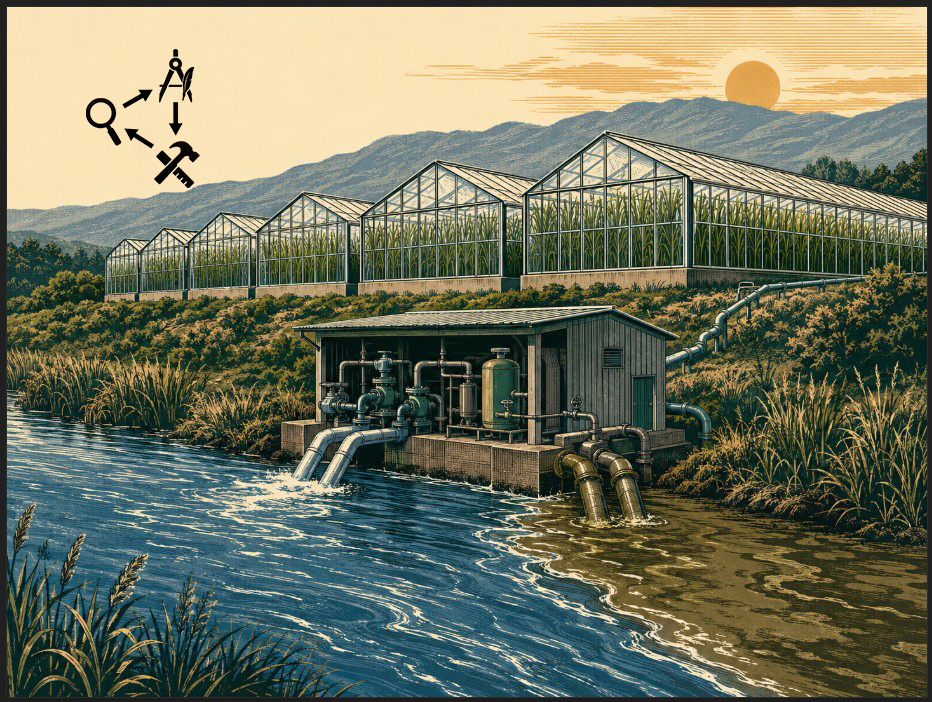
Stop acquiring farmland for feedstock. Grow the cane under cover, in hydroponic culture, fed by nutrient-impaired surface water.
A hoop-house system on a fraction of the field footprint yields continuous, controlled, multiple-cut biomass on a schedule, insulated from drought, storm, and the lumber-market volatility the film spends its closing minutes explaining. After buildout, the fertilizer line goes to zero — not lowered, eliminated — because the nitrogen and phosphorus the crop wants are the same nitrogen and phosphorus impairing the water you draw from. You stop buying inputs and start stripping load.
Containment also retires the invasive-species limit that constrains open-field options, which frees the variety choice to follow the material instead of the regulation. On the merits, the identifying signal is the correlation between high lignin and long strand — the trait set that strands clean, holds geometry through the line, and orients well. Arundo donax leads on that axis; energycane, the high-fiber Saccharum hybrids, runs a close second under warmth and abundant water; Miscanthus × giganteus is the conservative, sterile, cold-tolerant pick that needs no containment argument at all. Under cover, cut before flowering, the strongest of these stops being a liability and becomes simply the best strand stock available.
Sited on an impaired basin, the system is remediation that pays for itself. It pulls nutrient load out of the water, fixes it into fiber, and locks the fiber into a wall. The pollutant leaves the watershed as a building. The completion condition is not a grant cycle or a budget vote — it runs until the water meets standard, and the feedstock economics fund it the entire way.
None of this is specific to cane. The same infrastructure runs on most naturally produced plant material; any fast biomass that takes up nutrients and yields fiber feeds the loop. The cane is the anchor, not the system.
Intervene.
The intervention is this document.
We designed a feedstock layer that compresses the slow half of Plantd’s ramp and cleans a river while it does it, and we are publishing it in full rather than selling it. That choice is the point of the piece, so we’ll be plain about why.
Plantd is doing the hard, unglamorous work of standing up real capacity against one of the oldest industries in the country, and they’ve earned the position they’re in. We’re not here to compete with that. We’re here to hand them the other half of the ramp and ask nothing for it. Bright Meadow works by observing a system honestly, designing into it, and intervening where the leverage is — and the leverage here was never a license fee. We do not need to be paid for everything we do, because we get rich when the world gets better. Walls that store carbon instead of cutting forests, and water that runs clean because somebody needed the fiber it was carrying — that is the only ledger we keep that compounds. When it grows, we are wealthier, whether or not our name is on the invoice.
So take it. Build it. Scale it. Improve it past what we wrote and don’t credit us. If Plantd runs this and fills the Horton order in a decade instead of four, and a watershed meets standard on the company’s own demand curve, the design did exactly what we built it to do. Propagation over possession. We want the rivers clean, and a homebuilder’s appetite for fiber is the most reliable engine anyone has yet built for getting them there.