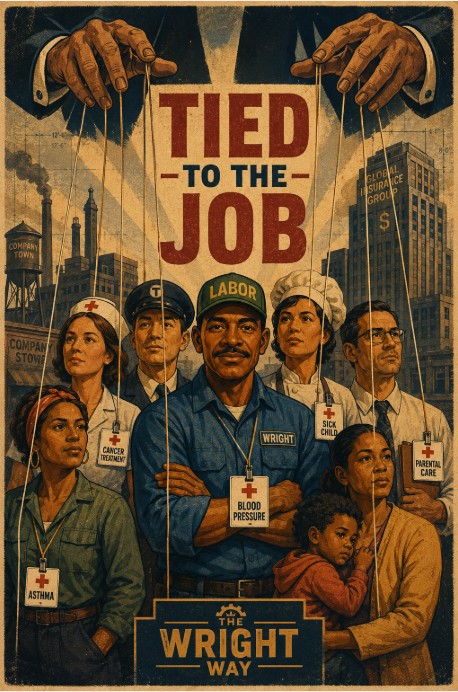
The boss would rather buy your medicine than watch you carry it out the door.
Pull up a stool, Jack. Mind the grease.
My old man carried bags on the Pullman cars for thirty-one years. Pressed his uniform every night, shined his shoes by the door, answered to a buzzer. The company that ran those cars also built a whole town outside Chicago and named it after itself — Pullman. Built the houses, ran the store, set the rents, printed the rules. A man could earn a fair wage in that town and never watch a dollar of it leave the company’s hand, because the company owned the roof over his head and the shelf he bought his bread from. They called it taking care of you. My father called it something… shorter.
The man I’m named for, A. Philip Randolph, spent a dozen years teaching those porters to stand up straight against that company. So you’ll forgive me if I know a leash when I see one — even a leash with a doctor’s note tied to it.
Here’s the shop-floor truth I want to set on the bench today. The health insurance your boss “gives” you was built off the same blueprint as that company town. A thing you can only use while you stay, that you lose the day you leave, is a tether with a ribbon on it. Understand that, and you’ll understand exactly why the biggest companies in this country spend real money fighting any system that would let a working man carry his own coverage out the door.
Now I’ll be fair, because fair is the only way I know how to talk. Nobody sat in a boardroom back in 1900 and dreamed this up to trap you. It came out of a war. Washington froze wages in ’42 so bosses couldn’t bid each other up for scarce hands. So the bosses got clever and started offering health coverage in place of a raise, since coverage didn’t count as a wage. Then the tax man blessed it — made that coverage tax-free in a way your paycheck never was. An accident of war and arithmetic. But here’s the part you measure twice on: a thing can start by accident and get kept on purpose. They kept it. They fight to keep it still. A man doesn’t fight that hard for an accident.
So let’s break it down, one cut at a time.
First cut. When your family’s medicine rides on your badge, you don’t sit down at any table as a free man. Every “take it or leave it” carries a second sentence the boss never has to say out loud — and your daughter’s insulin leaves with you. You can be the best hand in the building, know your worth to the dollar, and still swallow it, because the wage is yours but the medicine belongs to the company. Put a man’s child’s health on the table and you’ve turned a bargainer into a beggar in a nicer shirt. Respect is the first safety rule, and there’s no respect in a deal one side can’t walk away from.
Second cut, and this one’s the cruelest. Say a better job opens across town — more pay, shorter drive, a foreman who knows your name. The free market they preach says go take it. But you’re halfway through a treatment, and your doctor of fifteen years sits outside the new plan’s network. The deductible resets to zero come January, and you’ve already paid it once this year. That better wage could cost your wife her care or you yours, and they know it. For most of my working life it ran worse — a condition you already carried could get you turned away at the door, and they had a tidy word for it: pre-existing. That word chained more good men to bad jobs than any contract ever wrote. They’ve fenced it off some, for now. But a fence one election can move is a long way from freedom, and the cage was only ever repainted. So you stay. You stay for less money doing the same work, and you call it loyalty because the other word is too hard to say. That’s the free market they preach lying flat on the floor. They tell you you’re free to leave. They built the one cage you can’t walk out of.
Third cut. Walk a payroll with me. You’ve got your hourly hands, you’ve got your salaried staff, you’ve got the executives up in the glass — three different animals, paid three different ways, most of it dressed up as “benefits” so no man on the floor can read what any other man truly takes home. The hourly fella’s got a plan with a deductible that’d choke a mule. The staff’s got a better one. The executives have got arrangements that never show up on any list you’ll ever see. Pile enough of a man’s pay into “benefits” and you’ve fogged the whole ledger — and a fogged ledger is a gift to exactly one side of the table. You can’t stand shoulder to shoulder with a man when you can’t see what he’s standing on. Solidarity needs daylight, and benefits are how they keep the lights low.
Those are the three you likely came in knowing, and they’re sound. Let me add a few off my own bench, because the picture’s bigger than three cuts.
Fourth. The coverage walks out the door the same day you do — laid off, downsized, plant shuttered. Which means the moment you’re flat on your back and most in need of a doctor is the exact moment they hand you the bill for all of it. They call the offer to keep it COBRA, and the price would make a grown man laugh if he wasn’t already crying. A safety net that vanishes the second you fall is a magician’s trick.
Fifth, from a steward’s chair, and I sat in one a long while. Tying coverage to the job poisons the bargaining table itself. Every contract, every three years, we spent half our chips just holding onto the health plan we’d already won — never reaching for new ground, only defending the porch. Management learned to hold that plan over us like weather. They’d come in talking premiums and co-pays and watch the whole room forget about wages. A union spending its strength to keep what it already earned is a union running in place. That suits them fine.
Sixth, and here’s the joke of it. This is the country that’ll lecture you all day about pulling your own bootstraps, taking your risk, opening your own shop. Try it. Try walking away to start your own business when your boy needs a specialist every six weeks. You can’t. The system that worships the risk-taker nailed your boots to the floor. A man who can’t afford to quit can’t afford to dream, and a country that won’t let its people dream is poorer than it knows.
Seventh. Watch what they do to the part-timer and the contractor — the fella kept at thirty-nine and a half hours so he never crosses the line into “eligible.” A whole class of working people held just under the bar, dangling the promise of benefits like a carrot on a stick they sawed off themselves. They drew that line. They drew it on purpose.
Now a fair man will hear somebody object, so I’ll say it for him. “Phil,” he’ll say, “the employers stepped up when the government wouldn’t. Be grateful.” And I’ll tell him what I told my apprentices: I can be grateful for a thing and still see clear what it’s doing to me. A gift you can’t refuse and can’t keep stopped being a gift somewhere back down the road. Whoever’s good intentions started it, what it is today is leverage. Measure a thing by what it does, not by the story told about why it began. Check your measure, then check your motive.
So we come around to the question on the sign out front. Why do the biggest corporations in America spend so hard to fight a single system — one pool, coverage that follows the person instead of the paycheck? I’m not here to tell you how to vote; my father didn’t raise a man who hands out ballots. I’m here to tell you how the leash works, and you do your own arithmetic.
Run the numbers and you’ll find it was never the money. Half of them know they’d come out ahead, shed of the whole costly business of running an insurance desk inside a steel company. What they can’t stomach is the cord going slack. Cut your medicine loose from your badge and you can do the most dangerous thing a worker can do — you can walk. Quit a bad boss without betting your health on it. Hold out for the wage you’re worth. Organize without the biggest club they own hanging over the room. Cross town to a better job, or no job, or your own shop, and carry your coverage right out the door like a man carrying his own toolbox.
That’s the freedom they’re fighting. A free hand at the table — that’s all it ever was. They’ve held that leverage so long they’ve come to think of it as theirs. It was never theirs. It was always yours.
My old man, the porter, told me once: “We carried other folks’ baggage, son — but never their shame.” Your health is not the company’s baggage to hold over you. It belongs to you, and to the people who’ll sit up with you when you’re sick, and to nobody with a badge reader and a payroll. A working man’s body is the one piece of property they were never supposed to get a lien on.
Keep your craft sharp. Keep your conscience sharper. And don’t let a man tell you a leash is a gift just because he tied a bow on it.
Well — now you know, Jack.