The Factory You Didn’t Mean to Build
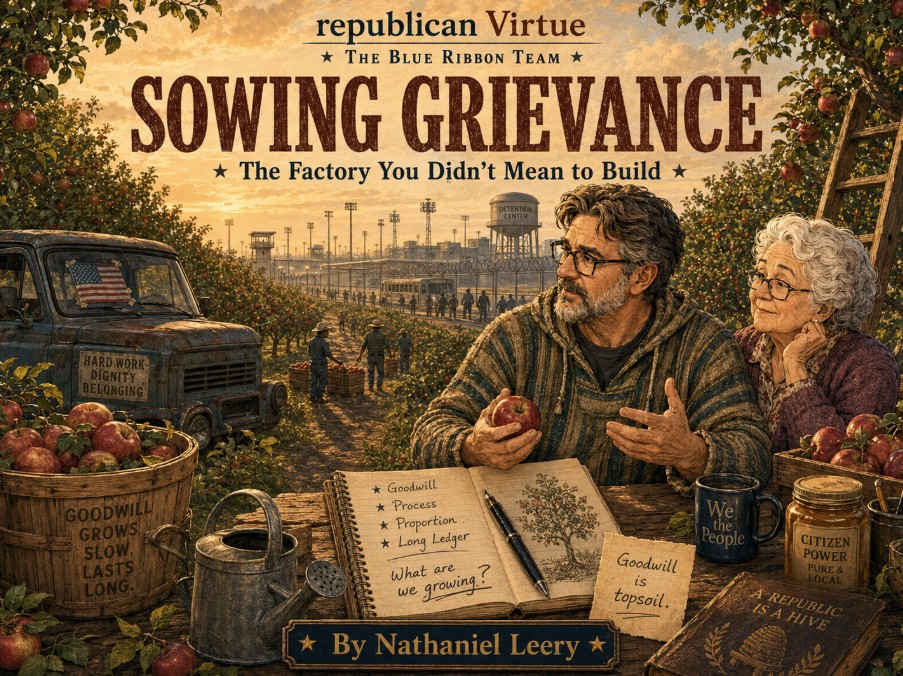
There is an orchard where the same families have come north for thirty years to pick apples. The grower knows their children’s names. The crew knows which rows ripen first. One of the men, years ago, taped a small American flag to the dashboard of the van he drove up from Michoacán. Nobody asked him to. He put it there the way a man puts a photograph of someone he admires where he can see it while he works.
Hold that flag in your mind for a moment, because this essay is about what we have been doing to the man who taped it there.
On the last day of June, the Supreme Court settled a question that was never truly open. In Trump v. Barbara, the Court reaffirmed that the Fourteenth Amendment means what it says: a child born on American soil is an American. Chief Justice Roberts, writing for the majority, called citizenship “the right to have rights.” The framers of that amendment chose their words in the shadow of a war fought over who counts as a person, and they chose broadly on purpose. The Court kept their promise. That part of the ledger is closed.
But a constitution can settle who belongs to the nation without settling what the nation has become in the meantime. And while the lawyers argued over the citizenship of infants, the machinery of enforcement was busy working on their parents, their uncles, their neighbors — and it was working without much thought for what it was manufacturing.
Every system produces something. A farm produces food. A school produces citizens. An enforcement regime produces outcomes too, and the outputs go well beyond the removal orders it stamps. It produces memories. It produces stories that travel home in phone calls and remittance envelopes and the long silence of a man who no longer calls at all. For a year and a half we have been running that machinery at full throttle — raids at courthouses, arrests at schoolyard fences, removals to third countries the deportee has never seen — and we have paid almost no attention to what the machine is actually building.
Here is what it is building. Take a large population of people. Strip them of standing, work, family, and future. Bind them together with a single shared grievance — we came to you because we believed in you, and you broke us for it — and then concentrate them, geographically and psychologically, in places where that grievance is the only currency they have left. History has a name for this arrangement. It is called an incubator.
Prisons taught us the lesson generations ago. Incarceration turned out to be the most efficient recruiting, vetting, and loyalty-forging apparatus ever devised, and the gangs it hardened became the backbone of transnational criminal networks. Compression does the work: put capable, motivated people in close quarters with nothing but time and a shared injury, and organization emerges the way mold emerges on bread. Exile scales the same model across borders. Displaced populations have become proxy forces in every century we have records for. Aggrieved migrants make ideal assets for hostile actors precisely because they already know our language, our roads, our seams. A foreign intelligence service surveying the camps and holding facilities of 2026 finds the hardest part of its work — motivation — already done, free of charge, courtesy of us.
Now consider what raw material we fed into this machine, because this is the part that should keep a strategist up at night longer than any moral argument.
These were, by any honest accounting, the most pro-American people on Earth. They walked. Some of them walked distances that would break a soldier, through jungle and desert, carrying children, to reach a country they had only seen on screens. They learned our language from dubbed sitcoms. They named their sons after our presidents. Every economist will tell you that self-selection is the most powerful sorting force in any market, and this population self-selected for belief in us. Whatever one thinks about the law they crossed, their opinion of America was closer to worship than to citizenship. We were sitting on the largest reserve of goodwill any nation has held since 1945, and goodwill, like topsoil, took two centuries of weather to accumulate.
We are strip-mining it. And here is the strategic malpractice at the center of it: the outcome of any individual case — stay or go, citizen or guest — matters far less than the manner in which we handled the man. A neighbor deported with a hearing, a handshake, and his dignity intact goes home disappointed. A neighbor dragged out in front of his children by masked officers goes home as something else, and he tells the story to everyone he meets for the rest of his life. Multiply that story by a million tellings and you have converted an admirer into an adversary at industrial scale, with no adversary having spent a dollar to do it. We made enemies in the one demographic where we had friends — where, frankly, we had devotees.
Jefferson called this country an asylum for mankind and understood the arrangement as a bargain rather than a charity: the people who choose you renew you. Tocqueville marveled that America’s real constitution lived in its habits — in how ordinary power treated ordinary people when no one important was watching. And Adam Smith, patron saint of every free-marketeer who invokes him without reading him, built his entire system on a prior book about moral sentiments, because he understood that markets run on trust the way engines run on oil. A nation’s word — its process, its decency, its predictability — is infrastructure. Investors price it. Allies price it. So do the poor, who are often better judges of a country’s character than its bondholders, because they bet their bodies on it instead of their money.
The Court has now done its part. It tended the deepest root in the orchard and found it sound: born here means belonging here, and no executive signature can girdle that tree. What remains is our part, and it requires no new amendment, no grand bargain, no act of Congress. It requires only that enforcement be conducted the way any sound system is run — with process, with proportion, and with the long ledger in view. A nation may control its borders and still refuse to manufacture grievance as a byproduct. Those two things were never in tension; we simply stopped doing the second one and called it strength.
It was never strength. Strength is what you can afford to spend without weakening. What we have been spending is the accumulated affection of the world’s strivers, and that account, once drawn down, refills at the speed of generations.
People once walked ten thousand miles toward us. The measure of these years will be what they carry on the walk back.