The Navy Rediscovers the Useful Ship
What the Combat Stores Ship Knew
Navies are remembered by their fighting ships.
The public remembers carriers, battleships, submarines and destroyers. Those are the ships photographed at sunset, reproduced as models and named in speeches. They launch the aircraft, fire the missiles and appear on the evening news.
Sailors know there is another fleet behind that fleet.
It brings the food, repair parts, clothing, mail, medical supplies, replacement electronics and thousands of ordinary objects required to keep a warship operating after it has sailed beyond sight of land. Its ships are less glamorous because their purpose is not concentrated in one dramatic weapon. Their purpose is usefulness itself.
No class embodied that principle better than the American combat stores ship—the AFS.
The abbreviation stood for combat stores ship, but that description never fully captured what the vessel was. An AFS was part floating warehouse, part refrigerated distribution center, part cargo terminal, part aviation platform and part industrial delivery service.
It carried food, but it was not merely a grocery ship. It carried repair parts, technical stores, clothing, medical supplies and mail. It could replenish ships alongside through connected replenishment, move cargo vertically by helicopter and serve several customers during the same evolution.
A circuit card, pump component or replacement fitting could matter more on a particular day than another missile.
The AFS carried the Navy’s bloodstream.
From Store Ships to Combat Stores Ships
The Navy operated supply vessels long before the AFS designation appeared. Earlier AF store ships transported refrigerated provisions and general supplies to forward bases and ships. Their importance grew as American naval operations expanded across the Pacific during the Second World War.
That war established a permanent truth: a fleet operating across an ocean cannot depend entirely upon ports.
The United States built an enormous mobile logistics system of oilers, ammunition ships, repair ships, tenders, tugs, hospital ships, stores ships and floating dry docks. The fleet train allowed combat forces to remain at sea and advance across distances that would otherwise have made sustained operations impossible.
After the war, the requirement changed.
Carrier task forces were faster, more mobile and expected to remain underway for longer periods. Jet aircraft and increasingly complex electronics created much greater demand for specialized parts and consumable supplies. It was no longer enough for a supply ship to move cargo between harbors. The ship had to operate with the fleet and deliver its cargo while everyone remained underway.
The answer was the combat stores ship.
The first purpose-built American AFS vessels were the seven ships of the Mars class:
- USS Mars — AFS-1
- USS Sylvania — AFS-2
- USS Niagara Falls — AFS-3
- USS White Plains — AFS-4
- USS Concord — AFS-5
- USS San Diego — AFS-6
- USS San Jose — AFS-7
They were built during the 1960s for a fleet that needed to remain continuously supplied while operating thousands of miles from the continental United States.
Their design was fundamentally about cargo flow.
The ships carried palletized refrigerated and dry stores. Vertical conveyors connected their cargo holds with the working decks. Forklifts and pallet trucks moved supplies through internal passageways designed around handling cargo rather than merely storing it.
Replenishment stations allowed cargo to be transferred across highlines while helicopters simultaneously conducted vertical replenishment. A carrier or cruiser could come alongside on one side, a destroyer on the other, and helicopters could deliver pallets to additional ships elsewhere in the formation.
The AFS did not need every customer to enter port, stop operating or even come alongside.
That was its great advantage.
USS Niagara Falls
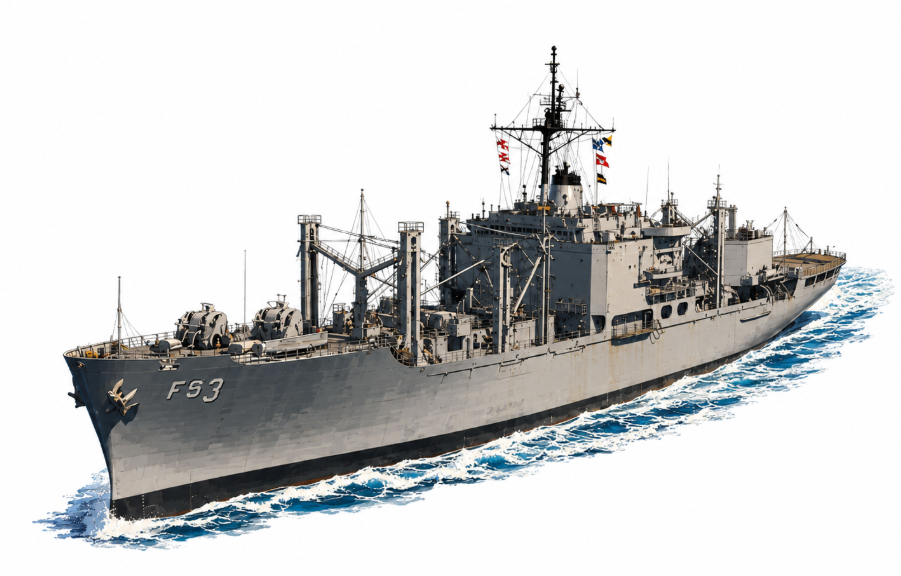
USS Niagara Falls, AFS-3, was laid down at National Steel and Shipbuilding Company in San Diego on May 22, 1965. She was launched on March 26, 1966, and commissioned on April 29, 1967.
She was approximately 581 feet long, displaced roughly 17,500 tons at full load and could make about 20 knots. Her holds carried refrigerated provisions, dry stores, technical materials and general fleet supplies. She had alongside replenishment stations and a flight deck, hangar and aviation detachment for two helicopters.
Her configuration allowed her to replenish ships on both sides while aircraft carried cargo to still more customers.
That made Niagara Falls something unusual in naval construction: a specialized ship whose specialization produced broad utility.
She was not optimized around one weapon, one enemy or one narrowly defined mission. She was optimized around moving useful things to wherever they were needed.
Commissioned while the Vietnam War was escalating, Niagara Falls entered the western Pacific supply system almost immediately. She supported ships operating off Vietnam and conducted vertical replenishment with UH-46 Sea Knight helicopters.
Those helicopters extended the ship’s reach well beyond the replenishment formation. A destroyer did not have to break away merely to receive a modest load. Priority repair parts, mail, provisions and technical supplies could be lifted from the AFS flight deck and placed directly onto another ship.
The AFS was not merely a cargo vessel.
It was a mobile distribution network.
The Fighting Falls
Over the following decades, Niagara Falls became a regular presence in the Pacific and Indian Ocean. She acquired the nickname Fighting Falls, an appropriate name for a ship whose combat contribution was measured in how long everyone else could remain in the fight.
Her home ports included San Diego, Sasebo, Alameda and Guam. Guam was a natural base for the ship. From there, she could support Seventh Fleet operations throughout the western Pacific and move into the Indian Ocean and Persian Gulf as required.
That geography mattered.
A ship based on Guam was already positioned within the maritime space the Navy was expected to cover. It did not first have to cross the Pacific from California whenever a crisis developed in Asia or the Middle East. It could move among carrier groups, amphibious forces, surface combatants and regional operating areas as demand changed.
By the time Iraq invaded Kuwait in August 1990, the AFS was a mature piece of naval machinery. Its crews had decades of experience sustaining American forces across the Pacific and Indian Ocean.
Then came Desert Shield and Desert Storm.
The popular history of the Gulf War centers on aircraft, armor, missiles and the rapid ground campaign. Its maritime history is often reduced to carriers launching sorties and battleships firing into Kuwait.
Behind those operations stood an immense logistical system.
Ships had to be fed. Aircraft required parts and maintenance materials. Electronics failed. Pumps wore out. Personnel needed clothing, medicine, mail and basic consumables. A carrier battle group was a moving industrial city, and every day at sea consumed part of the inventory that kept it alive.
USS Niagara Falls was there.
She supported American and allied vessels throughout the region. She could serve a carrier, cruiser, destroyer, frigate or amphibious ship without changing her essential purpose. Every part of the fleet eventually needed something she carried.
Readiness was not an abstract percentage reported to headquarters. It was a pallet moving across a wire, a helicopter arriving with a suspended load or the correct replacement part appearing before a broken system became a lost capability.
A carrier could project power hundreds of miles inland.
An AFS helped determine how many consecutive days it could continue doing so.
From War to Relief
After the Gulf War, Niagara Falls continued supporting a Navy that was discovering how little the end of the Cold War had simplified its work.
In December 1992, American forces entered Somalia as part of Operation Restore Hope. The mission required naval aviation, amphibious forces, sealift, supplies and sustained operations around a country whose shore infrastructure could not be treated as a dependable logistical base.
This was exactly the kind of environment in which a flexible supply ship justified its existence.
The same vessel that supported combat operations in the Persian Gulf could support humanitarian and stabilization operations off East Africa. The cargo mix could change. The customers could change. The political purpose of the deployment could change.
That is the distinction between a useful ship and merely a capable one.
A narrowly optimized combatant may be extraordinarily capable inside its intended mission. An AFS remained useful across radically different missions because every naval operation generated demand for physical supplies and because the ship possessed several ways to move those supplies.
Connected replenishment, vertical replenishment, refrigerated cargo, dry cargo, technical stores and aviation support were not optional mission packages.
They were permanent characteristics of the ship.
The AFS could arrive and begin being useful.
A Forty-Year Ship
USS Niagara Falls remained a commissioned Navy ship until September 1994. She was then transferred to Military Sealift Command and placed in service as USNS Niagara Falls, T-AFS-3.
The change was part of the Navy’s broader movement toward civilian-crewed auxiliaries. Under Military Sealift Command, civilian mariners operated most of the ship while a smaller uniformed detachment handled military communications and specialized functions.
The transfer extended the useful life of the platform considerably.
As a USNS vessel, Niagara Falls continued supporting the fleet across the Pacific and Indian Ocean. During the opening phase of the war in Afghanistan, she moved exceptionally heavy volumes of cargo. She later supported the humanitarian response following the 2004 Indian Ocean tsunami.
That post-Navy career reinforced the basic argument for the ship.
A vessel designed during the early 1960s supported the Vietnam War, Cold War deployments, the Gulf War, post-Cold War interventions, the opening phase of the war in Afghanistan and one of the largest humanitarian relief operations of the early twenty-first century.
Its machinery aged. Its helicopters changed. Its crewing arrangement changed. Its communications changed. The strategic environment changed several times.
Its usefulness remained.
USNS Niagara Falls was finally taken out of service on September 30, 2008, after more than four decades of work. She was later used as a target during the 2012 Rim of the Pacific exercise and sank in deep water southwest of Kauai.
The Navy expended a ship that had spent most of its life preventing the fleet from expending itself.
Consolidation and Its Price
The AFS did not disappear because the fleet stopped needing food, parts and general stores.
Its functions were consolidated into larger multiproduct replenishment ships.
Fast combat support ships carried fuel, ammunition and stores in one hull and possessed the speed to accompany carrier strike groups. Later dry cargo and ammunition ships combined several logistics functions under Military Sealift Command.
There were sound reasons for consolidation. One ship capable of delivering fuel, ammunition, refrigerated provisions and dry cargo could replace several specialized auxiliaries during many operations. Crewing requirements could be reduced. Scheduling could be simplified. A carrier group could receive a broad range of supplies during one replenishment event.
But consolidation came with a price.
A large multiproduct auxiliary is valuable because so many functions are concentrated aboard it. That also makes its absence, mechanical failure or loss more consequential. Every additional function placed in one hull reduces the number of hulls available to distribute across the ocean.
Efficiency and resilience are not the same thing.
An oiler carries fuel. An ammunition ship carries ammunition. A combat stores ship carries food, parts and general supplies. Those ships can operate together, but they can also be divided among separate task groups.
A universal auxiliary can do more things in one location.
Several useful ships can do useful things in several locations.
That distinction becomes decisive in a distributed war.
The Fleet We Are Building
The Navy is again confronting the geography that produced the combat stores ship.
The Pacific is enormous. Major ports and bases will be targeted. Ships will have to disperse rather than remain concentrated around a few carrier groups. Marine units may operate from islands and temporary shore positions. Uncrewed systems, small combatants and distributed formations will generate many modest but geographically separated demands.
The fleet does not merely need faster warships.
It needs more ways to move food, repair parts, ammunition, vehicles, drones, electronics, medical supplies, personnel and data among ships, islands and austere shore sites.
This is why the Navy’s renewed interest in commercial construction, medium landing ships and auxiliary capacity matters.
The Medium Landing Ship is a useful beginning, but it answers primarily an amphibious transportation problem. It does not replace the need for a dedicated fleet distribution ship capable of collecting, sorting and delivering the continuous flow of ordinary material upon which naval operations depend.
The Navy does not need to rediscover the requirement.
The requirement is visible every time a deployed ship runs short of a component, receives a pallet by helicopter or breaks formation to meet a replenishment vessel.
The Navy needs to rediscover the ship.
Build the Niagara Falls Class
The modern combat stores ship should not be another study, concept rendering or unfunded line in a thirty-year force plan.
It should be a class of ships.
Build seven.
Use the original names. Preserve the original hull numbers. Begin with the ship that proved the argument across four decades of service.
- USS Mars — AFS-1
- USS Sylvania — AFS-2
- USS Niagara Falls — AFS-3
- USS White Plains — AFS-4
- USS Concord — AFS-5
- USS San Diego — AFS-6
- USS San Jose — AFS-7
But do not build them in numerical order.
Drop USS Niagara Falls, AFS-3, into the water first.
Name the class for her.
The original ships were called the Mars class because Mars was the first hull. The new ships should be called the Niagara Falls** class** because Niagara Falls is the ship whose service most clearly demonstrates why the type must return—and because one of her own sailors made the case for bringing it back.
Keeping AFS-3 as the lead ship would violate the usual administrative neatness of sequential hull construction.
Good.
The Navy has sacrificed enough useful capability to administrative neatness.
The new Niagara Falls class should be commercially derived, conventionally powered and designed for serial construction in several American yards. It does not need destroyer speed, cruiser sensors or a billion-dollar combat system. It needs reliable machinery, long endurance, efficient cargo handling and enough speed to remain operationally relevant.
It should have substantial refrigerated and dry-storage capacity. It should carry repair parts, medical supplies, food, clothing, electronics, mail and configurable palletized cargo.
Its holds should be designed around rapid retrieval rather than maximum theoretical capacity. Cargo should move by elevators, conveyors, forklifts and automated handling systems from storage to issue stations without improvised routes through the ship.
It should replenish vessels on both sides.
It should support connected replenishment, vertical replenishment and boat transfer. It should have a full flight deck and hangar capable of handling Navy and Marine helicopters, tiltrotors and unmanned cargo aircraft.
It should carry standardized containers without becoming merely another container ship. It should possess workshops, additive manufacturing capacity and enough technical personnel to identify, fabricate or repair basic components while underway.
It should have the electrical capacity and communications spaces to support unmanned systems, temporary medical operations, command teams and disaster-relief detachments.
It should have defensive weapons sufficient to survive within a protected logistics formation, but weapons should not be permitted to consume the design. The ship’s principal contribution to combat will be the material it delivers.
Most importantly, it must be affordable enough to build in numbers.
The Navy should not turn the AFS requirement into another exquisite auxiliary costing so much that only three can be purchased. Nor should it collapse fuel, ammunition, provisions, repair, hospital and command functions into one irreplaceable universal ship.
Build the useful ship.
Build enough of them to distribute.
Place them at Guam, Hawaii, San Diego, Japan and wherever else the fleet expects to operate after the opening shots have damaged ports and disrupted ordinary supply routes.
Give each fleet commander a moving warehouse, refrigerated distribution center, aviation platform and repair-parts store that can serve ships at sea and units ashore.
Give the fleet something that can support a carrier strike group on Monday, an amphibious force on Wednesday and a humanitarian relief operation on Friday without waiting for a mission module or a contract modification.
The Navy already knows how to build the ship. The original seven provided the design philosophy:
Carry what the fleet consumes.
Arrange the ship around moving it.
Deliver it in more than one way.
Remain useful across every mission short of sinking.
USS Niagara Falls supported warships, allied ships, humanitarian operations and four decades of American presence across the Pacific and Indian Ocean. She was designed before Vietnam reached its height and remained useful into the war in Afghanistan.
That is not obsolescence.
That is successful naval architecture.
Authorize seven new combat stores ships. Build them commercially. Preserve the names and numbers. Put AFS-3 at the head of the construction schedule.
Launch USS Niagara Falls first.
Then send her back to Guam.
The fleet will find something for her to do before she arrives.