The Road to Mars Runs Through Earth
Another round of commentary has surfaced lately about Elon Musk’s apparent governing philosophy: get humanity to Mars, whatever it takes.
Before I go further, I need to establish something.
I am not an Elon Musk fanboy.
I regard the man as a racist. That is an opinion, and I arrived at it slowly, by watching his public behavior, the racial subjects he chooses to amplify, his origins, and the political movements he has funded and championed. A recent analysis of tens of thousands of his posts found a substantial and growing preoccupation with race and white identity, and his political interventions have included open support for far-right parties in Europe. The record is public. People can read it and reach their own conclusions. I have reached mine.
I was also one of the people dazzled by the early Tesla years. I believed the flash. Then I watched the SolarCity and the X transaction and the financial machinery surrounding it, and I came away convinced that people like me had served as fuel for a larger ambition. Shareholders challenged the acquisition as a bailout of Musk’s own interests; he prevailed in court. The verdict changed nothing about how the episode felt from where I stood.
So this is no defense of Elon Musk.
It is an acknowledgment that a person can be socially poisonous, politically dangerous, and personally objectionable — and still be right about something important.
Musk is one of the great technological accelerants alive today. He did not personally design the motors, write the code, or plot the trajectories. Thousands of engineers, machinists, and technicians did that work. But the organizations he drove forced electric vehicles into the center of the automobile industry, turned reusable orbital rockets from theory into routine, and made governments and competitors move faster than they intended to.
I can despise the man’s politics and still salute the machinery rising from the launchpad.
And on the central proposition, he is closer to right than his critics want to admit.
Humanity should become a multiplanetary species.
All of humanity. The species entire — every lineage, every language, every income bracket. Anything narrower is a gated community with a heat shield.
SpaceX describes its objective plainly: a self-sufficient Martian city, roughly a million inhabitants, millions of tonnes of cargo, thousands of Starship flights. Whatever one thinks of the timeline, the intended scale is a civilization, and that ambition deserves to be taken seriously.
It deserves seriousness because every species confined to one planet lives with a single point of failure. Asteroid impacts, supervolcanoes, engineered pathogens, nuclear war, ecological collapse, and catastrophes we have yet to imagine all sit somewhere on the long calendar of existential risk. A second self-sustaining human civilization would leave us mortal but harder to erase.
Mars is a first step, and a short one. It is the cold, poisonous practice field between remaining a planetary species and someday becoming a spacefaring one.
Musk’s approach, though, contains a fundamental error.
He treats the rocket as the mission.
The rocket is the delivery truck.
The mission is keeping human beings alive inside an environment that refuses to support them. That means closed water cycles, controlled agriculture, waste recovery, atmospheric management, durable energy, mineral extraction, biological stability, repairable machinery, and communities that can endure prolonged isolation without a resupply line of replacements from Earth.
Every one of those is an Earth technology we desperately need right now.
As I write this, Pennsylvania sits under smoke carried hundreds of miles from fires in Canada and the northern United States. Air-quality alerts have reached Code Red and Code Purple. Games postponed, windows shut, a significant fraction of a continent breathing the consequences of forests burning beyond the horizon. Climate change did not invent fire, but rising heat and deepening drought keep widening the conditions under which fire becomes a continental event.
This is what climate catastrophe looks like at first.
Another smoky week.
Another crop failure.
Another flooded town.
Another heat emergency.
Another insurance company abandoning another region.
Another aquifer falling faster than it can recharge.
Another place where ordinary life becomes more expensive, less healthy, and finally impossible for anyone who cannot afford to engineer a private atmosphere around himself.
The credible danger is a slow constriction: larger portions of the planet growing hotter, drier, less productive, more disaster-prone, harder to inhabit safely. The IPCC describes a narrowing window for climate-resilient development, mounting limits to adaptation, and growing risks to settlements, food systems, and human health.
The wrong response is to declare Earth lost and load the richest passengers onto a rocket.
The right response is to begin terraforming here.
Humanity has already terraformed much of Earth. We simply did it carelessly. We drained wetlands, straightened rivers, removed forests, irrigated deserts without recharging aquifers, paved watersheds, concentrated animals and waste and industry, dug ancient carbon out of the ground and injected it into the sky, built cities that manufacture their own heat, altered the chemistry of the oceans, and shuffled species across continents.
The question of whether human beings should manipulate planetary systems was settled generations ago. We do. The remaining question is whether we can learn to do it deliberately, intelligently, and restoratively.
Make more of this planet habitable.
Learn to restore damaged drylands without planting thirsty monocultures and calling the photograph a success. China’s enormous ecological-engineering projects have shown that degraded landscapes can be stabilized at continental scale — and shown, through their failures, why species selection, water budgets, and local ecology matter. The lesson is that climate, soil, water, vegetation, and human settlement can be engineered together when a society treats land restoration as infrastructure.
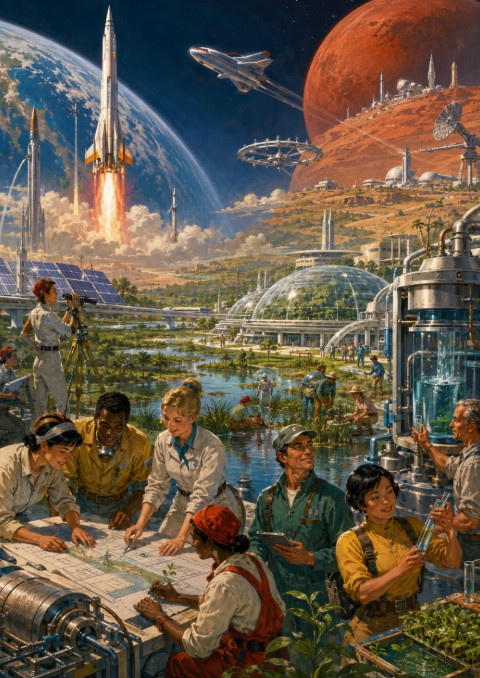
Build mechanical swamps.
We already know how. Constructed wetlands use plants, soils, gravel, and microbial communities to treat wastewater, agricultural runoff, stormwater, and some industrial discharge. They recover water, transform pollutants, create habitat, and replace portions of the concrete-and-chemical treatment chain with living machinery. The EPA describes them plainly: engineered systems that reproduce wetland processes under controlled conditions.
Scale them. Put them beside factories, mines, farms, subdivisions, and treatment plants. Fold them into flood control. Connect them to algae production, nutrient recovery, biomass processing, and irrigation. Stop treating water as a disposable carrier for everything we would rather stop seeing.
Develop agriculture that recycles its own water and nutrients.
Build cities that harvest heat.
Design buildings that stay habitable when the grid fails.
Turn sewage into water, fertilizer, energy, and industrial feedstock.
Recover phosphorus before it reaches the ocean.
Rebuild soil as biological machinery.
Create energy systems that keep working locally when national infrastructure breaks.
Every one of those systems belongs on Mars.
A Martian settlement cannot flush its nutrients into a river and order replacements from another continent. It cannot discard a machine because one proprietary sensor failed. It cannot let drinking water become sewage after a single pass. It cannot split agriculture, sanitation, energy, and manufacturing into unrelated industries and assume the waste disappears somewhere past the municipal boundary.
Mars will enforce circularity with death.
Earth merely sends a bill, and because the bill arrives unevenly, wealthy people have been able to pretend it is optional.
This is where the Mars program and the environmental movement should meet.
For every dollar spent on the machinery that carries people away from Earth, spend at least another dollar on the systems that keep them alive after landing.
Then deploy those systems here first.
A closed-loop water processor developed for Mars belongs in drought-stricken towns. A compact waste-recovery unit belongs in refugee camps and isolated rural communities. A low-energy greenhouse belongs in northern cities, deserts, and disaster zones. Autonomous construction machinery belongs in towns rebuilding after fire and flood. Microgrids designed for a Martian base belong in hospitals, farms, and neighborhoods that cannot afford to lose power for a week.
A technology has lost nothing because poor people benefited from it before astronauts did. It has been proven.
Earth is where we debug Mars.
Here is where we discover whether closed ecosystems stay stable for decades rather than months. Here is where we learn how humans behave inside constrained communities. Here is where we find out whether the machinery can be repaired by ordinary technicians, and which systems survive shrinking budgets, changing leadership, missing parts, and the certainty that somebody will eventually do something stupid.
A settlement that cannot survive those conditions in Pennsylvania is unready for Mars.
There is also a moral question that cannot wait until launch day.
Who is “humanity”?
If public money, publicly educated engineers, government launch contracts, international science, and generations of accumulated knowledge make a Martian settlement possible, then no billionaire gets to define the species at the boarding gate.
Mars cannot become a racial ark.
It cannot become a company town where oxygen is deducted from your wages.
It cannot become a feudal colony governed by whoever owns the satellites, the landing pads, and the airlocks.
If humanity reaches another world only to rebuild its oldest hierarchies inside a pressure vessel, we will have created nothing new. We will have exported the worst of the old civilization and welded the exits shut.
Musk is right that we should go.
He is wrong if he believes the destination excuses neglecting the departure point.
Earth and Mars are the same project at different levels of difficulty. The technologies that make a desert settlement flourish can restore damaged land here. The systems that recycle every drop of water there can stop us poisoning rivers here. The agriculture that feeds people under a Martian roof can feed cities, tundra, drought zones, and exhausted industrial valleys here. The energy architecture that carries a base through a dust storm can carry a town through a hurricane, a wildfire, a grid failure.
And the civilization mature enough to live on Mars must first prove it is mature enough to stay alive on Earth.
Build the rockets. Build them faster. Push outward. Put human footprints on Mars, laboratories beneath its surface, and eventually settlements across the solar system. Let our descendants become citizens of worlds we have yet to name.
But build the swamps too.
Restore the forests. Repair the soil. Recycle the water. Cool the cities. Reclaim the deserts where reclamation is ecologically possible, and learn to live gracefully within them where it is not.
Make Earth the prototype rather than the sacrifice.
There is no virtue in reaching Mars if we arrive as refugees from a planet we were intelligent enough to understand but too childish to maintain.
Fuck Thomas Wolfe.
You can go home again.
The entire point of going to the stars is making sure there is still a home to return to.