The Twin Stack: An Open Design for Passive Air Cleaning at the Source
A Bright Meadow Group concept paper. Published free for use anywhere, by anyone, without permission or royalty. Build it, improve it, tell us what you learned.
Observe
In 2016, researchers at the Chinese Academy of Sciences raised a 60-meter experimental tower in Xi’an, ringed at its base by roughly half a soccer field of greenhouse glazing. Sunlight heats the incoming air under the glass. Warm air rises through the stack, passing through filter banks on its way up, and exits clean at the top. The machine runs on sunlight and gravity. Monitoring found measurable PM2.5 reductions of ten to nineteen percent across the surrounding ten square kilometers, and residents nearby noticed the difference before they knew what the structure was for.
The critics answered with arithmetic. A city sits under an atmospheric box a kilometer deep and many kilometers wide, with dirty air flowing in from every direction. A single tower processes a rounding error of that volume each day. Judged as a city-scale atmosphere treatment plant, the tower fails the math.
The critics judged the wrong machine. The Xi’an tower was sited as a demonstration in a general urban district, asked to fight an entire air basin from one address. Its true lesson was never that one tower can clean a city. Its lesson was that a chimney and a greenhouse can move ten million cubic meters of air a day through a cleaning process with almost no electricity. That is a remarkable capability waiting for a correct assignment.
The correct assignment is proximity. Capture value scales with intake concentration. Air beside a mine portal, a coke battery, a highway trench, a scrap yard, or a foundry carries many times the particulate load of the citywide average, and it carries that load past the lungs of the specific people who live and work downwind. A machine that processes a modest fraction of a city’s air accomplishes little. The same machine processing the dirtiest air in town, at the fence line where that air is made, before it disperses, delivers its full effort exactly where the health harm concentrates. Dispersion is the enemy of every cleanup effort; siting at the source is the one move that fights it.
Design
The Twin Stack is an overhaul of the Xi’an concept along three lines: it closes the airflow into a loop, it removes every replaceable filter, and it borrows a second piece of ancient engineering to double the engine.
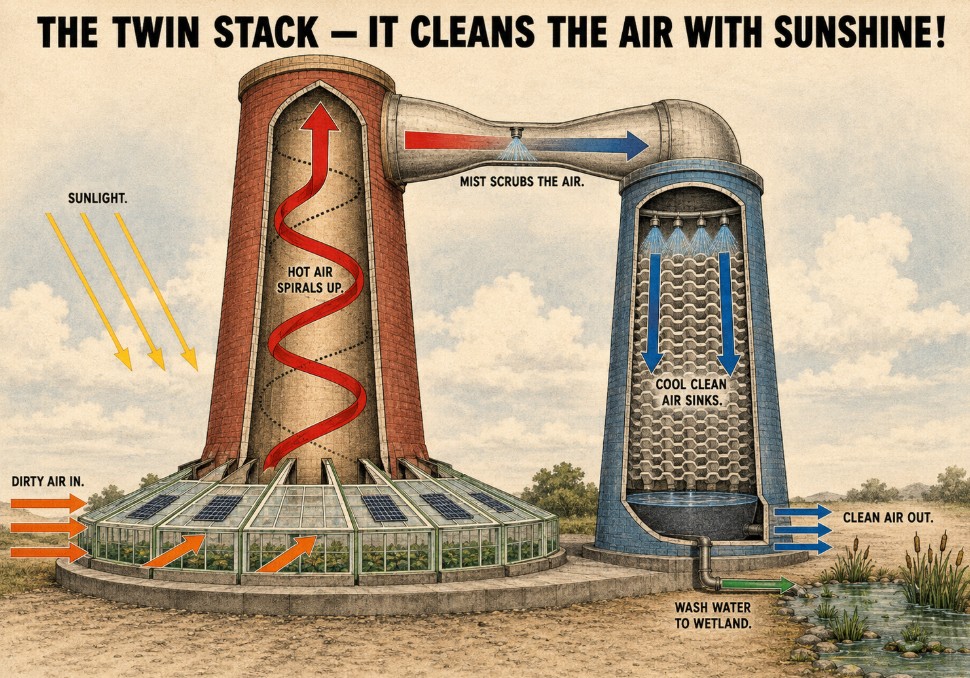
The loop. The Xi’an design is a single column with one driving force. The Twin Stack adds a second column: a downdraft tower descended from the Persian badgir, the evaporatively cooled windcatchers that have conditioned desert buildings for a thousand years. Air enters through greenhouse glazing at the base of the hot tower, spirals upward, crosses over at height, and descends the cooled tower to exit at grade. Heating at the bottom of the up-leg drives air up. Evaporative cooling in the down-leg makes the descending column dense, and its weight becomes push at the base. Both legs pump in the same direction. A solar chimney alone runs on the difference between heated air and the ambient sky; the Twin Stack runs on the difference between its heated column and its chilled one, a spread the operator controls on both ends.
The cleaning stages, none of which wear out. Air enters the hot tower through tangential slots, setting the whole column rotating as it climbs. The rotation slings coarse particles — grit, fly ash, pollen, mineral dust — against the walls, where they settle. This is a cyclone separator built at architectural scale, a century-old technology with no moving parts and no media. At the crossover, the duct necks down and water mist injects into the accelerated flow: a venturi scrubber, the standard industrial weapon against mid-range and fine particulate, placed where the machine’s velocity naturally peaks. The down-tower is packed with commercial cooling-tower fill, the corrugated high-surface structures that industry has refined for decades, kept wet by an electrostatically charged spray. Charged droplets scavenge submicron particles at high efficiency for a power cost of watts, supplied by photovoltaic panels on the greenhouse roof. The same wetted fill chills the descending air and keeps the engine turning.
Every surface washes itself continuously by operating. There are no filter banks to load up, choke the draft, and demand replacement. The entire particulate harvest flushes to a sump at the base of the down-tower, and the sump feeds a constructed wetland cell that treats the wash water with plants, gravel, and microbial communities before reuse. The wetland is part of the machine. Air cleaning and water cleaning close into one loop.
The seasons. Winter fattens the thermal draft precisely when valley inversions trap the worst air, and the down-leg can run dry through deep cold, with coarse capture continuing and the scrub stages resting. Summer humidity thins the evaporative advantage in Appalachian climates while desert and high-plains sites keep the full spread. The machine has strong seasons and adequate ones, and its strong season is smog season.
Intervene: Siting as the Design Decision
The structure is general. The siting is everything. Four placements define the intended use:
Mine lands and tailings. Active portals, ventilation exhausts, dry tailings fields, and culm banks generate concentrated dust plumes over long lives. A Twin Stack at the property line intercepts the plume at its densest, and the sump-to-wetland loop pairs naturally with the water treatment such sites already owe their watersheds.
Heavy industry, where the overhaul earns its keep. Any facility that needs air scrubbing is also, almost by definition, a facility that throws away heat. Furnace exhaust, compressor houses, kiln shells, and process cooling all reject thermal energy that currently buys nothing. Duct that waste heat into the base of the up-tower and it replaces or multiplies the solar greenhouse, driving the draft around the clock, through the night, through December, independent of weather. The polluting facility powers its own remediation with energy it was discarding. For an operator facing fence-line monitoring or community pressure, this is scrubbing capacity purchased with heat already paid for, running on a structure with no consumable filters and a maintenance schedule measured in years.
Traffic corridors. Highway trenches, interchange bowls, and urban street canyons channel exhaust into linear concentrations beside homes and schools. Towers sited along these corridors work the air people actually breathe at the hours they breathe it.
Inversion valleys. River-valley towns across coal and steel country sit under seasonal temperature inversions that seal pollution in like a lid on a pot. A stack tall enough to punch through the inversion layer does something no ground-level intervention can: it moves air across the boundary that created the problem, manufacturing a column of circulation inside an atmosphere trying to hold still.
What We Are Releasing
This paper, the design logic, the stage sequence, and the siting framework are released without restriction, in the same spirit as the rest of the Bright Meadow catalog: publish the intention, let anyone execute, reward the builders with a head start. The component technologies — cyclonic separation, venturi and charged-spray scrubbing, cooling-tower fill, solar chimneys, evaporative downdraft, constructed wetlands — are individually proven, mostly unpatentable, and cheap relative to the mechanical scrubbing they displace. The synthesis is the contribution, and the synthesis is now public.
What remains is the work honest engineering always demands: computational fluid modeling of the loop, freeze-protection detailing for cold-climate sump water, capture-efficiency measurement by particle class, and a pilot at a real fence line with real monitors upwind and down. The Bright Meadow Group invites correspondence from anyone positioned to carry any piece of it — a mining operator with a dusty portal, a municipality with a trenched highway, a university lab with an aerosol chamber, a manufacturer with heat going up a stack for free.
The Xi’an tower proved the sky can be farmed. The overhaul is to stop farming it in the middle of nowhere in particular, and to plant the machine where the harvest is.