An Accounting
A body is found early in the morning. By the middle of the afternoon there is a statement, and by evening the statement has hardened into the account, and the account becomes the thing that sits in the archive fifty years on, when somebody goes looking to understand what happened in this county in this year. The whole passage takes a day. Sometimes it takes eight hours.
I want to talk about that day, because I think that is where the trouble lives.
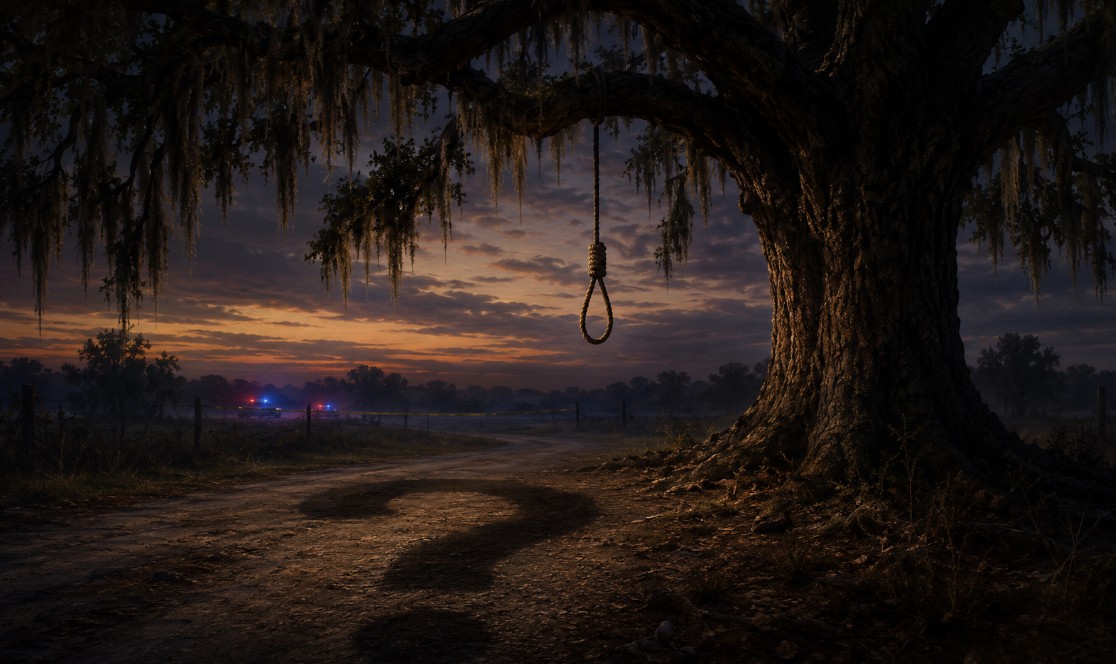
When a Black man is found hanging from a tree in this country and the matter is settled with the word suicide, I have not been able to arrive at belief. I want to be careful about what I am saying, because the careless version of this sentence has done real harm. I am not claiming to know what happened. I do not know who was present, or what the hours before that morning held, or what a man was carrying that his family may not have seen. Those questions belong to investigators and to the people who loved him, and I have no use for the spectacle in which strangers take a dead man’s life apart online, looking for the piece that fits the theory they arrived with. A grieving household is not a public exhibit, and the people making it one are not helping.
What I decline to do is put down what I know about this country because a determination has been announced.
The Marshall Project reported last November that at least nine Black men have been found hanging from trees in Mississippi since 2000, cases that have been treated, one after another, as self-inflicted. yahoo
Every one of those findings may be sound. I would be glad if that were so. My difficulty is with the request being made of me, which is that I receive a conclusion without the reasoning that produced it and consider the matter finished.
Here is where I part company with people who share most of my politics.
We are supposed to be the ones who distrust concentrated authority. We say the state carries the burden when it wants a man’s land, his money, or his liberty. Madison built the framework on the assumption that officials would be about as reliable as the rest of us and would need checking. Jefferson believed a citizen could be trusted with the country only if he could see what the country was doing in his name. The jury is itself an audit, twelve neighbors set between the government and its own confidence.
That inheritance sits poorly beside the habit of accepting a death ruling delivered from a podium the same afternoon.
If a man is suspicious of the government when it comes to inspect his property, some share of that suspicion belongs at the courthouse when a file gets closed.
Consider it as a design question, which is the only way I know to consider anything.
Every system has a default, which is the path taken when no one is pushing. In a sheriff’s office with a thin budget and a short bench, the default in an ambiguous death is the early determination, because it costs the least and satisfies the largest number of people in the room. That is not an accusation about anyone’s character. It is an observation about incentives, and incentives will produce what they produce whether or not the people inside them approve.
So the question worth asking is what the guardrails are. The honest answer is that we have not built any.
A death of this kind should set the same sequence in motion each time. The scene preserved and worked as a possible homicide until the physical evidence closes that door. An independent medical review. Notice to an outside civil-rights authority. The ligature examined, the suspension point reconstructed, the timeline built, the phone and the cameras and the last conversations preserved before anyone grows comfortable. And at the end of it, a written accounting of how investigators reached the place they reached, given to the family as a matter of course rather than as a favor.
Consider who that protects.
It protects the department that did the work. As things stand, a thorough investigation and a hurried one leave behind the same public artifact, which is a man in a uniform reading a statement, and a citizen has no way to tell one from the other. A required record gives the diligent sheriff something to point at. It answers the charge of a shortcut with a document, which is a sturdier reply than a denial. It hands a mother a file instead of a reassurance. And it starves the rumor before the rumor gets fed, which matters a great deal in a county where people have to go on living next to each other afterward.
There is a reason this particular manner of death cannot be treated as ordinary, and it is an argument about memory, which conservatives of the older sort understand in their bones.
We are the people who insist that history is not an inconvenience to be set down when it becomes awkward. For generations in this country, a Black body hanging in the open was a message, staged where it would be seen so that the seeing would do the work. Congress amended federal hate-crime law in 2022 to name that form of terror, after better than a century of bills that died in committee.
A nation that has done such a thing gives up the privilege of being surprised that its neighbors remember. We do not get to hand down that history and then ask people to set it aside at the exact hour it becomes relevant.
I have no interest in outrage as a public posture. It runs hot, spreads fast, and leaves the ground worse than it found it. I would rather ask for the thing that would settle the question in either direction.
Show the work. Publish the reasoning. Build the protocol and run it every time, in the cases that trouble no one along with the cases that trouble everyone, because a test administered only in doubt tells you less than half of what you wanted to know.
A government that has done its work with care has an interest in saying so on paper, where the saying will last. The rest of us have an interest in asking. That asking is the ordinary maintenance of a self-governing people, and it is owed in the seasons when we are certain as much as in the ones that keep us up.