I want to say up front that this is not my usual thing.
I write about mugs. I write about scarf weather and the light in the kitchen around four in the afternoon in November. I have a rule about staying out of politics, and I’ve kept it for three years, and I’m about to break it, and I’ve been sitting with that for most of a week.
So. Coffee’s poured. Let me tell you what happened.
The post
Last Tuesday morning I was doing the thing where you scroll before you’re really awake. And a woman named Oksana Shvachka — she designs fiber networks, this is her actual job — posted something that stopped me with the mug halfway up.
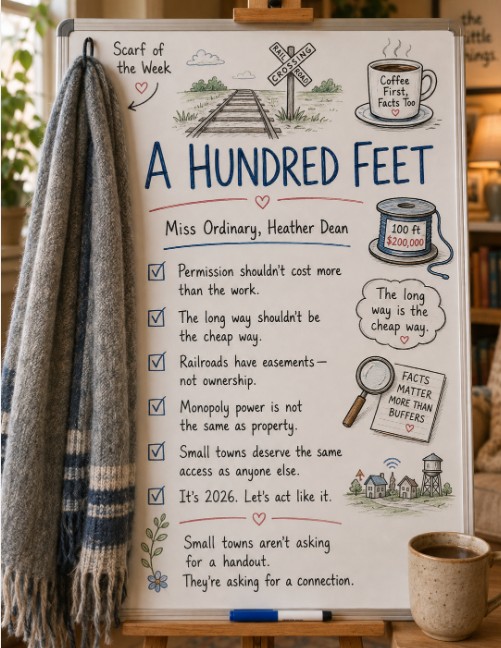
One hundred feet of fiber optic cable. Two hundred thousand dollars.
She said it twice, because she knew nobody would believe it. She hadn’t added a zero.
The hundred feet is where the cable crosses a railroad. That’s the whole thing. Not a mountain, not a river, not some heroic engineering problem. A hundred feet of ordinary ground with train tracks on it, and it costs two hundred thousand dollars to go under, because the railroad has to say yes and the railroad sets the price for saying yes.
And then the part I keep thinking about. She said going a thousand feet around it is cheaper.
Ten times the distance. Less money.
She wrote that the long way is the cheap way, and asked people to read it again, and I did, about six times, standing at the counter with my coffee going cold.
She also said she lived in a small town in Manitoba three years ago where the internet came through a phone line and there was no other option, and that it’s 2026 and the same town has the same problem.
Why I couldn’t put it down
Because I know that family.
Not that specific family. But I know the shape of them. Kid at the kitchen table with a hotspot propped on a cereal box, trying to load a homework portal. Somebody’s mom driving to a parking lot to do a telehealth appointment. Somebody trying to run a little business off a connection that drops every time it rains.
I have complained about buffering. I have said “why don’t they just run the cable” in the same tone I’d use about a pothole.
And it turns out the answer was never that it’s hard. The answer is that somebody has to give permission, and permission costs more than the work.
That’s a fee. That’s just a fee. There’s no cable in that number, no trench, no crew. It’s the cost of being allowed.
Then I did something out of character
I started reading. Which for me usually means recipe blogs, and this time meant court decisions, and I want to be honest that I was in over my head immediately and kept going anyway.
Here’s the first thing I found, and it knocked me sideways.
Earlier this month, a federal appeals court told the railroad CSX that it may not actually own what it’s been charging for.
Most railroads don’t own their land the way you own your yard. They have an easement — permission to use a strip of ground for a specific purpose, which is running trains. And the court said that permission covers the trains. It doesn’t cover the air above the tracks and it doesn’t cover the dirt underneath them. Those still belong to whoever owns the land. The judge wrote it out plainly: the right to license that space stays with the landowner.
So for years, decades, companies have been paying railroads enormous sums for the right to put a cable in ground the railroad may have no claim to.
I sat with that a long time. Somebody’s been paying rent to the wrong person, and the wrong person kept the money, and the people who went without internet went without.
And then I kept going, which was a mistake, or wasn’t
Because once you pull that thread you find out how the railroads got the land in the first place, and it’s us. It’s public land, granted to them in the 1800s, plus the power to take private land by force of law because they were doing a public good. That was the bargain. You get the corridor, you serve the country.
And then I found out what happened to the passenger trains.
I always assumed America just sort of drifted away from trains. Cars got popular, planes got cheap, that’s the story, and it feels true because it’s what everyone says.
The railroads ran the passenger trains themselves until 1971. It was an obligation attached to the deal. And when it stopped making money they wanted out, and getting out required proving to the government that nobody rode the trains — which they could arrange, because they ran the trains. Take out the dining car. Make the schedule worse. Let the station get shabby. Ridership falls. Bring the numbers in as proof the public doesn’t want it.
Amtrak, in 1971, was the exit door. The railroads paid a fee, handed off the equipment, and were released from the obligation forever. Half the routes vanished on the first day.
And they kept the corridors.
Then they pulled up the extra tracks, because track you’re not using is expensive to maintain and gets taxed. My valley’s main line was built four tracks wide. You can see it if you look at how wide the cut through the hillside is compared to how much rail is sitting in it.
Once the extra tracks are gone, passenger service genuinely is impractical. Which they can then tell you, and it’s true, and they made it true.
The part that made me put the laptop down
There’s a law that says Amtrak trains get priority over freight trains. It’s been on the books since 1973.
In fifty-odd years it has been enforced in court exactly twice.
The second time was 2024, when the Justice Department sued Norfolk Southern over a train called the Crescent, which runs from New York to New Orleans. The complaint says the Crescent got shoved into a siding for an hour and eleven minutes to let three freight trains go by. Another day, sidetracked three separate times and lost two hours. It says the freight trains are now so long they don’t fit in the sidings anymore, so the passenger train has to be the one that pulls over.
In 2023, 57 out of every 100 Crescent passengers arrived on time. The standard is 80.
It settled last September. Norfolk Southern agreed to give Amtrak trains top priority and to have a compliance officer certify every year that they’re following the law.
And here’s the number.
Delay minutes on that route dropped by 53 percent between 2024 and 2025.
Cut in half. No new track. No new trains. No new anything. The only thing that changed is that somebody was finally watching.
Which means the room was always there. Every one of those hours, every missed connection, every person who gave up on the train and drove instead — that was a decision somebody made, over and over, for fifty years, because the freight paid better.
Okay. The billionaire part.
I’ve written and deleted this section four times because I don’t want to sound like something I’m not.
The biggest railroad in the western half of this country is owned by Berkshire Hathaway. Which means it’s Warren Buffett’s, more or less — he’s the chairman, Greg Abel runs it day to day now.
And I have always liked Warren Buffett. Genuinely. The house he’s lived in since 1958. The Cherry Coke. He’s giving nearly all of it away. He’s the one they hold up when someone says the rich are all the same — see, here’s a good one.
I still think he’s probably a lovely man. That’s what I can’t get past.
Because he’s told everyone exactly what he does. He looks for businesses with a moat around them. That’s his word, not mine. He says he wants pricing power, meaning the ability to charge more without losing customers, because the customers have nowhere else to go.
He isn’t hiding it. He publishes it once a year and people frame the letters.
So the question stopped being whether he’s good. He might be. The question is what money has to become when there’s that much of it.
Past a certain size, it can’t earn its keep making better things, because there aren’t enough better things to make. It has to buy the places everything passes through. The rail, the wire, the pipe, the hundred feet you have to cross.
And once it owns the crossing, it will charge for the crossing. It will resist anything that lets people go around. Not because the owner is cruel. Because the machine only knows how to keep being large, and a nice man at the top of it doesn’t change what it does at the bottom of it, where a family in a small town is on year eleven of waiting.
That’s what got me. Kindness doesn’t reach down that far. The structure eats it.
There’s no good billionaire, and it has nothing to do with any billionaire’s character. That’s the sad part. That’s the part I’ve been carrying around all week.
What I actually want to say
Some things belong to all of us because all of us need them.
The ground under the tracks. The corridor cut through the mountains by people who died doing it, with land the public handed over on the promise that it would serve the public. The wires. The water. The roads.
We used to know this. We used to build things and hold them in common and think that was normal, and somewhere along the way we got talked into believing that a private owner would run it better, and what we got instead is a hundred feet of dirt priced like a house.
I’m not smart enough to write the policy. I’m a person who writes about scarves.
But I know that a thousand feet around being cheaper than a hundred feet across is a sign that something is broken in a way that’s costing real people real years of their lives. And I know that the fix isn’t a nicer owner.
One small thing, since I hate ending on heavy
Right now Union Pacific and Norfolk Southern are trying to merge — an $85 billion deal that would take six big railroads down to five and make the first coast-to-coast freight network in the country’s history.
The public comment period is open until November 18. It’s docket FD 36873 at the Surface Transportation Board, and they’re holding at least twelve in-person public meetings.
Anyone can write in. You don’t have to be an expert. You can just be someone who waited eleven years for internet, or sat on a train outside Altoona watching a coal train go by, or read a post about a hundred feet of fiber and couldn’t stop thinking about it.
I’m going to write one. It’ll probably be bad. I’m going to send it anyway.
Thanks for letting me be off-lane this week. Normal service resumes Friday, and I have a scarf update that’s genuinely delightful.
Small joys are still big deals. It’s just that some days you find out why the small joys are so hard to come by for people who deserve them exactly as much as you do.
Stay kind. Stay caffeinated. And find out who owns the ground under you.
— Miss Dean if you know what I mean.