Man Made: Chrome, Checkerboard, and the Car
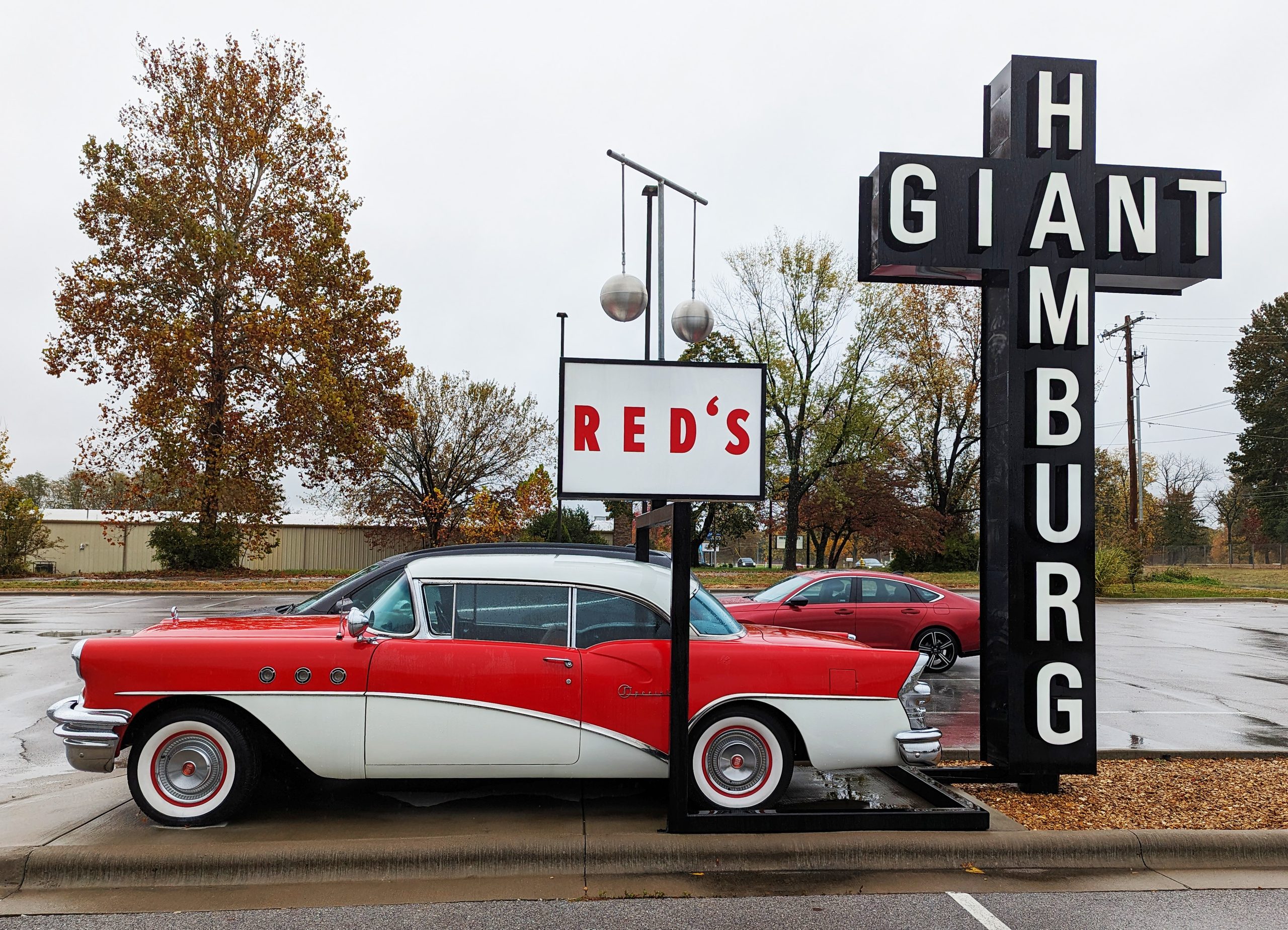
The sign is shaped like a cross because of arithmetic. Sheldon “Red” Chaney meant to letter it HAMBURGER, laid out his verticals, and discovered that the last two characters would have put the top of the pole into the power lines running along Route 66. So he cut it to HAMBURG, hung GIANT across the horizontal, and accidentally built one of the better pieces of vernacular signage in the American Midwest. The crossbar reads left to right. The staff reads top to bottom. Your eye has to make a turn to finish the phrase, which means you look at it a half-second longer than you look at a rectangle, which is the entire job of a roadside sign. Chaney was a burger cook working with a tape measure and a constraint. He solved it the way a designer solves it, by letting the constraint do the composing.
The car at the base of the pole is a 1955 Buick Special, and it is there for a reason older than nostalgia. Chaney parked his own Buick in that spot to keep customers from reversing into the signpost — a bollard with a hood ornament. The Special was Buick’s entry series that year, the Series 40, riding a 122-inch wheelbase and stretching about 206 inches nose to tail, which made the cheap Buick roughly the size of a picnic table. Under the hood sat the 264-cubic-inch Fireball V8, the small version of the engine everyone calls the nailhead for its narrow vertical valves, rated at 188 horsepower when ordered with the variable-pitch Dynaflow automatic. The three portholes on the front fender are rank insignia: three for a Special or a Century, four for a Super or a Roadmaster, so a man could read your standing in the world from the next lane over. The chrome band running the length of the body is Buick’s sweepspear, and it does the thing that makes 1950s two-tone paint work — it dips toward the rocker behind the front wheel, then sweeps back up over the rear fender, so the red and the white are divided by a line that moves. Paint the same car in one color and it goes slab-sided and dull. The wraparound windshield with its dogleg pillar, the wide whitewalls, the red-painted wheels behind chrome covers: 1955 was the year Buick sold enough of these to pass Plymouth for third place in the country, and the reason is sitting right there at the curb in a wet parking lot in Springfield. It is a big honest shape with jewelry on it.
Inside, the design logic holds. Checkerboard tile on the floor, vinyl booths in colors that would look at home on a Jetsons production cel, chrome-edged tables, and a letterboard menu over the pass. Every one of those choices started as a maintenance decision. Checkerboard vinyl composition tile hides scuff and grease and can be replaced a square at a time. Vinyl upholstery wipes down. Stainless and chrome take a rag and a spray bottle and come back looking new. Porcelain enamel panels shrug off a decade of hot fry oil in the air. The mid-century diner is a room engineered to be cleaned fast by a tired person at eleven at night, and the aesthetic we now buy reproductions of is what industrial hygiene looked like when someone bothered to make it cheerful.
The letterboard deserves its own attention, because it is the last piece of hand-set typography most Americans encounter. Black felt, aluminum channels, a shoebox of white plastic characters in a drawer under the register. Prices change when the beef invoice changes, and they change in about four minutes. The kerning is uneven. Somebody ran out of capital S and used a 5. That imperfection is doing real work — it tells you a person stood on a stepstool this morning and decided what today costs. A backlit menu board printed at a sign shop in another state says the opposite. One of these rooms is being run by someone in it.
There is a term from ecology that fits better than “third place.” An ecotone is the transition zone where two systems meet — the brushy margin between forest and field — and it reliably supports more species than either system it borders. The diner is an ecotone. It sits on the seam between the road and the town, and it holds a mix you find in neither one: the trucker and the church group, the second-shift crew coming off at eleven, the kid who has been nursing a Coke for an hour because there is nowhere else to be, the couple who has eaten in the same booth since 1974. The counter seating is the mechanism. A booth is a private room with the door taken off. A counter puts strangers shoulder to shoulder facing the same direction with a cook in front of them, which is the oldest social geometry we have. Add drive-in speakers on the wall playing doo-wop — Red’s ran actual salvaged units — and you have a room that gives people permission to stay.
The food is exactly the food you want it to be. Burgers, fries, onion rings, Texas-style chili with no beans in it, malts and shakes, and a local root beer poured into a cold glass. Red’s built a reputation partly on a running gag about magnets improving the flavor of the beef, which tells you the operation understood that a burger stand is a performance as much as a kitchen. There is a discipline in refusing to be clever with the menu. The room is doing the work. The food’s job is to be good, hot, and the thing you drove there for.
The revival that this photograph shows opened in 2019 at eight times the footprint of the original, with a replica sign, a drive-thru window, and this Buick out front. It got about one year before 2020 closed the dining rooms, and it did not fully recover. It served its last plate on May 14, 2025, and went to auction the following morning in three lots. The building and contents brought $575,000. The Buick brought $15,700. The replica sign brought $850, to a man in Nixa.
Sold as separate lots, the room stops being a room and becomes inventory — a car here, a sign there, a stack of vinyl booths somewhere else. The design language of this building was open-source from the start: enameled steel, checkerboard tile, hand-set letters, chrome trim, a big shape with jewelry on it, and a parking-lot geometry that turns a curb into a place people linger. That vocabulary is available to anybody with a lease and a tape measure, the same way it was available to a burger cook in 1947 who ran out of room for two letters and built a landmark.
Sources
- Springfield Business Journal, “Red’s Giant Hamburg auction draws top bid of $575K,” May 16, 2025
- Springfield Daily Citizen, “With financial woes, Red’s Giant Hamburg goes to auction May 15,” April 2025
- Route 66 News, “Red’s Giant Hamburg sold for $575,000 at auction,” May 19, 2025
- Route 66 Road Map, “Red’s Giant Hamburg in Springfield, Missouri”
- 417 Magazine, “Check Out Red’s Giant Hamburg Along Historic Route 66,” 2020
- Over-Drive Magazine, “1955 Buick Fact Sheet”
- Conceptcarz, “1955 Buick Special Series 40”
- Curbside Classic, “1955 Buick Century Riviera Hardtop”