River Refugium Project — Design Notes
The River Refugium Project has a stage in it that people consistently misread. They look at the biofiltration train, see tanks with media and aeration, and file it under filtration. Then they ask the reasonable engineering question: how do we make it smaller?
That question is the failure mode. Everything below is an argument for why.
What the hobby taught me
I keep aquariums. I like large tanks, large tanks get expensive, and being who I am, I responded to the expense by doing a deep dive on what every piece of equipment was actually for. I also read a stack of old books on fish keeping — the kind written before the hobby had a supply chain.
What I found was that fish keeping has been commoditized down to a product. You buy a mechanical filter. You change the carbon on a schedule. When your fish die anyway, you buy a better filter. The industry sells you a machine that removes things from water, and it works well enough to keep the machine selling.
The old books weren’t describing a machine. They were describing a system that had to be established, that took time to mature, and that would then hold itself stable. Somewhere between those books and the shelf at the pet store, the living part got engineered out and replaced with a cartridge.
It’s better now than it was. Newcomers to the hobby generally know that a tank has to cycle and that bacteria do the work. But the money still flows toward equipment that filters water rather than toward conditions that process it, and most tanks are still built around a toy rather than a habitat.
I went through the standard progression. Hang-on-back. Deep gravel beds. Pump and canister systems. Each one worked better than the last, and each one failed in a way that pointed at the next.
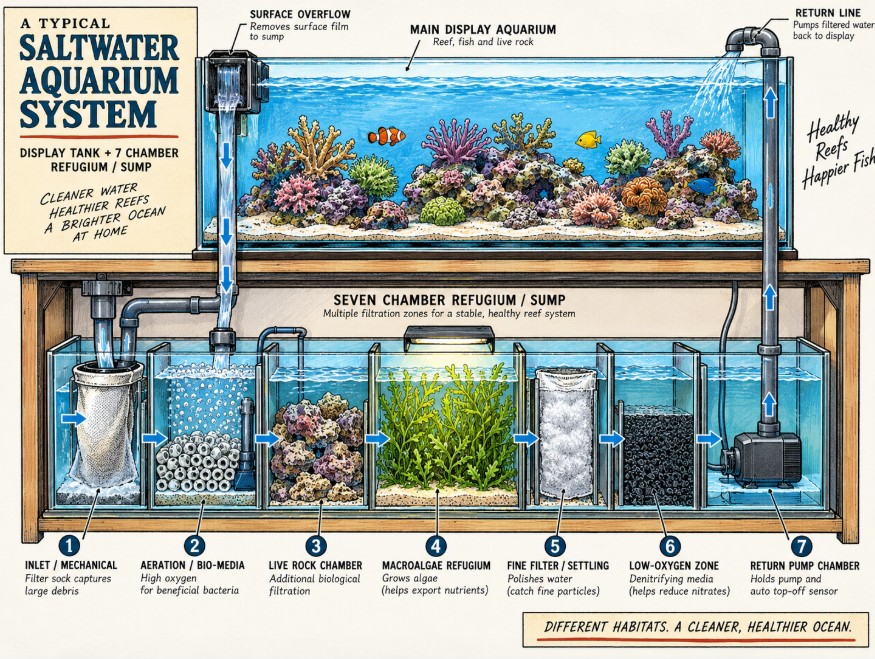
Then I started looking at what the saltwater people build. Reef keepers construct genuinely wild contraptions — sumps, chambers, macroalgae beds, live rock, a whole parallel ecosystem plumbed under the display tank. They call one of those chambers a refugium. I have never kept saltwater fish and have no real ambition to. But I took the word, because the idea behind it was the thing I’d been circling.
Sitting with the canister design and the reef contraptions at the same time, it clicked into three variables.
Surface area for bacteria. Plenty of nutrient. As much gas exchange as you can force through aeration and collision.
That’s it. That’s the whole mechanism. Those designs took much longer to start to smell and much longer to need a water change, and the reason is that the biology was completing its work instead of stalling partway through.
Smell is the diagnostic. A system that smells is a system where something is being produced faster than anything present can consume it. A system that smells clean is one where every waste stream has an organism waiting on it. You can measure a tank six ways and the nose will still tell you first.
Once I found aquaponics, I stopped cleaning my aquariums for water quality reasons entirely. I clean them now because I want them to look nice.
The seven-layer forest, underwater
Permaculture people talk about the seven-layer forest — canopy, understory, shrub, herbaceous, ground cover, root, vine. The point is that a mature forest fills every vertical niche, and that filling them is what makes it productive and stable rather than merely green.
Bacteria have a seven-layer forest too.
Nitrifiers need oxygen and surface. Denitrifiers need the opposite. Heterotrophs breaking down organic solids want different conditions again. There are organisms working on sulfur, on iron, on phosphorus, on compounds nobody in the room has thought about. Every one of them has a niche defined by oxygen tension, surface texture, flow rate, and what’s coming down the pipe.
Every treatment system I have looked at picks its favorite and ignores the rest.
That’s what a compact filter is: a decision to optimize one process at high throughput per unit volume, and to control every other condition out of existence. It’s an efficiency logic, and it’s genuinely efficient at the thing it selected. It’s also why those systems are brittle, why they need constant intervention, and why the water coming out is clean by a narrow definition and not by the nose.
The refugium runs the other way. Build the range of conditions. Make the ideal habitat for the organisms you know you want, then leave room — deliberate, wasteful-looking room — for the ones you haven’t identified. Accept lower throughput per unit volume in exchange for range of function and stability.
My own tanks are more complex than they need to be, because I’m always testing something. But the complexity is intentional: I’m creating as much varied bacterial habitat as I can fit, because I want every waste stream processed. I want the tank to smell good.
The same logic runs the plant side. I don’t choose plants because they grow well. I choose them for the nutrient or pollution problem in that particular water. That’s why the RRP carries a bioaccumulator species matrix instead of a crop list. Uptake is guild selection, same as the bacterial side, and the appendix exists because the selection has to be made against the water you actually have.
Why the RRP designs look simple
The four-barrel configurations in the RRP documentation are deliberately plain. So is the Tier-0 pond-and-compost version. That simplicity is a teaching decision, not a design ceiling.
There is enormous room for refinement in the refugium stage. Media geometry, flow paths, aeration strategy, staging, the ratio of aerobic to anaerobic volume — all of it is open, and a skilled operator who starts playing will find real improvements.
That same operator will also kill systems finding them. I have killed my share. Over-aeration is cheap insurance precisely because colony collapse is not — the cost is wildly asymmetric, and the failure arrives faster than the recovery.
So the published configurations are the version that works while you learn what you’re looking at. Run them as specified, get your baseline, then start varying one thing at a time with an A/B against a system you haven’t touched.
The mistake I expect
Here is what I think a competent operator gets wrong, and it isn’t from carelessness.
They build it. It works. Then something underperforms — a bed that doesn’t clear, a nitrate number that sits higher than they’d like, a house that lags. They diagnose it as a single-process problem, because that’s what their training does with an underperforming unit. They narrow the conditions to fix the one process.
It works. The number improves.
Then something else underperforms, and they do it again.
Nobody decides to abandon the refugium concept. It gets engineered out by increments, each one locally correct, until what’s left is a compact filter with good numbers on the parameters someone chose to watch and a bad smell nobody put in the report.
If you take one thing from these notes: varied processing is the design, not a byproduct of it. The empty niches are load-bearing. When you narrow conditions to optimize a process, you are removing habitat, and you will not find out what lived there until the water tells you.
Watch the whole system. Trust your nose. Build the forest, not the filter.
Here is the current documentation for the River Refugium Project that has grown from my work.
Documents
RRP0003 — Consolidated Technical Whitepaper, Version 3.0
RRP0003-apA — Site Selection Matrix
RRP0003-apB — National Watershed Priority Map
RRP0003-apC — Initial Recommended Sites
RRP0003-apD — Master Glossary
RRP0003-apE — Field Documentation Kit