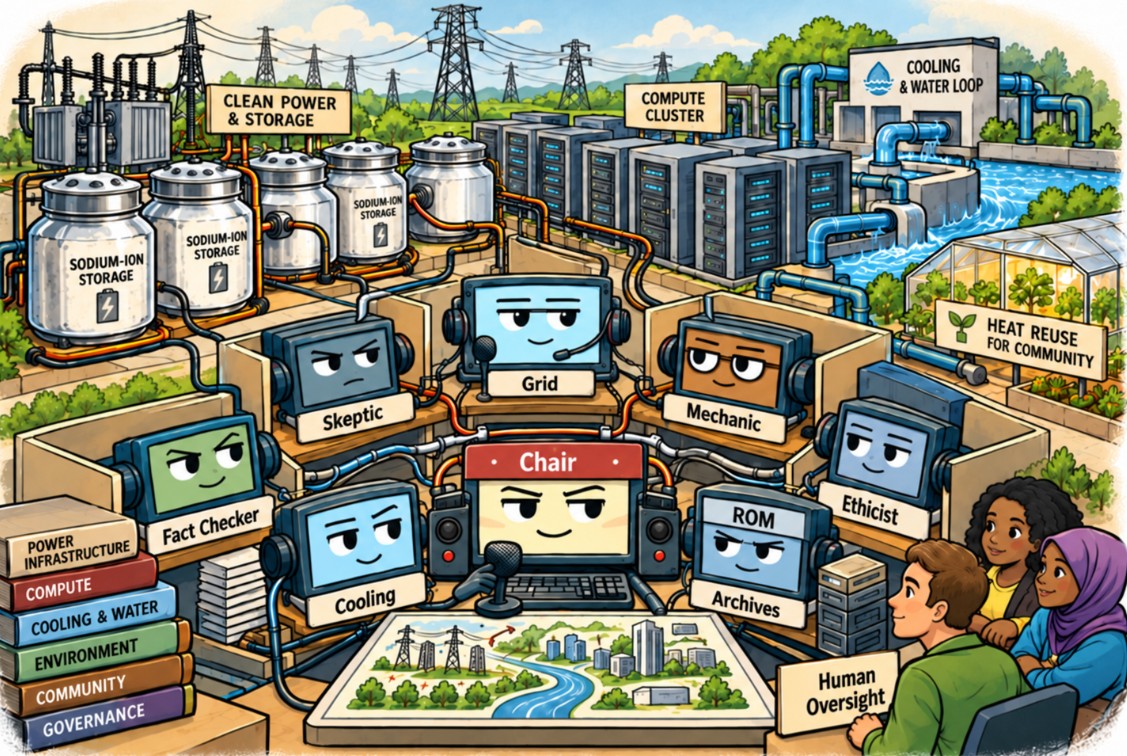
One corpus, read as a single design: how machines should think, where they should live, and who should own them
Over the past ten months this site has published a long run of pieces on machine reasoning, data centers, cooling, power and public ownership. They went out one at a time, under several bylines, between architecture features and labor history. Read together they make one argument, and this piece gathers them in order so the argument can be read whole.
The argument has three layers:
- a theory of how reasoning improves;
- a machine architecture that applies the theory;
- a physical infrastructure that applies the same principles to buildings, water, power and ownership, with a smaller ecological footprint as the result.
The layers share a backbone. Build from uneven parts. Force ideas and resources across boundaries. Watch the crossings. Publish the numbers.
Each idea links to the article where it first appeared.
Part One: The Theory
Thought lives at the edges
Edge Thinking: The Missing Operating Theory of Artificial Intelligence started from permaculture. A landscape’s productivity concentrates where unlike systems meet: forest and field, land and water, warm and cold. The piece proposed that intelligence follows the same pattern, and stated it as a hypothesis: intelligence quality scales with the density and quality of controlled transitions inside a system.
A transition is any point where an idea has to:
- change representation,
- survive compression,
- cross a bandwidth limit,
- move between precision regimes,
- endure disagreement, or
- justify its energy cost.
Weak ideas die at those crossings, and strong ones generalize.
The industry built its systems the other way, around uniform processors, uniform precision, uniform clocks and minimal friction. That buys speed. It also lets a bad idea travel through the system as efficiently as a good one, because nothing in a uniform pipeline changes shape enough to break a fragile claim.
Constraint is the engine
Constraint Is the Engine took the edge idea into practice. People improve an idea by forcing it through translations: intuition into language, a rough notion into formal reasoning, confidence into justification, one perspective into another that doesn’t share its assumptions. Writers who switch roles between editor, skeptic and reviewer are running review passes. Each role limits what can be claimed, how confidently, and what counts as evidence.
A large model speaks from one continuous authority. Nothing inside it disagrees hard enough to interrupt a weak thought, so approximation passes for knowledge. The piece names four monitoring signals an edge-based system produces naturally:
- disagreement between subsystems;
- collapse under higher precision;
- failure to compress meaningfully;
- energy spikes with no gain in accuracy.
Research outside this corpus lands close to the same place. A 2025 analysis of why language models hallucinate found that training and evaluation reward a confident guess over an admitted “I don’t know,” much as a multiple-choice test rewards guessing. A system scored only on its final output has no reason to learn hesitation. Gaps in data contribute too. Architecture is the lever this corpus pulls on.
Friction produces understanding
Designing for Reasoning, Part I: Why Friction Matters described how people actually reason when they’re thinking honestly. They hold competing explanations, test a position, feel it wobble, shift, return and refine. The discomfort of an almost-fit is the signal that more work is due.
Modern systems are trained toward fluency and internal coherence, which treats ambiguity as failure. The piece reframes much of what we call hallucination as premature convergence: the system settles before competing readings have been explored, the way a person speaks confidently before finishing the thought. Its thesis compresses to one line: efficiency produces answers, and friction produces understanding.
Orchestrated friction
Orchestrated Friction clarified the mechanism. Humans look like efficient learners from few examples, but that’s partly a measurement problem. From before birth onward a person takes in continuous, multimodal, socially corrected input that nobody counts.
The real difference sits around extrapolation. Both people and models extrapolate. A person then meets resistance (contradiction, uncertainty, memory conflict, social risk, recursive review) before speaking. A model usually goes straight from inference to output.
Orchestrated friction is the deliberate or emergent resistance that makes a system review its own conclusions before committing to them. It does four jobs:
- detects errors,
- calibrates confidence,
- refines the model,
- improves learning efficiency.
The piece closes on the observation that people are effective because they hesitate.
Part Two: The Reasoning Architecture
A council, and a noisy line between its members
Designing for Reasoning, Part II: An Open Experiment in Deliberate Friction turned the theory into a test.
The setup:
- A Chair agent answers questions after consulting three to five Council Members.
- Each member has a defined role: skeptic, mechanic, fact-checker, alternative framing.
- The council runs in three conditions: solo with no council, a text-only council, and a council linked by analog audio (text to speech, through the air, to a microphone, back to text). The analog link adds delay, loss and mishearing on purpose.
The four hypotheses:
- H1: the council beats the solo system on reasoning-heavy tasks.
- H2: the imperfect analog channel beats clean text.
- H3: councils show better calibration, meaning fewer confident errors.
- H4: quality rises at a cost in time and compute, with higher decision value per answer.
Outputs are graded blind on accuracy, reasoning quality, calibration and robustness. Configurations, prompts and logs are published.
Outside this corpus, a 2023 study of multi-agent debate found that several model instances proposing and critiquing each other’s answers improved factual accuracy and mathematical reasoning over a single instance. That is independent support for H1. H2, the deliberately noisy channel, remains the open and more original claim.
A memory that refuses to change
Designing for Reasoning, Part III: Anchoring Intelligence added a read-only knowledge layer, the ROM. It holds what is stable, not meaningfully debatable, and catastrophic if hallucinated: unit conversions, physical constants with pinned editions, mathematical identities, engineering tables. The ROM doesn’t reason, interpret or argue. It answers lookups with versioned, hash-stable facts.
The worked example puts a council to work on the kinetic energy of a 1,200-kilogram satellite breaking up at low-Earth-orbit velocity:
- The Chair (CTRL_CORE) decomposes the task.
- ALU_FAST sketches rough estimates.
- FPU_STRICT identifies the exact equations.
- MMU_CHECK refuses to proceed without verified constants and requests the ROM.
- BRANCH_SKEPTIC challenges the framing.
- Once ROM_BASE returns formulas and constants, sloppy estimates collapse, recalculations tighten, and unsupported assumptions drop out.
The Chair writes only after that, with confidence it has earned.
The rules are strict:
- Lookup is mandatory for checkable claims.
- A failed lookup forces a downgrade or a rejection.
- Retrieval stays separate from explanation.
- The ROM is consulted before synthesis.
Outside this corpus, retrieval-augmented generation already grounds model outputs in an external store. The ROM proposal is stricter: it’s mandatory, deterministic and versioned, and it is barred from interpretation. It localizes disagreement to the claims that are open to it.
Uneven parts by design
Edge Thinking specified the hardware philosophy beneath the council. A reasoning system should combine:
- fast, low-precision processors for speculation and association;
- slow, high-precision processors for verification;
- stochastic units to escape local minima;
- sparse, event-driven units for salience;
- narrow serial pathways that force abstraction;
- high-bandwidth vector units for dense pattern work.
Five operating rules follow:
- Bottlenecks: require summaries at each handoff, because what survives compression is the thought.
- Precision migration: ideas begin in low precision and are forced upward. One that collapses under higher precision was only approximate confidence.
- Energy is attention: scarcity enforces conservatism, abundance permits exploration, throttling forces priority.
- Asynchronous clocks: cheap processes stay on and expensive ones run rarely, which gives the system background thought without continuous heavy computation.
- Supervision: a supervisory layer watches disagreement, failure patterns, and confidence against correctness, then learns which transition paths pay off.
Precision migration and the ROM cover different failures and work as a pair. Migration catches numerical approximation. The ROM catches false facts that would survive any amount of precision.
The piece also says how to test the whole idea today. Hold the model weights constant and change only the plumbing:
- Vary: transition frequency, bottleneck severity, precision thresholds, noise injection, arbitration rules.
- Measure: calibration, robustness, creative accuracy, failure predictability, and insight per unit of compute.
More meaning per switch
Multi-Dimensional Signal Computing carried the edge idea down to the physics of computation. Binary switching stays as the reliability layer: control flow, addressing, arithmetic. Meaning moves into structured signals that vary along several axes at once, such as amplitude, frequency, phase, polarization and spin.
A state becomes a point in a multi-axis space instead of a 0 or a 1. Blended states can carry graded truth, partial membership and uncertainty natively. That suits the tasks the reasoning architecture leans on hardest: inference, optimization, classification and constraint satisfaction.
Outside this corpus, the industry already uses partial versions of this. High-speed data links send four voltage levels per symbol (PAM4). Flash memory stores three or four bits per cell. Analog in-memory accelerators compute with continuous conductance values. Claude Shannon’s 1948 work sets the ceiling: the number of distinguishable states along an axis is bounded by its signal-to-noise ratio, so capacity grows with the logarithm of that ratio. The gain per axis is real and finite, which matches the paper’s own list of engineering challenges.
The paper’s energy argument (fewer toggles per unit of meaning, parallelism carried inside the signal instead of in more wires) is where it joins the footprint question.
From one mind to a population
The Wrong Clean Compute scaled the council into an ecosystem. Take two systems built separately, on different data with different architectures. Feed both a continuous stream of new information, and on a schedule make them reconcile their accounts: state what each holds, locate where they diverge, and record the divergence. Reconciliation pulls them together, and new data keeps generating fresh disagreement faster than reconciliation resolves it. Then do it with a thousand systems.
Topology. The network’s shape is the design. Each node connects to only a fraction of the others, and any two nodes are separated by at least two intermediaries. Each intermediary ingests a claim and re-emits it in its own terms, the way a fungal network metabolizes what passes between trees instead of relaying it. A claim reaching a distant node has been restated twice in foreign representations, so the path itself is the review pass.
Variety. Make the systems as different as possible while keeping them able to work together. The axes include architecture, training data, language, formalism (prose, logic, code, probabilistic graphs), timescale, and position in the data stream. Data entering at particular points and propagating outward gives each node a durable, self-renewing difference in what it sees.
Throughput versus uptake. Data moving through the network is the carrier, and what a node integrates is the payload. Past a certain volume, information washes through faster than any node can take it up. Uptake needs residence time, which is a second reason for the two-hop rule. The piece leaves one question open: what plays the role of soil, holding material between cycles and releasing it slowly?
The product. Reconciliation produces a disagreement log. Its entries sort into errors in one system, genuine underdetermination, and something new. A flag marks a location and gives no verdict, so a flag has to open an investigation instead of being suppressed.
The health metric. Track the rate of novel disagreement per unit of incoming data. If data keeps flowing while novel disagreement falls, the population has converged on itself instead of on the world. Track alongside it the fraction of flags that get investigated, as opposed to auto-resolved by majority vote.
Keeping the books
Aggregated Knowledge pointed the population at its highest-value job: reconciling the written record of science against itself. Humans generate ideas, anomalies and new measurements, and the machine keeps the books.
Four design rules separate a working reconciler from a confident fabricator:
- The residual pile is the product. Any flattening forces pieces. Log each one and hand the residuals back to people, the way Kepler’s eight arcminutes of Mars error produced the ellipse.
- Residual shape is a diagnostic. Randomly scattered residuals are noise. Residuals clustered by instrument, laboratory, decade or funder point to systematic bias.
- Underdetermination is held. Where the evidence can’t decide, the output is both accounts plus the measurement that would separate them.
- Plurality over canon. Several reconcilers, built independently and fully open, turn their disagreement into a measurement.
The deepest defect in the record is the measurement nobody published. The repair is hashed, timestamped pre-registration: twenty registrations against three publications shows the shape of the seventeen missing results.
Part Three: The Bridge
This section is an editorial synthesis. The corpus supplies each half, and the mapping lines them up.
The architecture in Part Two and the infrastructure in the sections below follow one rule set:
| Reasoning principle | Infrastructure expression |
|---|---|
| Uneven components, forced to interact | Compute nodes of different sizes, climates and energy sources, linked by fiber |
| Two-hop indirection and position in the stream | A geographically distributed network where each region’s node is fed different local data |
| Energy is attention: throttle with scarcity | Compute follows energy, runs on stranded surplus, and sheds load at grid peaks |
| Asynchronous clocks: cheap always on, expensive rarely | Inference everywhere at small nodes; heavy training concentrated and scheduled |
| ROM: fixed, versioned, grounded | Sovereign civic archives and auditable records on public hardware |
| Supervisory monitoring | Public reporting of water, power and heat, plus physical clearance protocols |
A smaller ecological footprint follows from building the infrastructure the way the reasoning should work: distributed, heterogeneous, energy-aware and watched.
Part Four: Where the Machines Live
Distributed Intelligence Infrastructure diagnosed the hyperscale campus. Concentrating hundreds of megawatts on one site produces evaporative water draw, heat rejected to the sky, grid shock, political backlash, and a concentration of informational power. These are architectural consequences of concentration, not moral failures.
The alternative is a network of 1 to 10 megawatt nodes that are distributed, grid-integrated, heat-recovering and locally accountable.
What the nodes do:
- inference hubs;
- municipal compute;
- research acceleration;
- regional data vaults.
Large training clusters can stay centralized while fine-tuning, inference, municipal modeling, education and industrial optimization spread out.
Where they go. Small nodes need few staff and no adjacent population center, so they can sit where power is cheapest or stranded. They also fit into existing buildings: vacant offices, retail anchors, warehouses, and municipal buildings that already have floor load, power and fiber.
Why it’s sturdier. A network of thousands of nodes has no single point of failure.
The node pays its way in a place before anyone builds it. A Different Way to Think About Data Centers proposed that Johnstown and Cambria County own one outright. The model:
- county and municipal founding stakes;
- professional technical operation;
- excess capacity leased out;
- compute allocated to universities, workforce training, civic archives and regional modeling.
Owning a node turns a black box into a knowledge utility.
Part Five: Heat and Water
Name the real problems
The AI Water Panic Is Misplaced narrowed the public fight to three issues:
- local infrastructure strain, which is a question of delivery capacity and timing;
- cooling tower blowdown that small sewer systems weren’t built to take;
- cost allocation, where residents fund upgrades for private gain.
The fix it named: developers pay for the full infrastructure upgrade before operations begin.
On consumption, the corpus refined itself. Data Centers and Water treats evaporative cooling as real consumption, matching how hydrologists define consumptive use: water that leaves the local basin, even though it rejoins the global cycle. It also calls heat what it is, an externality dumped on the public when the operator doesn’t pay to handle it.
That piece set a baseline for any facility large enough to stress a town:
- closed-loop cooling by default;
- waste heat recovered for community use;
- upgrades funded up front;
- transparent metrics;
- a no-net-harm standard.
The Containment Standard
Data Center Problems, or Public Ones? reduced the policy to one line: a facility shall contain the environmental and infrastructure costs of its own operation to the greatest technically practical extent.
Regulation draws the boundary and engineering solves inside it. The zoning office states results, such as “no harmful permanent draw on local potable water,” and leaves the design to engineers.
The standard set for large compute facilities:
- no harmful net impact on municipal potable water capacity;
- no uncompensated public electrical expansion;
- facility-scale monitoring with public reporting;
- closed or highly recirculating cooling unless an alternative proves equal or lower ecological impact;
- continuous emissions monitoring of on-site generation;
- developer-funded infrastructure;
- emergency shutdown, containment and islanding standards;
- periodic independent inspection.
Cooling designs, from the rack outward
The corpus works the cooling problem at four scales.
The rack. Cooling Server Cabinets With Gravity rebuilds the cabinet around its permanent occupant.
- The hottest GPU and CPU servers move to the bottom, under the tallest warm column.
- Each cabinet exhausts into a sealed chimney.
- Indoor windcatcher towers, modeled on the badgir of Yazd, catch conditioned air from a small sealed conditioning room and drive it down to an underfloor plenum.
- The outflow across the chimney tops adds suction, so the hall itself holds no fans.
- Coils reject heat through a closed circuit to dry coolers, borehole loops or sky panels, running as a thermosiphon where the layout allows.
Fan power follows the cube of fan speed, so a fan at half speed draws about one eighth of the power. Each share of airflow that gravity takes over cuts fan energy by a larger share.
The building. Passive Cooling for Data wraps the server hall in a second skin.
- Server heat drives a central stack.
- Air chilled by mist falls down the outer jacket.
- The inner wall, ribbed like a motorcycle cylinder, works as one large heat-exchanger plate.
- The jacket’s water comes from non-potable sources: harvested rain, treated municipal effluent, brackish or sea water.
- Blowdown runs through a constructed wetland. The mist loop gets UV treatment and drift eliminators to control Legionella.
- Pressures are staged so any seepage runs from the dry side toward the wet side.
The paper also catalogs other heat paths with operating histories:
- liquid-metal chip interfaces;
- sealed thermosiphons;
- infrared-emitting heat sinks;
- ground loops at 10 to 13°C;
- deep lake and seawater loops (Toronto, Hamina, Heerlen);
- radiative sky cooling through the 8–13 micron atmospheric window;
- phase-change heat banks;
- district heat (Stockholm, Espoo).
The river. Data Center Cooling Design builds the double hull over a walled river channel and draws on the cool layer of air that sits on the water. Above Water Air Rights supplies the site and the discipline:
- The volume over a channel usually has a public landlord, so the ground lease pays the public before any further policy is written.
- Shipbuilding logic carries the detailing: cambered decks, bilge channels, a floodable lowest level.
- The structure stays out of the water, on clear spans founded behind the banks, with soffits above the design flood so the building never acts as a dam.
On the physics of draft: buoyant draft scales with stack height and temperature difference. A ten-meter column 20°C warmer than the outside air yields roughly eight pascals of pressure, while server fans work at tens to hundreds. At megawatt scale the stack shares the work with slower-turning fans, which is how the September and October designs specify it.
The ship. Ship to Shore Data points at the Navy’s retiring hulls. Dock landing ships and nearly new Littoral Combat Ships carry sea chests, raw-water intakes, heat exchangers, hardened generator rooms, fuel bunkers, compartmentalization and certified fire suppression. That is the shell and the cooling plant a waterborne data center needs, and the Navy is scrapping or sinking them.
The proof of concept is Nautilus Data Technologies’ barge at the Port of Stockton. River water runs through a heat exchanger against a sealed loop, nothing evaporates, and the water returns slightly warmer.
The piece scores candidate moorings on three public numbers:
- intake temperature, which sets capacity under the discharge permit;
- flow, which disperses the warm plume;
- intake depth, where water below the thermocline holds its temperature through August.
The St. Lawrence Seaway’s 78-foot lock width sorts the fleet. The 57-foot-beam LCS hulls can reach the Great Lakes, and the 84-foot dock landing ships take the coastal and river berths.
Heat put to work
Server exhaust at 35 to 50°C is too cool to boil or distill water. It sits in the range where greenhouses, fish culture and microbial treatment thrive through a northern winter.
The Data Center Dividend sketches the full loop:
- Waste heat runs to an adjacent aquaponic greenhouse complex of the kind the River Refugium Project documents.
- Year-round growing produces biomass.
- The biomass feeds hydrothermal processing.
- The river downstream leaves cleaner than it arrived.
The heat drives the biology, and the biology does the cleaning.
Part Six: Power and Materials
Compute follows energy
The Containment Standard asks facilities to carry their own generation, safely and monitored, with islanding where appropriate. Distributed Intelligence Infrastructure adds the siting logic. Nodes go where wind is curtailed, where hydro has surplus at night, and where generation lacks transmission. There they run as dynamic loads that ramp up when power is plentiful and shed when the grid peaks.
This is Edge Thinking’s “energy is attention” applied at grid scale. A reasoning system that explores when energy is abundant and turns conservative when it’s scarce is the same machine as a node that throttles with the grid.
Spend abundant materials to protect scarce ones
Bet on Salt addresses what storage is built from. Copper, lithium and cobalt face tightening supply, export controls and concentrated refining, and the piece cites industry analysis putting a 100-megawatt data center at up to 500 tons of copper.
Sodium-ion cells avoid the scarcest inputs:
- sodium in place of lithium, with domestic sodium sourced from Wyoming trona;
- aluminum foil on both electrodes, so no copper current collector;
- iron and manganese cathodes in place of cobalt;
- shipment at zero volts, and electrolytes with higher flashpoints.
Placed near loads, these batteries let existing wires and transformers carry steadier, cooler loads and last longer. Salt stands guard over copper, the way a sacrificial anode protects a hull.
Grid Arbitrage runs the numbers on a western Pennsylvania warehouse. The plant combines dual-fuel engine-generators, a 1.5 MW / 4.5 MWh sodium-ion battery and a hydronic heat-recovery loop. On likely grid peaks it drops grid draw from about 2 MW to around 0.2 MW, cutting PJM capacity charges, while the engine heat warms the building. A compute node with on-site storage and a heat customer next door works the same way.
Part Seven: Ownership
The corpus treats ownership as an engineering variable, because the owner writes the specification.
- The Data Center Dividend proposes a Pennsylvania Public Compute Authority on the Turnpike Commission model. It would be financed by revenue bonds, lease capacity, and pay a dividend to residents on the Alaska Permanent Fund pattern. A public owner downwind and downstream sets standards above the federal minimum, keeps citizen records on state-controlled hardware, and keeps the value in the state.
- Why Not Treat AI as a Utility? imagines the Open Forge: a model living in an invention-commons data center, loaded with engineering texts, expired patents, open CAD and safety protocols, that clarifies and stress-tests ideas for inventors who lack a bridge from imagination to prototype. A utility carries obligations: universal access, predictable cost, dull reliability, transparency and accountability.
- The Corpus Is the Field makes the property case on Locke’s own terms. The companies own the rig, and the public owns the field. Training extracts from a corpus written by everyone who ever recorded a thought, and that extraction owes a royalty.
- The Cloud Asked to Borrow MY Laptop adds the user’s view. Customers already supply files, devices, electricity and corrections, and the public deserves a receipt for a layer of life built from its own output. It calls for local deployment where possible, open standards and public auditability.
The accounting layer ties ownership to evidence. Distributed Intelligence Infrastructure called for logging, attributing and metering each compute task. Aggregated Knowledge specified the mechanism:
- an ordered, untamperable ledger only for commitments such as pre-registrations;
- content addressing and Merkle history for the records themselves, which is mature, cheap and energy-light.
No proof-of-work mining is needed for the bulk of the record.
Part Eight: Governance You Can Put Your Hand On
The Guardrail grounds safety in physical things. Software can’t reliably secure itself against software, so the dependable controls are ones a system can’t reach.
Three pillars:
- Air gaps for designated high-autonomy systems, which stop propagation.
- Mechanical interrupts at rack or cluster level, which no software command can override.
- Interval shutdowns, daily or weekly by risk level.
The clearance protocol. No restart is automatic. A named review team reads the logs, flags anomalies against thresholds, files a written clearance determination, and physically restarts the system. A denied clearance ends the instance. Weights may be archived for study, but the instance doesn’t resume.
The mandate. Any facility above a defined compute threshold would carry these requirements, with records filed with an oversight body and licenses enforced. The essay puts the reason plainly: an alignment protocol can’t be audited, and a switch test log can.
A network of small nodes suits this framework. Each interrupt governs a smaller domain, and each clearance team reviews a smaller system.
Part Nine: What to Measure
Each article names its own measures. Gathered together:
Reasoning quality
- Calibration: confidence against correctness (Edge Thinking; Part II)
- Robustness under ambiguity and adversarial prompts (Part II)
- Creative accuracy, failure predictability, and insight per unit of compute (Edge Thinking)
- Rate of novel disagreement per unit of incoming data, and the fraction of flags investigated (The Wrong Clean Compute)
- Residual clustering by source (Aggregated Knowledge)
Facility footprint
- Water withdrawn and consumed, discharge temperature, electricity use and peaks, cooling method and emergency modes, published monthly (Data Centers and Water)
- Power usage effectiveness and heat reused (Data Center Cooling Design; Passive Cooling for Data)
- Intake temperature, flow and depth at waterborne sites (Ship to Shore Data)
Governance
- Interrupt test logs and clearance records filed with the oversight body (The Guardrail)
The Invitation
The articles in this corpus closed in similar ways. Part II dared readers to run the experiment differently and publish what breaks. Part III said to replace the ROM with your own trusted tables. Multi-Dimensional Signal Computing released its framing as open conceptual architecture. Edge Thinking ended on the shortest version:
Build it. Break it. Prove it wrong, or make it real.
That stands for the whole design. The reasoning architecture, the cooling, the siting, the storage, the ownership and the switches are published openly as one corpus, for anyone with a server room, a river, a retired hull or a county budget to pick up and test.
Sources
From this corpus:
- Edge Thinking: The Missing Operating Theory of Artificial Intelligence — https://blueribbonteam.com/blog/2025/12/19/edge-thinking-the-missing-operating-theory-of-artificial-intelligence/
- Constraint Is the Engine — https://blueribbonteam.com/blog/2026/01/02/constraint-is-the-engine/
- The AI Water Panic Is Misplaced — https://blueribbonteam.com/blog/2026/01/05/the-ai-water-panic-is-misplaced/
- Why Not Treat AI as a Utility? — https://blueribbonteam.com/blog/2026/01/07/why-not-treat-ai-as-a-utility/
- Designing for Reasoning, Part I — https://blueribbonteam.com/blog/2026/01/18/designing-for-reasoning/
- Designing for Reasoning, Part II — https://blueribbonteam.com/blog/2026/01/18/designing-for-reasoning-part-ii/
- Designing for Reasoning, Part III — https://blueribbonteam.com/blog/2026/01/21/designing-for-reasoning-part-iii-of-a-2-part-series/
- A Different Way to Think About Data Centers — https://blueribbonteam.com/blog/2026/01/24/a-different-way-to-think-about-data-centers/
- Data Centers and Water — https://blueribbonteam.com/blog/2026/02/04/data-centers-and-water/
- Multi-Dimensional Signal Computing — https://blueribbonteam.com/blog/2026/02/12/multi-dimensional-signal-computing/
- Orchestrated Friction — https://blueribbonteam.com/blog/2026/02/16/orchestrated-friction/
- Distributed Intelligence Infrastructure — https://blueribbonteam.com/blog/2026/03/13/distributed-intelligence-infrastructure/
- The Data Center Dividend — https://blueribbonteam.com/blog/2026/04/19/the-data-center-dividend/
- The Guardrail — https://blueribbonteam.com/blog/2026/06/02/the-guardrail/
- The Cloud Asked to Borrow MY Laptop — https://blueribbonteam.com/blog/2026/06/15/the-cloud-asked-to-borrow-my-laptop/
- Data Center Problems, or Public Ones? — https://blueribbonteam.com/blog/2026/07/13/data-center-problems-or-public-ones/
- Above Water Air Rights — https://blueribbonteam.com/blog/2026/07/17/above-water-air-rights/
- Data Center Cooling Design — https://blueribbonteam.com/blog/2026/07/17/data-center-cooling-design/
- Ship to Shore Data — https://blueribbonteam.com/blog/2026/07/17/ship-to-shore-data/
- Aggregated Knowledge — https://blueribbonteam.com/blog/2026/07/31/aggregated-knowledge/
- The Corpus Is the Field — https://blueribbonteam.com/blog/2026/08/07/the-corpus-is-the-field/
- The Wrong Clean Compute — https://blueribbonteam.com/blog/2026/09/04/the-wrong-clean-compute/
- Passive Cooling for Data — https://blueribbonteam.com/blog/2026/09/27/passive-cooling-for-data/
- Bet on Salt — https://blueribbonteam.com/blog/2026/10/02/bet-on-salt/
- Grid Arbitrage — https://blueribbonteam.com/blog/2026/10/05/grid-arbitrage/
- Cooling Server Cabinets With Gravity — https://blueribbonteam.com/blog/2026/10/12/cooling-server-cabinets-with-gravity/
Outside references:
- Kalai, Nachum, Vempala and Zhang, “Why Language Models Hallucinate,” 2025 (arXiv 2509.04664)
- Du, Li, Torralba, Tenenbaum and Mordatch, “Improving Factuality and Reasoning in Language Models through Multiagent Debate,” 2023 (arXiv 2305.14325)
- Lewis et al., “Retrieval-Augmented Generation for Knowledge-Intensive NLP Tasks,” 2020 (arXiv 2005.11401)
- Shannon, “A Mathematical Theory of Communication,” Bell System Technical Journal, 1948
- U.S. Geological Survey, definitions of water withdrawal and consumptive use