There is a barbed wire fence in Rio Arriba County that runs along a line a court drew in the 1890s. On one side, grazing. On the other, grazing. The grass does not know. But there are families along that road who can tell you where the older line ran, the one drawn by a grant from a Spanish governor, and they can tell you the year a surveyor in a distant office decided the older line had been a misunderstanding.
The fence is real. The line under it is an argument that won.
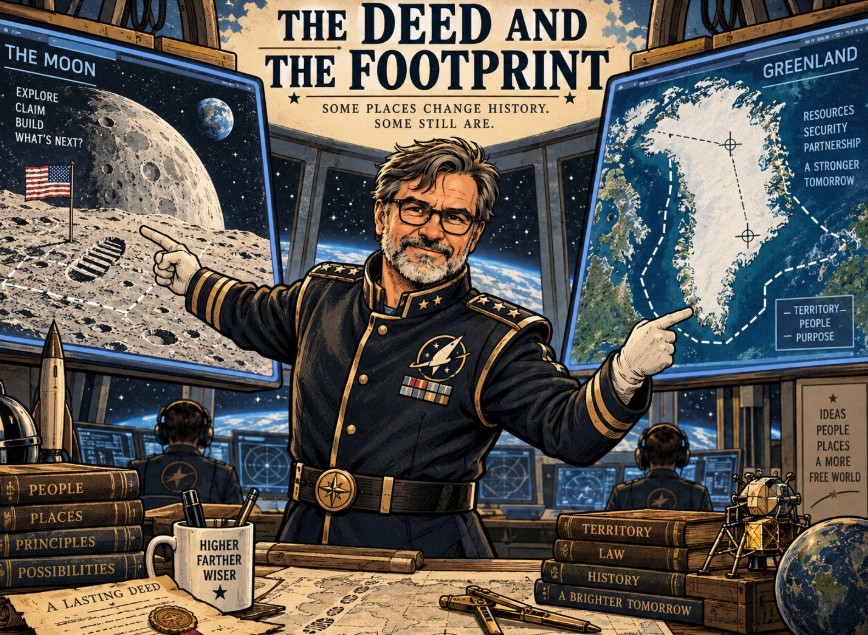
I have been thinking about that fence since a certain proclamation went up on a Sunday afternoon in September — three words over a rendered image of the Moon, with a flag appended, and no explanation offered. The commentary sorted itself within the hour into mockery and alarm. Both readings share a premise: that the proclamation expresses something rather than does something.
I would like to try the other premise. It repays the effort.
What a deed is made of
The old law of nations built title from a short list of ingredients. You found the place. You planted something on it. You kept acting like the owner afterward. And nobody with a better claim managed to stop you.
That list converted arrival into ownership across four centuries, and it is still holding up a considerable share of the map. Jefferson — whose feel for landholding was as fine as any American’s, and whose Notes on Virginia read like a man in love with a survey — bought eight hundred thousand square miles from Bonaparte in 1803, a seller who held the ground by paper from Spain and had put almost no one on it. The citizens living there were consulted by nobody. The transaction was between two arrivals, neither of whom had tended the soil.
Run the American lunar case through the same list. Discovery: we are the party who put people on the surface. Flag: planted six times, in photographs that are among the most reproduced images our species has made. Continuous display of authority: absent. Capacity to exclude anyone: absent. Yield: real, and increasingly written in the language of a prospectus — the December 2025 order directs a crewed landing by 2028, initial outpost elements by 2030, and a surface reactor ready for launch by decade’s end, all of it under the heading of lunar economic development.
So the American claim is rich in ceremony and thin in practice. Arrival, a flag, and no ability to hold the ground.
Hold that shape in mind.
The same ingredients, on an island
Danish title to Greenland is no rhetorical flourish. It was litigated and won. In 1933 the Permanent Court of International Justice decided the Eastern Greenland case for Denmark against Norway, and the reasoning turned on continuous and peaceful display of state authority over territory the court itself described as difficult of access and thinly inhabited. Denmark did not have to show dense settlement or working development. It had to show that it kept behaving as sovereign and that nobody effectively objected.
The strongest terrestrial precedent for title-by-persistence sits directly beneath the island in question.
Set the two side by side. Arrival long ago. Flag and formal administration. A population that reads as a rounding error against the landmass. Minerals that other powers want and the titleholder has limited means to bring up. And a defense that runs through somebody else’s navy.
The claims rhyme. Denmark’s is stronger on display of authority. It is not stronger on the ingredients a market-minded American cares about: use, cultivation, and the ability to hold what you say is yours.
Losing on purpose
Here is where the proclamation stops being weather and starts being architecture.
Assert the lunar claim and lose, and you have not lost a moon. You have produced an authoritative restatement of what does and does not create title. Article II of the Outer Space Treaty says it about as plainly as international instruments manage anything: celestial bodies are not subject to national appropriation by claim of sovereignty, by means of use or occupation, or by any other means.
Read that clause as an answer rather than a prohibition. The question it answers is whether arrival creates ownership. It says no. It says no about a body where the flags are American, the footprints are American, and the party being told no is the one that got there first and paid for the trip.
A man who wanted that principle on the record — loudly, in front of every respectable legal desk in the West, with each of them rushing to affirm it — could hardly have designed a better provocation than claiming the Moon on a Sunday afternoon. The rebuke is the harvest. What sits on the table afterward is a freshly endorsed rule that arrival plus flag plus thin presence yields nothing at all, and a map full of holdings that rest on close to exactly that.
Lose in public. The loss builds the tool. Carry the tool to the case you meant to win.
The costume and the confession
The same afternoon produced Space Force dress uniforms in space gray and satin black, which the internet identified within minutes as the wardrobe of a certain galactic empire, and a map of New Mexico with the word Mexico struck through in red. Tocqueville built whole chapters on smaller tells than a costume. Suetonius reports that Nero, having taken a considerable share of central Rome by proclamation after the fire and put a palace on it with a lake in the middle, remarked that he could at last begin to live like a human being. The extravagance is beside the point. The instrument is the point: a seizure announced rather than negotiated, with the announcement understood by everyone present to be the entire process.
And the map of New Mexico is a hinge rather than a joke. The land between Albuquerque and Taos came to the United States by the Treaty of Guadalupe Hidalgo in 1848, whose Articles VIII and IX promised that the property of Mexicans remaining in the ceded territory would be inviolably respected. Then came the Surveyor General, and the Court of Private Land Claims from 1891 to 1904, and the community grants of the northern valleys went into that framework and largely did not come out. Common land — grazing, timber, and water held by the village rather than the household — proved difficult for a court trained on individual fee title to recognize as property at all. The fence in Rio Arriba County stands where that reasoning left it.
Now consider what Article II is. The Outer Space Treaty was drafted by powers who had watched the scramble for Africa and had no appetite for a second one at altitude. Article II is a confession. It is a statement by the arriving nations that title-by-discovery was an illegitimate basis for ownership, entered into the record at the precise moment those nations found themselves positioned to lose by it.
Denmark signed that treaty. So did we.
The claim on the table is not that the Moon should belong to America. The claim is that a rule the signatories disowned in writing in 1967 is still holding deeds on the ground in 2026 — in the North Atlantic, and along a road in northern New Mexico, and in a good many other places where somebody arrived, planted something, and called the matter settled.
Three words and a flag. It is doing a great deal of work.
Two things at once
Let me be plain, since the alternative is being clever at the reader’s expense.
The conduct is indefensible. A president revising the map of his own country from a telephone, in a costume borrowed from a film about an evil empire, announcing dominion over a body he has no means to reach and less means to hold — that is playing at sovereignty. Citizens of a republic are entitled to better, and the men who designed the office assumed we would insist on it.
And a question loses none of its force by arriving in poor company. The one on the table is old, and it was standing there long before this administration tripped over it: what makes a claim to ground legitimate, and what is owed to the people already living on it when the answer comes back thin. Jefferson could not answer it in 1803. The Court of Private Land Claims answered it badly in 1898. The drafters of Article II answered it honestly in 1967, and then went home to countries built on the other answer.
We can hold the man in contempt and hold the question in earnest. The habit of weighing an argument by its author serves us well on ordinary days and poorly on this one.
The fence in Rio Arriba County is waiting on the same sentence.