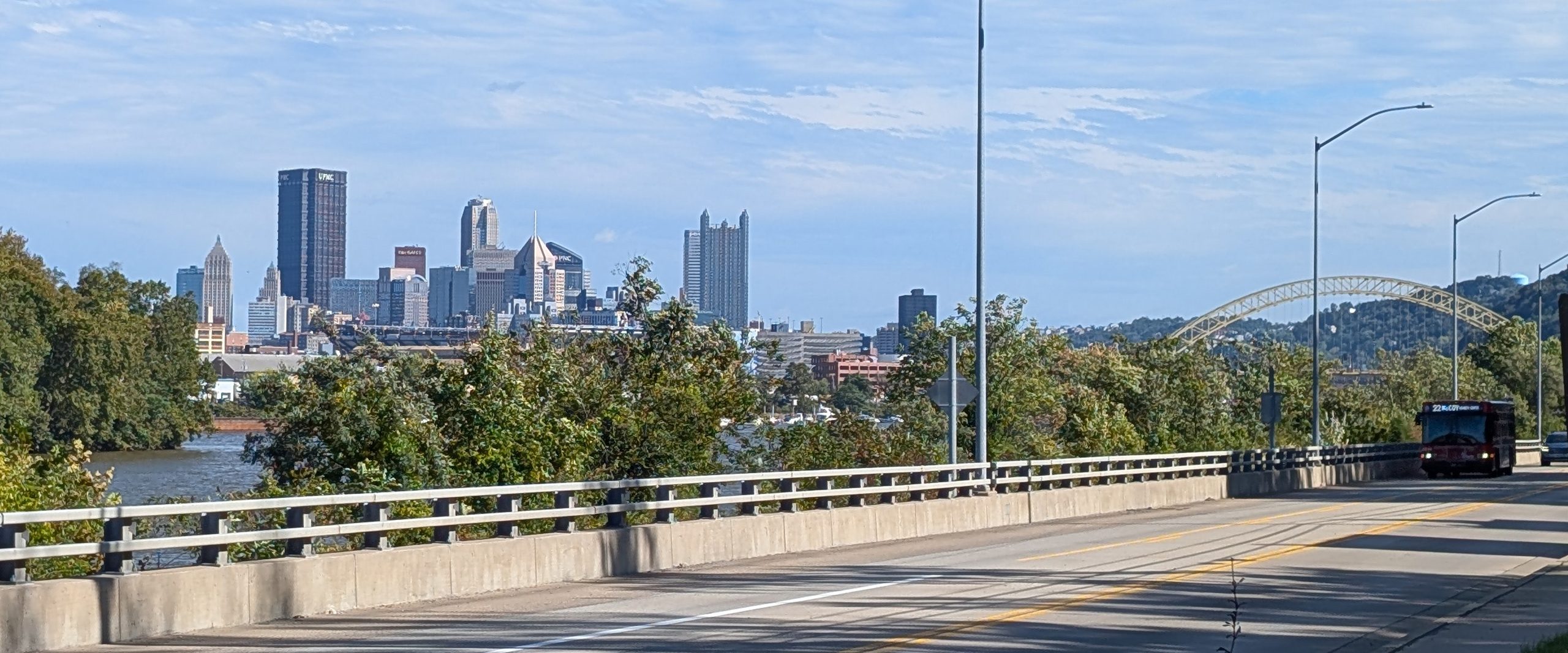
Back in March 2025, this site ran a panorama of Pittsburgh from the Grandview Avenue overlook, the postcard angle, with the camera warping the sidewalk into a curve that wrapped around the city. That post promised Man Made would grow once we moved east. Here’s the city from the other side of the house: from the northwest, with the Ohio River between us and downtown, a guardrail in the foreground and a red city bus rolling up the lane toward the camera.
From Mount Washington you look down on Pittsburgh like a map spread on a kitchen table. From out here you look across at it like a stage from the cheap seats, and the cheap seats show you how the set is built. The layers stack up one behind the other: concrete barrier, roadside brush, the river, the low riverfront buildings and parking decks, then the towers rising out of the Golden Triangle with the green hills holding the whole thing in a bowl.
The dark slab that owns the left half of the frame is the U.S. Steel Tower, 64 stories and 841 feet, the tallest building in the city since it topped out in 1970. U.S. Steel built it as a sales brochure you could walk into. The company wanted to show off Cor-Ten, a weathering steel designed to rust on purpose, growing a skin of dark brown oxide that protects the metal underneath like a scab protects a cut. So the structural columns went on the outside where everyone could see them.
That created a problem. Building codes require structural steel to be wrapped in fireproofing, and wrapping the columns would have hidden the product they were trying to sell. The answer was to make the 18 exterior columns hollow and fill them with water mixed with antifreeze and a rust inhibitor, about half a million gallons in total. In a fire, the liquid circulates and carries heat away from the hot spot, the same way coolant keeps an engine block from cooking itself. It was the first building to use liquid-filled columns for fire protection. Even the floor plan carries a message: the tower is a triangle, echoing the shape of the downtown point where the Allegheny and Monongahela meet.
Look at the top of it and you’ll see the letters UPMC. The medical system leased space in the tower and put its name on three sides of the crown in 2008. Pittsburgh’s whole economic history fits in that one image, a steel company’s monument to steel now wearing a hospital’s logo like a name tag at a reunion.
To the left of the big tower, the stepped pyramid crown belongs to the Gulf Tower, which held the title of tallest in the city before the Steel Tower showed up. Across the frame to the right, the cluster of glass spires is PPG Place, the glass company’s Gothic castle, finished in 1984 and built out of the product it sells, the same trick U.S. Steel played with Cor-Ten a decade and a half earlier. Pittsburgh companies seem to like a building that doubles as a sample case.
Then there’s the bridge on the right, and this is where the photo ties back to our last Man Made piece. That yellow steel arch is the West End Bridge, carrying US 19 across the Ohio about a mile below the Point. It opened in December 1932, built by Allegheny County with superstructure steel from the American Bridge Company. The designer was George S. Richardson, the same county engineer who drew the George Westinghouse Bridge over Turtle Creek, which opened that September. One engineer, one year, two very different answers to two very different crossings.
The Westinghouse Bridge is concrete, a material that loves to be squeezed, so Richardson built arches that push down and out into the valley walls. The West End Bridge had a different problem. Its main span runs about 780 feet over a working river that needed clearance for barge traffic, with riverbanks that weren’t going to take a massive sideways shove. So he used a tied arch. An arch wants to spread its feet apart under load. A tied arch hooks the feet together with the deck itself, the way the string on an archer’s bow keeps the wood from straightening out. The bridge carries its own push inside itself and sets straight down on its piers. The roadway hangs from the arch on cables that were pre-tensioned so the deck wouldn’t sag under traffic, a technique that was new in the United States around 1930. At its completion, it was the longest tied-arch bridge in the world.
The city opened it during the depths of the Depression, with hunger marches and empty relief funds in the same newspapers that covered the ribbon-cutting. Richardson’s two bridges from 1932 are still carrying traffic. Allegheny County paints its bridges a gold-yellow, and from this distance the West End arch looks like a handle on the side of the city, something you could pick Pittsburgh up by.
That’s what the back-door view gives you that the overlook doesn’t. From Grandview the city poses. From across the Ohio, with a bus coming up the lane and brush growing along the guardrail, you can see the working parts: the river that made the place, the bridge that crosses it, and a skyline built by companies that used their own headquarters to advertise what came out of their mills.