I am a conservationist by nature, and orangutans have had a hold on me for a long time.
Some of it is the name. Orang hutan, the old man of the forest. Whoever coined it had looked one in the face. An orangutan makes it hard to read a map of shrinking tropical forest as colored acreage, because somewhere in those green blocks is an animal that remembers where the good fig trees are, raises a single youngster for years, builds a fresh nest every night and knows its neighbors on sight. The forest it moves through gets a little smaller every season, like a house where someone keeps closing off rooms.
So palm oil sits uneasy with me. Oil-palm expansion has cleared a great deal of Southeast Asian forest, orangutan country included, and the IUCN lists it among the serious threats to tropical biodiversity and to orangutans by name.
Still, wishing palm oil out of existence gets us about as far as wishing for rain. The crop is valuable because it is a monster producer, putting out far more oil per acre than soy, rapeseed or sunflower. The IUCN has made the uncomfortable point that swapping palm for those oils could take substantially more farmland to fill the same demand. People want the oil. Manufacturers want it. The countries that grow it want the income. The palms are going in the ground one way or another, and the useful question is how well we handle the fruit once they bear.
That question came to me sideways, watching a video of a small village pressing operation. The crew worked the old way: cook the fruit, break it, mash it, press it, skim the oil, start the next batch. Sweaty, steady work, and I had no quarrel with the sweat. I’ve earned my share of it. Hard work done well carries its own dignity.
What caught my eye was the pile coming off the press. The spent fiber glistened. It was wet and greasy enough that you could practically wring a cup out of a handful. Oil was going straight onto the waste heap, and oil from this particular crop carries a price paid in forest.
I spent years as a claims adjuster, and that pile looked to me like a loss nobody had bothered to write up.
The FAO has put numbers to it. Simple spindle presses in traditional and small-scale systems pull roughly 55 to 70 percent of the oil out of the fruit. Motorized screw presses and improved small mills reach around 76 to 90 percent.
Run that through a pair of villages. Both want to sell the same hundred drums of oil. One recovers 60 percent of what’s in its fruit, the other 90. The second village fills its hundred drums from about two-thirds the fruit the first one needs. Carry that across a region and you’re talking about whole groves that never have to be planted, and forest that never has to come down to plant them. Conservation, by way of a screw press.
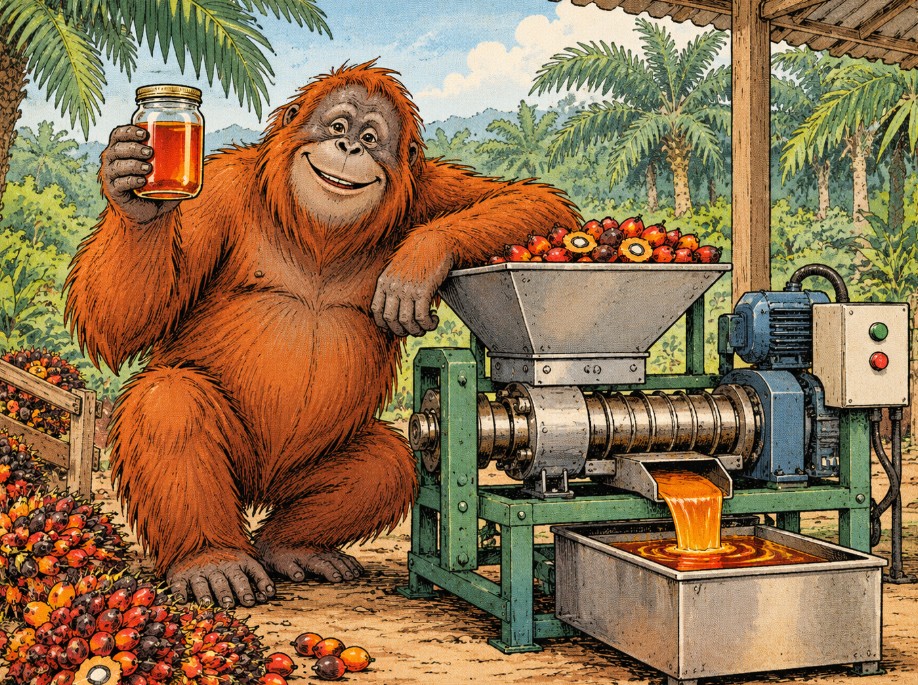
None of this means bulldozing village mills in favor of plantation-scale factories. The small machines already exist. FAO documentation describes motorized digesters and screw presses chewing through hundreds of kilograms of fresh fruit bunches an hour, some built as a single compact unit sized for small producers.
I hear plenty of talk about palm oil: where it’s grown, which labels to trust, what to boycott, which plantations to shame, which apes are losing ground. All fair conversation. Between the tree and the bottle, though, there’s a press, and the press rarely gets a word in.
Think about everything already spent by the time the fruit reaches it. The land was cleared years ago. The palms were planted and tended, the fertilizer spread, the bunches cut and carried in by truck or wheelbarrow. All that investment arrives at the press, and then a third of the oil goes out the back with the fiber. It’s like hauling a full load of firewood home and burning half of it in the yard.
My permaculture training put it plainly: a waste stream is a resource you haven’t figured out how to catch yet.
I doubt the crews would fight the change much. A motorized digester still needs hands. Someone feeds it, runs the batches, keeps the bearings greased, clears the jams and sorts what comes out. The muscle that used to crank a spindle all day goes into tending a machine that turns the same harvest into a good deal more sellable oil. In rural places where every machine gets eyed as a job thief, this one makes the same worker’s day worth more.
The fiber benefits too. FAO has recorded older manual presses leaving 18 to 35 percent of the oil behind in the fiber, and improved screw systems cut those losses hard. Get the oil out first, and what’s left is clean biomass for fuel, compost or soil building, instead of a greasy heap drawing flies.
A better press won’t save the forest on its own. Keeping intact forest standing, stopping illegal clearing and protecting orangutan range all rank ahead of it. Conservation tends to come together the way a stone wall does, one fitted rock at a time, and this rock is sitting right in front of us.
The world is going to keep buying palm oil. The surest way to keep that appetite from eating more forest is to wring every reasonable drop out of the fruit we’re already growing. Before anyone clears ground for another palm, press the harvest we have properly.
The old man of the forest may owe part of his future to something as plain as a better press.
Sources (verify before publishing):
- IUCN Oil Palm Task Force, Oil Palm and Biodiversity: A Situation Analysis (Meijaard et al., 2018)
- FAO, Small-Scale Palm Oil Processing in Africa, Agricultural Services Bulletin 148 (Poku, 2002)