A lot of young men meet Fight Club secondhand, as a training manual. Clips of Tyler Durden laying out the rules get cut over gym footage and dark synth, and the message comes through simple: harden yourself, on your own, and you’ll become the man. Grind alone, toughen alone, win alone.
Watch the film and it runs the other direction.
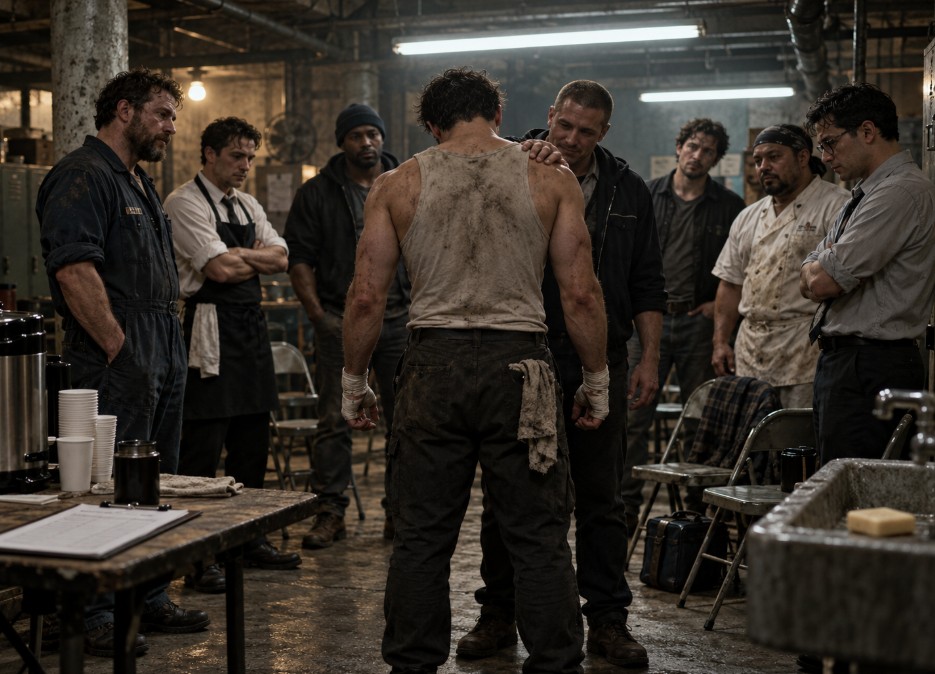
Look at who shows up in that basement. Mechanics, waiters, clerks, office guys with a week of nothing to show for it. None of them trained for this. The narrator is a man who can’t sleep and drifts between support groups looking for someone to listen. They come back because the others come back. Week after week, the hardness grows out of the showing up.
The film keeps track of what that does to them. The narrator says the rest of life starts to feel like someone turned the volume down, and whatever his job throws at him, he can take it. The men start to recognize each other out in the world, a nod across a restaurant, a bruise on a coworker. Their toughness carries a membership card.
That’s how a union local works, or a tenant meeting, or a volunteer fire company. At your first meeting you’re nervous to open your mouth. A year in, you’re telling a manager no with five people standing behind you. The courage shows up as a side effect of the company you keep. A man who toughens himself alone has nowhere to aim it but at the people around him. A group gets tough with a purpose before it gets a fist.
The film also tells you where that strength comes from. Tyler works the jobs people look past. He runs the projector at the movie house and waits tables at hotel banquets, his hands in the food of people who never look at his face. The men who follow him come out of kitchens, garages, laundry rooms, and night shifts. When a police commissioner threatens them, the staff he has walked past for years remind him who cooks his meals, hauls his trash, connects his calls, and drives his ambulances. Tyler puts it plain: “the people you are after are the people you depend on.”
Bankers and lawyers make their living selling a version of that idea. They set themselves up as the gate a deal has to pass through, and they charge a toll at the gate. For them it’s a trick. For working people it’s plain fact. The wires get strung, the trucks get driven, the mail gets carried, and the floors get mopped by our hands. The whole works runs through us. Working people forget that, and then the owners forget it too, until somebody reminds them.
So watch the movie, and skip the clips. Then go find your basement. It might be a break room, a shop meeting, or a neighbor’s porch. The hardcore you’re after sits on the far side of showing up for other people.
Sources:
Chuck Palahniuk, Fight Club (W. W. Norton, 1996)
Fight Club, directed by David Fincher, 20th Century Fox, 1999