Man Made: Nothing New Under the Sun
A coin, a lever, and two thousand years of selling things to strangers
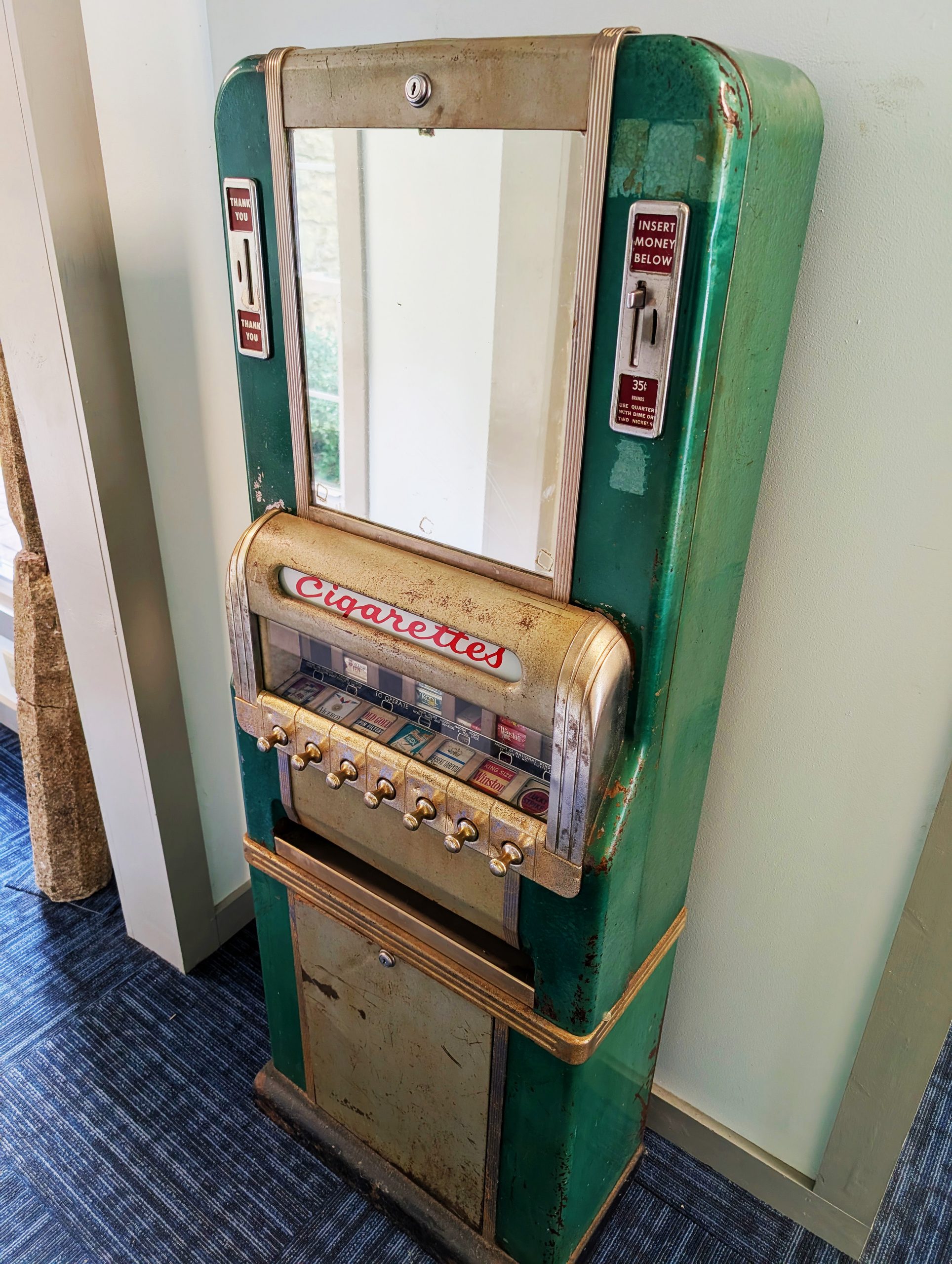
It stands about chest-high to a tall man, green as a 1950s kitchen, its shoulders rounded like the top of a refrigerator or the fender of a Hudson. Chrome bands run up its face in ribbed pairs, the same trim a designer of the era would have put on a radio cabinet or a diner stool. Near the middle, under a chrome hood, the word Cigarettes is lettered in red script, the kind of handwriting a sign painter used when he wanted a product to feel like a friend instead of a purchase.
This is a pull-knob cigarette vending machine. The small print on its instruction strip appears to credit National Vendors of St. Louis, one of the big makers of the type. It once stood in a bar, a bus station, a hotel lobby, or a bowling alley, a silent clerk working the night shift without a break.
The Design: A Shop Window Wearing a Car Grille
The machine’s styling comes out of Streamline Moderne, the late branch of Art Deco that borrowed its look from trains, airliners, and automobiles. Speed was the fashion, so objects that never moved got dressed as if they might. The vertical chrome bands work like racing stripes. The hood over the selector knobs bulges forward like the nose of a sedan, and the seven brass knobs line up beneath it the way door handles and hood ornaments catch the light on a showroom floor.
The real genius sits under that hood: a strip of glass showing the actual packs inside. Viceroy, Old Gold Spin Filter, Kool, Herbert Tareyton, Winston King Size, Lucky Strike. The manufacturers paid for the advertising on those wrappers, and the machine put it to work for free. Each column was its own little billboard, and the customer did his shopping by looking at the merchandise itself, the same way a fruit stand sells apples.
Above that sits a tall panel of mirrored glass. Plenty of these machines carried mirrors, giving a patron a chance to check his hair or straighten his tie while he fished for change. It also made the machine a piece of furniture people stood in front of on purpose, the way a hallway mirror gets glanced at by anyone passing.
The wear tells its own story. The chrome on the hood has bloomed with rust where the plating thinned. The green enamel is chipped down to bare metal along the edges and corners, right at the height where hips, elbows, and bar stools would have bumped it. Paint wears where people live, and this machine was lived beside for years.
The Engineering: A Coin as a Key
On the right side, a chrome plate reads INSERT MONEY BELOW, and beneath it sits a coin slide. The customer loaded coins into a small carriage and pushed it home. Inside, gauges sorted the coins by size and thickness; a slug or a wrong coin would fall through to the return. The right coins, in the right combination, dropped into place and released a lock on the selector mechanism.
Pull a knob, and a pusher slides the bottom pack out of its column and down toward the tray. The rest of the stack settles by gravity, ready for the next customer. No motor, no wiring required for the vend itself. Weight, levers, springs, and gravity do the whole job, the way a mousetrap does its job without a battery.
Now step back about nineteen and a half centuries.
Around the first century AD, Heron of Alexandria described a device in his Pneumatica that dispensed holy water at temples. A worshipper dropped a coin through a slot. The coin landed on a small pan balanced at the end of a lever. The coin’s weight tipped the pan down, which lifted the other end of the lever and opened a valve, and water flowed out. As the pan tilted, the coin slid off into a collection box, the lever fell back, and the valve closed. One coin, one measured portion, and the machine reset itself for the next visitor.
Set the two side by side and the family resemblance is plain. In both, the coin acts as a key. Its physical presence completes a mechanical linkage, the linkage releases a fixed portion of product, and gravity handles the reset. The cigarette machine adds coin sorting and a choice of seven columns, and it trades water for paper packs, but the principle Heron sketched in Alexandria is the principle sitting in this green steel cabinet. Ecclesiastes said it before either machine existed: there is nothing new under the sun.
The Economics: Thirty-Five Cents
The price plate under the coin slide reads 35¢ BRANDS — USE QUARTER WITH DIME OR TWO NICKELS. That plate is a small economic document in its own right. Machines like this carried swappable price cards because operators had to keep up with tax increases and price changes, and the machines outlived several prices over their working lives. Thirty-five cents for a vended pack puts this one’s working years around the mid-to-late 1960s, when machine packs typically ran a few cents above the store counter to pay for the convenience.
Run thirty-five cents through roughly sixty years of inflation and you land somewhere around three and a half dollars in today’s money. A pack in Pennsylvania now averages close to twelve dollars. Inflation alone explains less than a third of that climb. The rest is mostly tax. Pennsylvania’s excise tax by itself is $2.60 a pack, the federal tax adds another $1.01, and sales tax rides on top. The state’s tax alone is more than seven of these machines’ worth of packs.
Break that twelve-dollar pack into twenties, and a single cigarette costs close to sixty cents. So the old price card holds a neat irony: the quarter and dime that once bought twenty cigarettes would not cover one today. You could not legally buy that one anyway. Federal rules now require cigarettes to be sold in packs of at least twenty, and vending machines like this one are restricted to adult-only venues. The loose single, once sold from a jar beside the register, has been regulated off the counter.
So the machine stands in a quiet hallway now, retired, still wearing its last price like a name tag at a reunion. Its mechanism would work fine if anyone loaded it. The engineering never went out of date; Heron proved that. What changed was everything around it: the money, the law, and what society decided a pack of cigarettes ought to cost the person buying it.
Sources
- World Population Review, “Cigarette Prices by State 2026” (Pennsylvania average price and state excise tax)
- Review42, “Cigarette Prices by State (2026)” (federal excise tax of $1.01 per pack)
- Heron of Alexandria, Pneumatica (coin-operated holy water dispenser)