The Lantern You Ride In
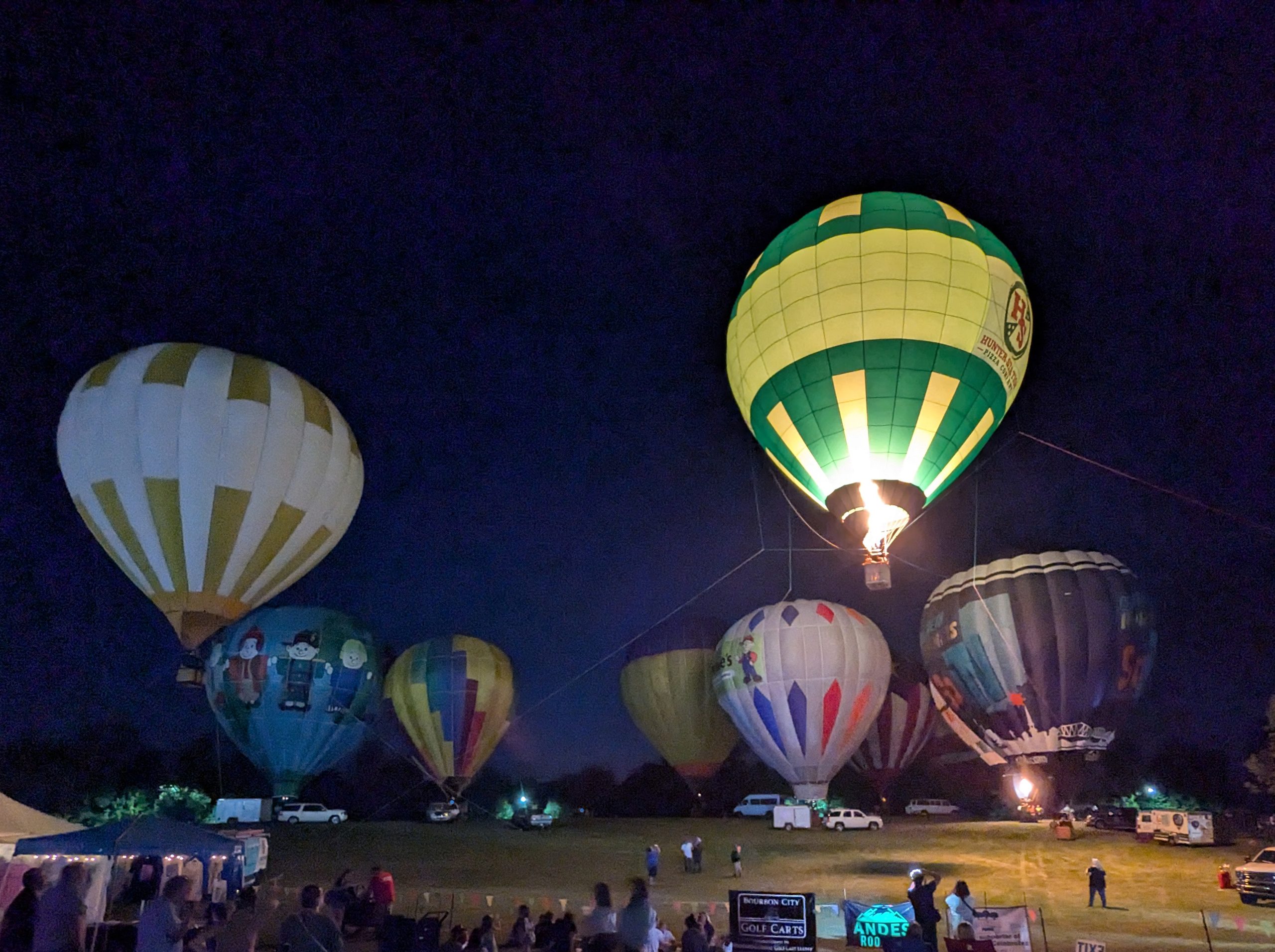
Sellersburg, Indiana, 2024. Dusk settles over a mown field, and the balloons come up off the grass one at a time. Each burner blast turns an envelope into a paper lantern the size of a house. A green-and-yellow one hangs above the crowd with its flame showing through the mouth like the pilot light in a furnace. Tether lines run from its basket down to trucks parked at the edge of the field. A line of kids waits to go up, hover, and come back down.
That tether tells you a lot about hot air balloons. The idea is one of the loveliest humans have had. The execution is a fire, a bag, and a rope.
The Principle
Heat air and it expands. Expanded air weighs less per cubic foot than the cooler air around it, so a bag full of it rises the way a cork rises in a bucket. There are no wings, no propeller, and no engine in the usual sense. Air heated to around the boiling point of water buys you roughly a quarter ounce of lift per cubic foot, which is why a basket carrying three or four people needs an envelope about as tall as a seven-story building.
Once you’re aloft, you travel inside the wind at the wind’s own speed. Passengers feel stillness. A match held up in the basket would burn straight. You steer by climbing or sinking into layers of air moving in different directions, like changing lanes on a highway where the lanes are invisible and you have to guess which one goes to Louisville.
On paper, it’s the gentlest flying machine ever built. (Editor: “ever” slipped in here; swap for “yet built” if you want it gone.)
The Practice
The burner sounds like a dragon clearing its throat a few feet above your scalp. Flights happen in the first and last hours of daylight, when the wind lays down and the sun hasn’t started stirring the ground air into bumps. A breeze over about ten miles an hour scrubs the day. You don’t choose where you land. The pilot picks a field from whatever the wind offers, while a chase crew follows in a pickup with a trailer, knocking on farmhouse doors to ask permission after the fact.
Then there are the wires. Sellersburg knows this one. Some years back, a balloon carrying a freshly engaged couple came down near State Road 60, found the grass too tall, and climbed to try again. The basket brushed power lines. The pilot was knocked unconscious, the new fiancé gave him CPR until medics arrived, and the three of them were treated for burns. She’d said yes on the first touchdown.
So the festival version is a balloon tied down at three points that rises the length of its ropes and settles back. A tethered ride is an elevator with a campfire in it, priced around the cost of a movie ticket. People line up anyway, and they’re right to.
How We Got Here
The Montgolfier brothers, Joseph and Étienne, were paper makers in Annonay, France. In 1783 they figured out that a bag held over a fire would rise, though they believed smoke itself held the lifting power. They burned damp straw and wool to make the thickest, foulest smoke they could. That June they flew an unmanned balloon in front of a crowd. In September, at Versailles, they sent up a sheep, a duck, and a rooster for Louis XVI. The animals came down fine.
On November 21, 1783, Jean-François Pilâtre de Rozier and the Marquis d’Arlandes flew over Paris for about twenty-five minutes, forking straw into a brazier hung under the opening and patting out sparks in the fabric with wet sponges. Ten days later, Jacques Charles flew a balloon filled with hydrogen. For the next century and a half, gas balloons won out, because they stayed up longer and didn’t require carrying a bonfire. Pilâtre de Rozier died in 1785 trying to cross the English Channel in a balloon that combined both: a fire hung beneath a bag of hydrogen.
Indiana has its own principle-versus-practice story. In 1859, John Wise lifted off from Lafayette in a gas balloon named Jupiter, carrying mail bound for New York. The wind had other plans and set him down near Crawfordsville, about thirty miles away. The mail finished the trip by train. It still counts as the first airmail delivery in the United States.
Hot air came back in 1960, when Ed Yost flew a nylon envelope with a propane burner out of Bruning, Nebraska. The balloons over Sellersburg are his design with better fabric and brighter paint. In 1999, Bertrand Piccard and Brian Jones circled the globe in a hybrid balloon of the type now called a Rozière, named for the man who died testing the idea.
The Glow
Festivals worked out something the Montgolfiers missed. The best part of a hot air balloon can happen with the basket on the grass. At a balloon glow, pilots fire their burners in the dark and the envelopes light up from inside, one after another, like a field of jack-o’-lanterns. No wind window, no chase truck, no power lines.
In principle it’s a flying machine. In practice it’s the prettiest lamp in Clark County, and on an Indiana night in late summer, a field full of them is plenty.
Sources
- WAVE 3 News, “Hot air balloon accident in southern Indiana” — wave3.com/story/18723065
- News and Tribune, “Setting up for celebration in Sellersburg” (Sellersburg Celebrates schedule, tethered rides and balloon glow at Silver Creek Township Park)
- Montgolfier, Pilâtre de Rozier, Charles, Wise, Yost, and Breitling Orbiter 3 details are from the general historical record