Two Names
I want to set two names next to each other, the way you might set two stones on a fence post after a long walk so you remember where you’ve been.
One belongs to my grandmother, Fannie Mae Bowers England Malone. The other belongs to a congresswoman from Minnesota, Ilhan Abdullahi Omar. They didn’t meet. As far as I know, neither one heard the other’s name. They came from different countries, different generations, and different worlds.
They meet in me, in the fall and winter of 1992, aboard a Navy supply ship off the coast of Somalia.
The Supply Ship
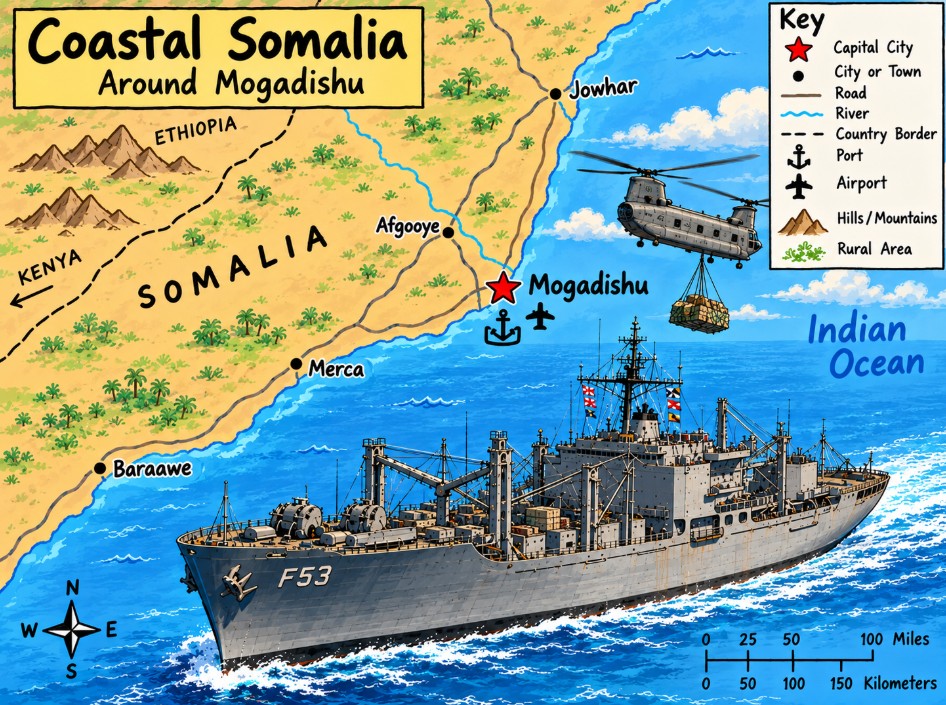
I was a radioman aboard the USS Niagara Falls, AFS-3, a combat stores ship. That year we were assigned to supply and resupply the Tarawa Battle Group as it staged for the landing at Mogadishu. The operation was called Restore Hope.
Somalia had come apart. Civil war had wrecked the country’s ability to feed itself. Food existed, and relief groups were trying to move it, but armed factions held the roads, the ports, and the warehouses. Getting a sack of grain from a ship to a family had turned into dangerous work.
So we were there before the Marines went ashore on December 9. Our job sat at the far upstream end of the effort. We kept the battle group stocked so it could secure the port and the routes inland, so the relief people could do their work, so somebody hungry could eat.
The Men by the Red Cross Ship
One day stands out.
Our helicopter pilots were running supplies when they spotted armed men gathering near a Red Cross ship. It looked like a robbery taking shape. We called it over to the Tarawa, and the Tarawa sent a couple of gunships to discourage them.
That was the business we were in. Keep the food moving. Keep it away from the men with guns and get it to the people without food.
I remember thinking about those men, though. I wondered whether they were the cause of what was happening to their country or one more set of its victims. A man with a rifle near a food ship could be a predator. He could also be a father whose world had collapsed, doing the arithmetic of survival with the only tool he had left.
December 21
On December 21, 1992, Fannie Mae Bowers Malone died. We were operation critical.
She was the one adult in my childhood whose love I didn’t have to wonder about. Other people loved me. With her I didn’t have to check. A kid who grows up short on that kind of certainty learns to treat it like a well on dry ground. You know where it is. You build close to it.
I couldn’t come home to bury her. I was eleven thousand miles away, doing the job I’d been sent to do, and I stayed where I was.
I have carried that absence for more than thirty years. It sits beside the other memory, the one with the gunships and the Red Cross ship, and the two have grown together like the roots of trees planted too close.
The Girl in the Camp
Ilhan Abdullahi Omar was born in Mogadishu on October 4, 1982, the youngest of seven. Her mother died when she was two. Her father and grandfather raised her. When the civil war broke the country open, she was eight, and her family fled. They spent four years in a refugee camp in Kenya.
By the record, she was ten that December, while we sat off the coast staging the landing.
I don’t know whether any meal of hers passed through a supply chain I touched. Her family was already gone from Somalia, and there’s no tracing one meal back to one sailor. I know what we were there for. We were there because of children like her, and because of the men with guns who had made her country unlivable.
That’s the picture I’d ask people to hold. The warlords were the men massing by the food ship. She was a little girl in a family running from them. Children in that place lived under the threat I watched from a radio room, and they lived under it without a ship to go back to.
In 1995 her family was granted asylum in the United States. She was twelve. She went to school, learned the language, and became a citizen in the year 2000, and at the age of seventeen. In 2018 the people of Minnesota’s Fifth District sent her to Congress.
That’s a long road, from a camp in Kenya to the House floor. I can’t look at it without thinking about the far end of the watershed.
The Same Storm
We met the same catastrophe from opposite sides. For me Somalia was a deployment, a set of orders, a stretch of ocean, and a funeral I missed. For her it was home, and then the place her family had to escape.
I’ve watched the arguments over her for years: her politics, her faith, her loyalty, her right to be here. Lately the circumstances of her arrival have become the subject of a federal investigation. A congresswoman’s votes and statements are open to anyone’s criticism, and anything she has actually done can be examined. That’s how representative government is supposed to run.
Her religion is her business. I didn’t serve in Somalia to sort the hungry by what they believed about God. I don’t recall that being part of the mission. A child who lived through a war doesn’t answer for the militants who started it, and being Muslim doesn’t make an American citizen less of one.
I don’t need to agree with her politics. I don’t need her gratitude, or anyone’s. I need to remember what we were doing there, and why I wasn’t home.
What I Ask
Fannie Mae Bowers Malone was worth coming home for. I didn’t get to. I’ve had to believe the work I stayed for was worth something too, that the water ran where it was supposed to.
One of the children from the far end of that watershed grew up and came here.
Please respect that.
For Fannie Mae Bowers Malone.
Sources
- Encyclopaedia Britannica, “Ilhan Omar” — britannica.com/biography/Ilhan-Omar
- Minnesota Legislative Reference Library, member record: Omar, Ilhan — lrl.mn.gov
- Biography.com, “Ilhan Omar Biography”
- Arab News / Fox News reporting on the federal investigation, October 2026