A Bright Meadow Group look at the routes and hubs the Continental Network grows once its trunks are down, and a bet on the city that won’t wait for them
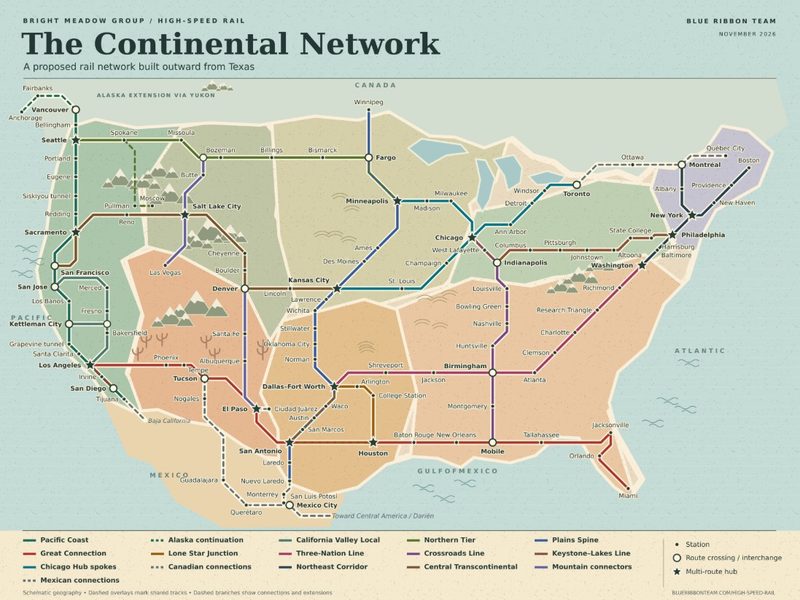
The Continental Network put the whole map in one place: three islands, nine lines, the junction cities and the gates. A map like that works like a seed. Once trains run on it, the towns between the lines start asking why they sit an hour’s drive from a station, and the cities on the lines start asking why they reach only two directions. This piece draws the second map, the one that grows out of the first, and puts a chip on which part of it goes up first.
OBSERVE
Networks fill in. The 1956 highway act drew the long trunks, and the decades after it added the loops, spurs and beltways the first stroke left off. The railroads did the same after 1869, when branch lines and cutoffs turned a handful of transcontinental lines into a web.
The first network leaves gaps you can see. Atlanta has the country’s busiest airport, but on the Three-Nation Line it’s just a through stop. St. Louis sits on the Chicago spoke and reaches two directions. Nashville and Louisville hang off the Crossroads Line. Jacksonville is a bend in the Great Connection on its way to Miami. Billings waits on the Northern Tier with the open Plains between it and Kansas City. Las Vegas sits at the end of the Salt Lake connector like a porch light at the end of a long driveway.
Las Vegas has already started digging. Brightline West broke ground on a station south of the Strip and plans to run 200 mph trains down the I-15 median to Rancho Cucamonga. The money isn’t finished. The line is still waiting on a federal loan, its Florida sister company went into bankruptcy this fall, and the finish date has slipped to late 2029. Still, the first leg of the spider has a hole in the ground, and the city around it has paid for its own transit before. Strip resorts backed the bonds that built the Las Vegas Monorail. The convention authority paid for the tunnel loop under its convention center, and resorts have bought their own stations on it.
The ground is easy. About four-fifths of Nevada is federal land, and the valleys between Las Vegas and its neighbors run long, flat and empty. A desert line crosses few property lines, few farms and few towns. A mile of track there gets fewer lawsuits than a city block of track in New Jersey.
DESIGN
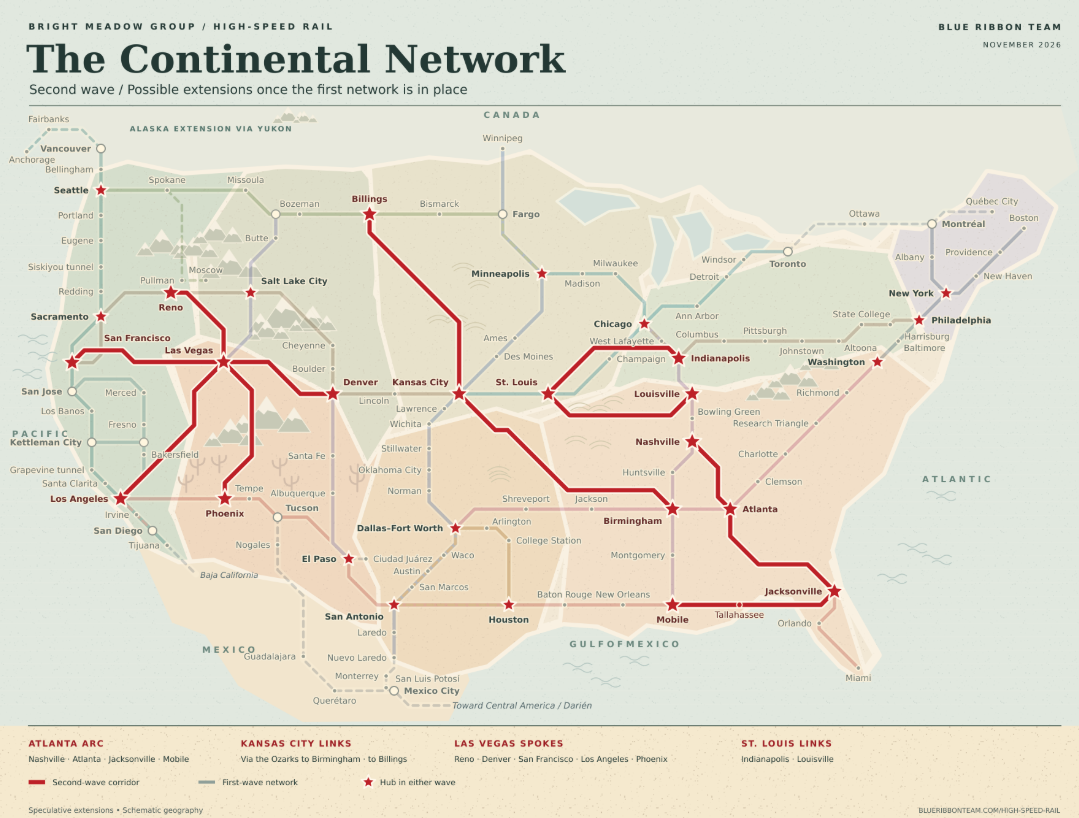
The second wave adds four groups of corridors, and each one turns a through stop into a hub.
The Las Vegas Spokes. Las Vegas to Los Angeles, to San Francisco, to Reno, to Phoenix and to Denver, plus the Salt Lake connector from the first wave. That’s six legs out of one station, a spider sitting in the middle of the desert. Los Angeles comes first on the Brightline West line in the I-15 median. Phoenix follows the planned I-11 corridor south past Hoover Dam. Reno runs up the length of Nevada along US 95. San Francisco crosses the Sierra to the Bay. Denver runs east across southern Utah and the Colorado Rockies to meet the Central Transcon. Las Vegas makes its living bringing people in, and the spider brings them from six directions at once. A convention in Las Vegas becomes a morning’s ride from four states.
The Atlanta Arc. Nashville to Atlanta to Jacksonville, with the Gulf leg from Mobile to Jacksonville tying the arc back to the Great Connection. Atlanta becomes the hub of the Southeast, and its airport becomes a transfer point between plane and train. Nashville becomes the crossing of the Crossroads Line and the Arc. Jacksonville becomes the corner where the Arc meets the Gulf and the run down to Miami. Florida gets a second door to the network at its northern edge.
The Kansas City Links. Two diagonals out of the center of the continent. One runs southeast through the Ozarks to Birmingham, tying Kansas City to the Crossroads Line and the Three-Nation Line without a dogleg through Dallas or Chicago. The other runs northwest across the Plains to Billings and hooks the Northern Tier straight into the middle of the map. Kansas City already sits where the Spine meets the Central Transcon and the Chicago spoke. With the links it becomes a six-way junction, the crossroads of the continent with track running in each direction.
The St. Louis Links. St. Louis to Indianapolis and St. Louis to Louisville. St. Louis gets its own reach east without routing through Chicago, and the Ohio Valley gets a loop that ties Indianapolis, Louisville and St. Louis to each other and to the Crossroads Line. Indianapolis and Louisville each become hubs.
The new hubs. Some cities go to bed as a stop on one line and wake up as a junction:
- Las Vegas: the spider of the Southwest.
- Atlanta: the Southeast’s hub.
- Nashville: where the Crossroads Line meets the Arc.
- Jacksonville: Florida’s northern door.
- St. Louis: the Mississippi’s gate to the east.
- Indianapolis and Louisville: the corners of the Ohio Valley loop.
- Phoenix: where the Great Connection meets the Vegas spoke.
- Reno: where the Central Transcon meets the road south to Las Vegas.
- Billings: where the Northern Tier gets its line to the center of the continent.
The campuses. Georgia Tech and Vanderbilt sit a short morning’s ride apart. Washington University in St. Louis and the University of Louisville share a line. UNLV and the University of Nevada, Reno stop being two schools at opposite ends of a state with a desert between them.
The people. A Phoenix family rides up for a show on the Strip and is home by morning. A kid from eastern Montana takes the train from Billings to college in Kansas City. A machinist in Louisville takes a contract in St. Louis and keeps his house.
The bet. Las Vegas pays for its own rail and has its spider built before the rest of the network is half done. Vegas money doesn’t sit on an opportunity. The city exists because people looked at a railroad water stop in the desert and put money on it. A casino knows what a visitor is worth down to the dollar, so a train that brings in a few million extra visitors a year from Phoenix, Denver and the Bay pays off on the casino floor long before it pays off at the ticket window. And they have desert: open, flat ground mostly owned by one landlord in Washington. While the federal authority works through Texas and the Plains Spine, Las Vegas builds its legs on its own clock, the way it built the Strip.
INTERVENE
The second wave runs on the same playbook as the first, with a few additions.
Leave the door open for local money. The National High-Speed Rail Act should let cities, states and private builders put up their own spokes ahead of the federal schedule, as long as they build to the national standard. When a city builds its spoke early, the network doesn’t have to pay for that spoke.
Hold the standard. Gauge, power, signals and trainsets have to match the national spec, so the Vegas spider plugs into the network the day the federal trunks reach it.
Release the desert. Grant right-of-way across federal land to the builders, the way the Pacific Railway Act granted land along the first transcontinental line.
Close the first spoke. The Brightline West loan sits on a federal desk. A decision there puts the first leg of the spider on rails.
Reserve the second-wave medians while they’re cheap. That means I-15 and I-11 in the desert, I-24 and I-75 through the Southeast, I-64 from St. Louis to Louisville, and I-70 from St. Louis to Indianapolis.
Let each wave follow the line it hangs from. The Atlanta Arc follows the Three-Nation Line. The St. Louis Links follow the Chicago spokes. The Kansas City Links follow the Spine. Las Vegas keeps its own schedule.
When the Plains Spine reaches Kansas City, we expect trains in Las Vegas to already be running in five directions out of the desert. Put a chip on it.
Sources
Blue Ribbon Team, The Lone Star Junction: https://blueribbonteam.com/blog/2026/10/20/the-lone-star-junction/
Blue Ribbon Team, The Continental Spine: https://blueribbonteam.com/blog/2026/10/21/the-continental-spine/
Blue Ribbon Team, The Keystone Network: https://blueribbonteam.com/blog/2026/01/14/the-keystone-network/
Blue Ribbon Team, The Plains Spine: https://blueribbonteam.com/blog/2026/11/19/the-plains-spine/
Blue Ribbon Team, The Great Connection: https://blueribbonteam.com/blog/2026/11/11/the-great-connection/
Blue Ribbon Team, The Three-Nation Line: https://blueribbonteam.com/blog/2026/11/14/the-three-nation-line/
Blue Ribbon Team, The Chicago Hub: https://blueribbonteam.com/blog/2026/11/16/the-chicago-hub/
Blue Ribbon Team, The Central Transcontinental: https://blueribbonteam.com/blog/2026/11/20/the-central-transcontinental/
Blue Ribbon Team, The Pacific Coast: [link]
Blue Ribbon Team, The Head Start: https://blueribbonteam.com/blog/2026/11/09/the-head-start/
Blue Ribbon Team, Two Lanes to Anchorage: https://blueribbonteam.com/blog/2026/11/05/two-lanes-to-anchorage/
Blue Ribbon Team, Second Shift: https://blueribbonteam.com/blog/2026/11/07/second-shift/
CT Examiner, Amtrak’s Next Gen Acela — Just Hype?: https://ctexaminer.com/2025/08/27/amtraks-next-gen-acela-just-hype/
Railmarket, STB accepts Union Pacific–Norfolk Southern merger application: https://railmarket.com/news/business/57579-us-surface-transportation-board-accepts-union-pacific-norfolk-southern-merger-application
Surface Transportation Board, UP–NS environmental review, Docket FD 36873: https://www.stb.gov/upns-eis-fd36873/