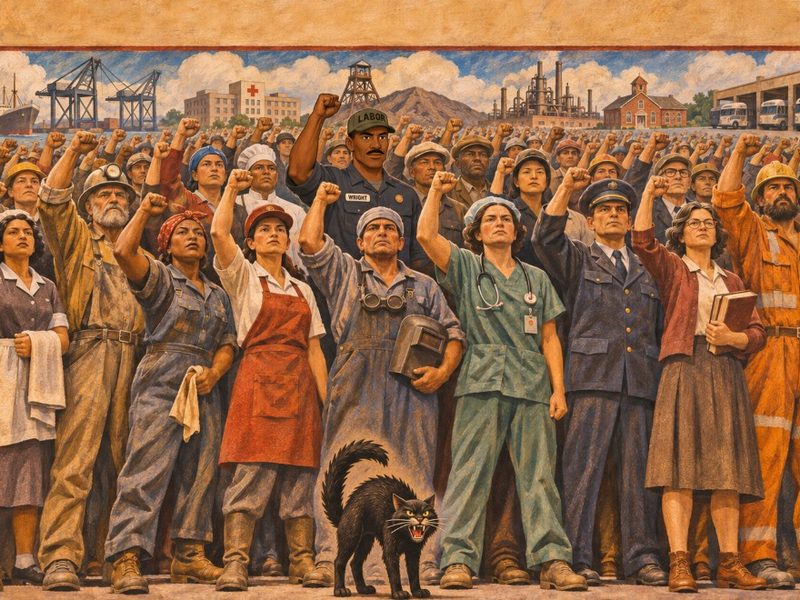
Johnstown made iron and steel for about 140 years. Cambria Iron opened in the 1850s, rolled rails for railroads pushing west, became Cambria Steel, passed to Bethlehem in the 1920s, and went cold in the early 1990s. The rails, the bridges, the wire, the beams that held up a good piece of the country came out of this valley. Then the furnaces went out, and the knowledge of how to run them started walking out the door with each retirement party.
Here’s an idea for keeping some of it.
Build one working mill line and run it as a living museum.
Anyone who grew up in Indiana knows Conner Prairie, the 1836 settlement outside Indianapolis where you walk into a village and the blacksmith is shoeing a horse and the woman at the loom will tell you what she’s weaving and why. Nobody stands behind a velvet rope. You smell the forge. Kids leave knowing how a nail gets made because they watched someone make one.
Johnstown could do that with steel.
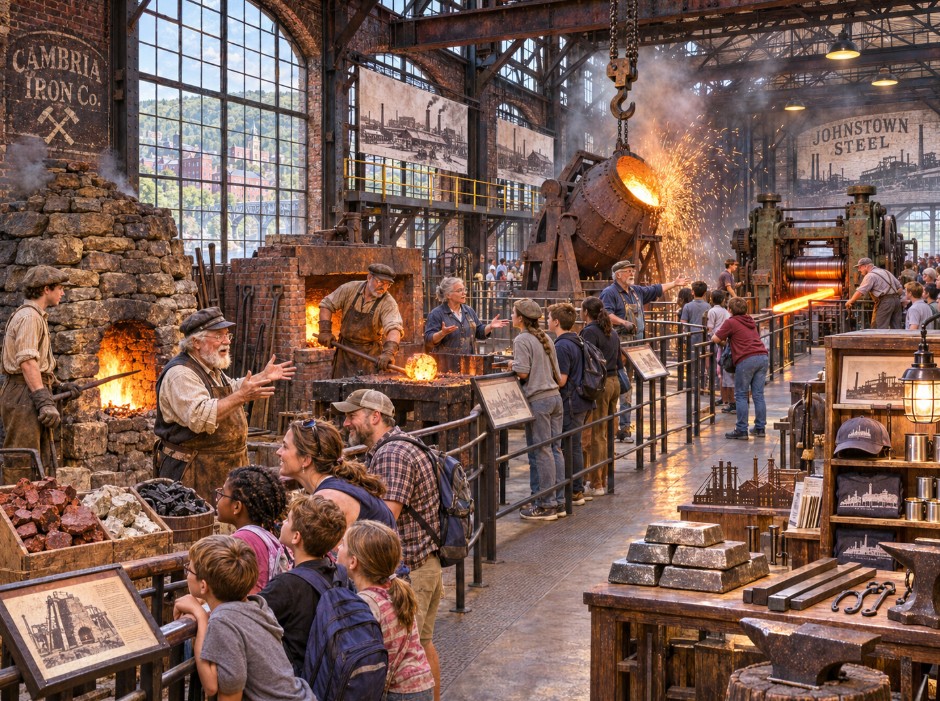
Picture a visitor starting at a stone furnace from the charcoal era, the kind still sitting in the hollows of western Pennsylvania, fed with local ore and limestone. A few steps on, a puddler works a ball of iron the way men did before Bessemer. Further down, a small converter throws its shower of sparks. At the end, a rolling stand turns glowing billet into bar while somebody explains why Cambria’s rail mill mattered to a country laying track as fast as it could. One building, one afternoon, and you’ve walked from colonial ironmaking to the industrial age.
And it makes something. Small runs of real product: bar stock for blacksmiths and bladesmiths, ingots stamped with the year, hardware for local restoration projects. Pennsylvania’s Hopewell Furnace already shows people will travel to watch iron history up close. A working line takes it a step further, because what comes out the end can be bought, carried home, and hammered on.
What a living museum brings in
Conner Prairie keeps receipts. A study the museum commissioned put its impact on Indiana’s economy at $39.1 million in 2016, with 560 jobs tied to that spending and $12.6 million in wages. About 391,000 people came through the gates that year. That’s a village of log houses and costumed interpreters in a Fishers cornfield, carrying a head count a mid-sized plant would be glad to have.
Hopewell is smaller and closer to what Johnstown would start with. The National Park Service counted about 54,000 visitors in 2023, and they spent $3.6 million in the towns around the park. Once that money moved through local businesses, it added up to $5.8 million in economic output and 51 local jobs. Across the park system, lodging takes the biggest bite of visitor spending, with restaurants next. The money follows the overnight stay. A family that drives in for the Flood Museum and the Inclined Plane can see both before supper and be on the road home by dark. Give them a working mill line with a scheduled pour on Saturday morning, and they book a room Friday night.
Beamish, in the old coal country of northeast England, shows what fifty years of this looks like. The open-air museum rebuilt a pit village, a 1900s town, and later a 1950s town, with working trades throughout. In 2024 it drew more than 838,000 visitors. Around 2013 its director said roughly two-thirds of the crowd came from outside the region, carrying outside money into a place that needed it, and by 2016 more than 430 people worked there. County Durham lost its pits in the same stretch of years Johnstown lost its mills. The museum that remembers the pits is now the region’s biggest attraction.
Closer to home, Rivers of Steel runs tours and iron pours at the Carrie Furnaces outside Pittsburgh. Sloss Furnaces in Birmingham, Alabama, has run a metal arts program since 1985. School groups come in on weekday mornings, kids carve a design into a sand mold, watch the iron go in, and carry home what they made. It costs twenty dollars a student.
What a living museum keeps
The people who can teach this are still around, but the clock is running. Johnstown has retired steelworkers who know how the work felt in the hands, and that kind of knowledge doesn’t survive well in a binder. Put them in the building as instructors and interpreters while they’re willing, and train the next round of hands beside them. A museum that keeps the skill alive gives the country a little seed stock to plant from if it ever decides to build big again.
The clock is easy to read. If the mills went cold in the early 1990s, a man who was 25 on his last shift is pushing 60 today. The melters and rollers who ran crews then, men who learned from workers hired during the war, are in their seventies and eighties.
Colonial Williamsburg has been working this problem since the 1930s. Its trade apprenticeships average five to seven years, and its master blacksmith has been at the forge since the 1980s. The foundation’s own trades director has written that some of those trades survive only because the foundation kept them going. Back in 1981, a Williamsburg gunsmith named the weak spot: few museums train enough craftsmen to staff their own shops, because apprenticeships cost money, and six to eight years looks long to a young person who could finish college in four. Williamsburg’s answer in 1936 was to set its craft program up as a company that leased shops to tradesmen and took a percentage of what they sold. A Johnstown line that sells bar stock and stamped ingots already has the start of that model built in.
Britain has started counting what it’s losing. The Heritage Crafts Red List assessed 285 traditional crafts in 2025 and listed 165 of them as endangered, 72 critically. What they track is a broken chain: few practitioners, few trainees, no clear route for the skill to pass along. A craft can go from healthy to gone in one generation, the way a family recipe disappears when the grandmother who cooked it by feel passes on and the card in the drawer just says “flour, enough.”
Japan shows how far one furnace can carry a whole craft. Traditional sword steel, tamahagane, comes out of a clay smelter called a tatara. By the 1970s production had nearly stopped, and Japanese swordmaking was at risk of losing its raw material. In 1977 a sword preservation society, the government’s cultural affairs agency, and Hitachi’s steelworks rebuilt a tatara in Shimane Prefecture. It runs a few times each winter, with the clay furnace built fresh for each smelt. The steel is graded by hand and sold to Japan’s roughly 300 licensed swordsmiths, and the furnace trains the next generation of furnace masters while it works. One building, a few weeks a year, and a thousand-year craft keeps both its steel and its know-how.
Starting with what’s here
The pieces are already here. The old Cambria Iron buildings still stand along the river, and the Johnstown Area Heritage Association already tells the story of the mills. There are metal shops in the region, trade programs in the schools, and a tourism trade that runs on the Flood Museum and the Inclined Plane. A working mill gives visitors a reason to stay an extra day, and it gives the city something to point at that says this is what we did, and we still know how.
Nobody needs to start with a full line. A furnace and a forge in an old mill bay, a few weekend demonstrations, a sign-up sheet for retirees willing to teach. See who shows up. If the crowds come, add the next era.
Johnstown has spent a long time being remembered for what happened to it. This would be a way to be remembered for what it made. Johnstown deserves as much.
Sources
Japanese Sword, tamahagane production and swordsmith supply: https://japanesesword.net/blogs/news/tamahagane-inside-japans-most-guarded-steel-making-secret
Indiana Chamber of Commerce, Conner Prairie 2016 economic impact study: https://www.indianachamber.com/?p=2338
National Park Service, Hopewell Furnace 2023 visitor spending: https://www.nps.gov/hofu/learn/news/tourism-to-hopewell-furnace-contributes-$5-8-million-to-local-economy.htm
National Park Service, 2014 Valley Forge and Hopewell visitor spending (lodging share): https://www.nps.gov/vafo/learn/news/economicbenefit2014.htm
Durham University Business School, Beamish case study (2024 attendance): https://www.durham.ac.uk/business/media/durham-university-business-school/study/mba/durham-mba-full-time/Beamish-Case-Study.pdf
Museums Association, “Open Plan,” 2013 (Beamish visitor origins): https://www.museumsassociation.org/museums-journal/features/2013/03/01032013-open-plan/
Beamish Museum, 2016 record attendance and staffing: https://www.beamish.org.uk/?p=4169
Sloss Furnaces, educator programs: https://www.slossfurnaces.org/educators
UAB Reporter, Sloss Metal Arts weekly school pours: https://www.uab.edu/reporter/people-of-uab/a-visual-guide-to-ars321-521-metal-fabrication-and-casting
Rivers of Steel, Intercollegiate Iron Pour at Carrie Furnaces: https://riversofsteel.com/?p=14589
Colonial Williamsburg, Conversations with Master Tradesmen: https://colonialwilliamsburg.org/learn/living-history/master-trades
James M. Gaynor, “A History of Historic Trades,” Colonial Williamsburg Journal: https://research.colonialwilliamsburg.org/Foundation/journal/Winter04-05/trades.cfm
Gary Brumfield, “Craft Apprenticeship in Historic Site Museums” (1981, reprinted in The Abbey Newsletter): https://cool.culturalheritage.org/byorg/abbey/an/an07/an07-2a/an07-a201.html
Benchpeg, Heritage Crafts Red List 2025: https://benchpeg.com/news/craft-skills-remain-under-threat-with-20-new-additions-to-the-uks-red-list-of-endangered-crafts/
NBTHK, History of Nittoho Tatara: https://touken.or.jp/english/explanation/informationcorner.html