It’s scarf weather. Today is a rust-colored plaid flannel I found at the church thrift sale last fall, with one corner I mended myself in thread that doesn’t quite match. I’m at the corner table with my laptop open to a document I have been “working on” for forty minutes. The cursor has been blinking in the same spot for a good chunk of that time.
I’m also listening, a little. Two tables over, a couple is deciding whether their gutters can wait until spring. Behind me, somebody’s cousin is getting married in June and the whole family has opinions about the venue. The barista is telling a regular about her dog’s new raincoat. None of it is mine to fix, so I go back to my phone and scroll.
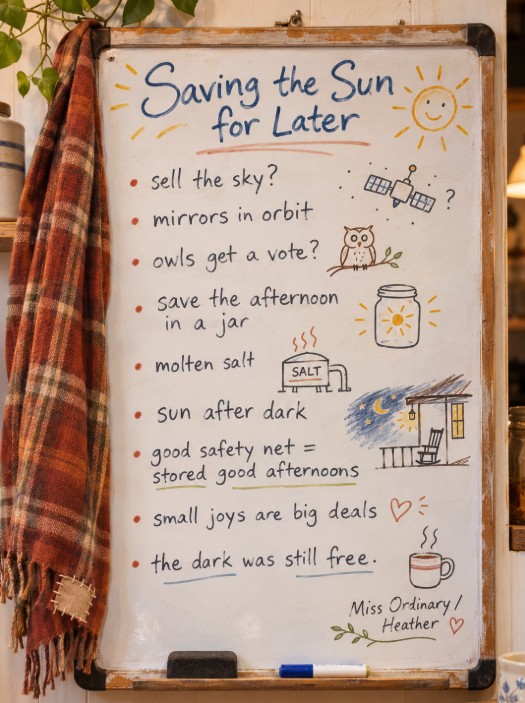
The first story floated up somewhere between a sourdough video and a sweater sale. A startup in California called Reflect Orbital wants to fly big mirrors in orbit and bounce sunlight onto chosen spots on the ground after dark. They plan to sell it to solar farms, to towns that want to skip streetlights, to anybody who wants to work past sunset. Their first goal is a glow about as bright as a full moon. Longer term they’re talking about tens of thousands of mirrors. Astronomers are upset. Groups that protect the night sky have filed complaints. Somebody in the comments asked whether the owls get a vote.
I thought about my back porch. When I can’t sleep I go out there with tea, and the dark is the whole reason I go. Night is the one thing on my calendar I don’t have to schedule. I’m not sure I want to rent it back by the hour.
So I closed that app, a little unsettled, opened a different one, and it handed me a different story.
Way up in western Tibet, at fourteen thousand one hundred feet, China just connected a solar plant to its grid that keeps making electricity after the sun goes down. They did it without a single mirror in orbit. The plant has regular solar panels, and during the day, when the panels make more power than the town can use, the extra goes into heating a big tank of salt until it melts. Molten salt holds heat the way my favorite mug holds coffee, long after you’ve forgotten about it. At night that stored heat makes steam, the steam turns a turbine, and the lights stay on.
Two stories about the same wish. Somebody wanted the sun to work a later shift. One version sells the sky. The other version saves the afternoon in a jar and opens it at bedtime.
Here’s the part that made me set my phone face down for a minute. The salt-tank idea started here. Back in the 1980s and ’90s, American engineers built test towers in the Mojave Desert, and one of them used molten salt to store the sun’s heat. Years later a company built a full-size version in Nevada. It had trouble, the company went under, and we moved on.
China picked the idea back up and kept at it. Their plants on the plateau are hard to build. The air has a lot less oxygen, the building season is short, and the cold gets into machinery. The people building them say as much. They keep building anyway, and each one teaches the next.
I don’t know much about grids. I do know a little about trying things.
When I first moved to Johnstown, I wanted to try a little Saturday booth selling the scarves I’d been thrifting and mending. I didn’t do it. I had a job with health insurance, and the booth would have eaten my Saturdays and maybe some of my savings, and if I got sick in the middle of it, I didn’t know what would happen to me. So the scarf booth stayed an idea on a receipt in my coat pocket.
I think about that receipt a lot, honestly. Mine was a small idea and no power grid depended on it. But I wonder how many of us are carrying those receipts around. The second idea. The third idea. The one that isn’t a sure thing, the one that needs a few years and a few failures before it works.
A big, flashy idea can usually find somebody rich to bet on it. Mirrors in space found twenty million dollars. The smaller ideas need something else. They need a person who can afford to fail at them once or twice, and a country that doesn’t let that person fall off a cliff when they do. Health care that doesn’t vanish with the job. Training that doesn’t cost a decade of payments. A way to keep paying the rent while the salt tank gets figured out.
A good safety net works a lot like the salt. It stores up the good afternoons so people can get through the dark stretches and keep working on the thing. And when lots of people can keep working, the second-tier and third-tier ideas get to grow up. Some of them turn into the thing that keeps the lights on at fourteen thousand feet.
The gutter couple decided spring was fine. The cousin’s venue is still up for debate. My cursor was still blinking.
I wrapped the plaid a little tighter, ran my thumb over that crooked mended corner, and went home before it got dark. The dark was still free when I got there.
Small joys are big deals. I’d like to keep this one.
Sources:
China activates world’s highest grid-connected solar thermal plant — Interesting Engineering (Nov 2026)
Ambitious solar thermal power project gets ready — China Daily (May 27, 2026)
Start-up plan to ‘sell sunlight’ with satellite mirrors concerns environmental groups — The National (Aug 11, 2026)
Filling Space With Mirrors Is Big Business — Xataka On