A Bright Meadow Group look at the Northeast Corridor, the line that had the first shot at American high-speed rail
The Continental Spine named three switchyards for a national rail network: Texas, Chicago and the Northeast Corridor. This piece takes up the third. The line from Washington to Boston holds one of the largest concentrations of wealth and power on any coastline in the world. It runs through the capital and the country’s financial center, past a string of universities from Johns Hopkins to MIT. With that much money along one set of tracks, Tokyo should be studying these trains the way an apprentice studies the master’s bench. Instead the corridor offers moderate service at best, and the Shinkansen became the model everyone else copies.
OBSERVE
The corridor had a head start. Japan opened the Shinkansen in 1964. By 1969, Metroliners were running up to 125 mph between New York and Washington. The two countries stood five years apart at the starting line. Japan kept laying new, dedicated track. The corridor kept patching the old line.
The patching continues. Amtrak’s NextGen Acela entered service in August 2025 with a top speed of 160 mph, but it can reach that speed in only four places, about 40 miles out of the 453 between Washington and Boston. When the new trains launched, some were scheduled at seven hours and five minutes end to end, slower than the trains they replaced, and Amtrak pointed to aging track, power and signals. That works out to an average of about 65 mph. A Nozomi covers the roughly 320 miles from Tokyo to Shin-Osaka in about two and a half hours.
Stop to stop, the trip drags. Philadelphia to New York takes more than an hour. New York to New Haven takes close to an hour and a half. New Haven to Providence takes more than an hour. In a corridor this dense, a single leg that long is hard to excuse.
The reasons are in the ground:
Shared track. NJ Transit, SEPTA, MARC, Metro-North and the MBTA run commuter trains on the same rails. The Acela spends the trip like a sports car stuck behind a school bus.
Split ownership. Amtrak owns most of the line, but Metro-North and the state of Connecticut own the stretch from New Rochelle to New Haven.
The Shore Line. East of New Haven, the route hugs the coast, crosses a movable bridge at river after river, and curves like a garden hose.
Old tunnels and bridges. Baltimore’s B&P tunnel dates to the 1870s. The tunnels under the Hudson opened around 1910.
Some of that is getting fixed. Tunnel boring for the new Hudson River tubes began in September 2026, with an opening targeted for 2035. The new Portal North Bridge now carries trains over the Hackensack. Both projects survived funding fights with Washington this year, including a construction pause in February. These repairs keep the corridor running. Speed is a separate job.
DESIGN
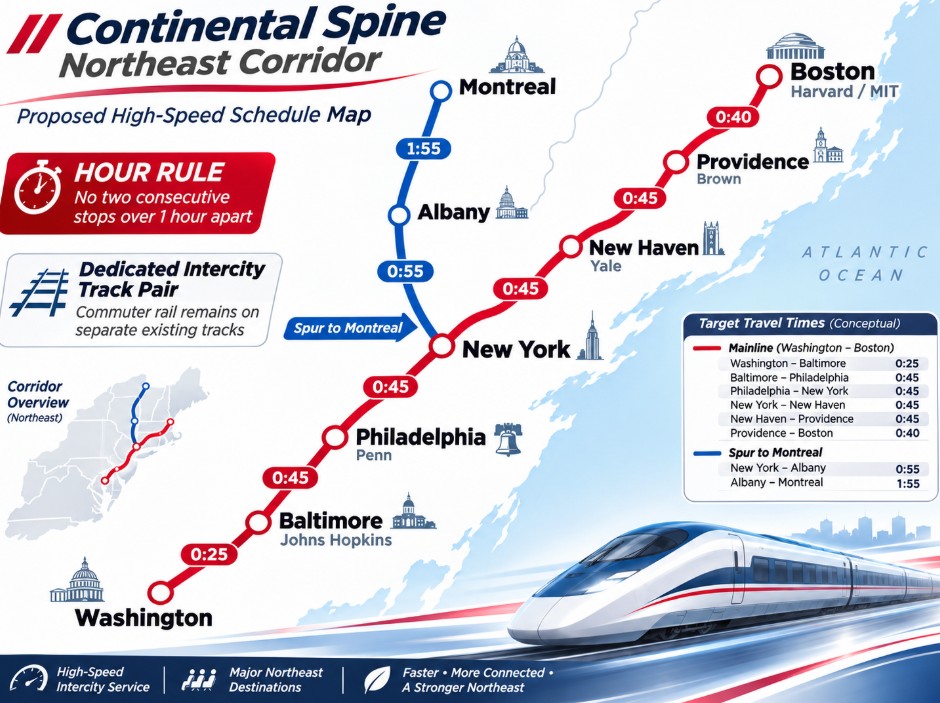
The hour rule. No two consecutive stops more than an hour apart. Washington to Baltimore already meets it. The rest of the line gets rebuilt until it does too.
A track pair of its own. The Continental Spine’s second alignment rule applies here: the fast trains get a dedicated pair, and the commuter railroads keep the existing tracks. The commuter lines carry the daily load into the cities, and the intercity trains stop waiting behind them.
New alignment where the old line curves. Connecticut is the place the curves cost the most time. An inland route through Hartford and Springfield trades the coastline’s bends for straighter ground.
The stops. Washington – Baltimore (Johns Hopkins) – Philadelphia (Penn) – New York – New Haven (Yale) – Providence (Brown) – Boston (Harvard, MIT), with the spur from New York through Albany to Montreal.
Its place in the order. The Northeast Corridor builds in parallel with Texas and the West Coast. In a perfect world all three start at once. When the money has to be ranked, the Northeast comes third.
Texas comes first because it is the international hub. It faces Mexico and the rest of the hemisphere, and it has to be born. Nothing there yet does the job.
The West Coast comes second because of its critical mass in transportation. Ports, airports, and a high-speed line already under construction in California give it a body of traffic waiting for the trains.
The Northeast comes third because it had its head start and wasted it. Its trunk also won’t join the rest of the network until phase four or five, so it can grow on its own timeline without holding anything else up. It stays an island for years either way, and the question is how fast the island gets.
INTERVENE
- Build in parallel, fund in order. The Northeast Corridor moves forward alongside Texas and the West Coast, third in line for federal dollars.
- Attach the hour rule to the money. Federal funding for the corridor comes with two conditions: a dedicated track pair for intercity trains, and stop-to-stop times under an hour.
- Bring the Connecticut stretch under one roof. The federal rail authority acquires or leases the New Rochelle–New Haven segment so one owner answers for the whole line.
- Keep Gateway funded. The Hudson tunnels carry the corridor’s heaviest traffic. They need a steady flow of money instead of another pause.
- Build to the national standard. Gauge, power, signals and trainsets match the rest of the network from the first day, so when the trunks meet in phase four or five, they connect like plugs into sockets.
Sources
Blue Ribbon Team, The Continental Spine: https://blueribbonteam.com/blog/2026/10/21/the-continental-spine/
Blue Ribbon Team, The Lone Star Junction: https://blueribbonteam.com/blog/2026/10/20/the-lone-star-junction/
CT Examiner, Amtrak’s Next Gen Acela — Just Hype?: https://ctexaminer.com/2025/08/27/amtraks-next-gen-acela-just-hype/
Daily Beast, Amtrak Rolls Out New High-Speed Trains Running Slower Than the Old Ones: https://www.thedailybeast.com/amtrak-rolls-out-new-high-speed-trains-running-slower-than-the-old-ones
NJBIZ, Hudson Tunnel Project begins major boring milestone: https://njbiz.com/hudson-tunnel-project-tunnel-boring/
NJBIZ, Gateway Program coverage: https://njbiz.com/tag/gateway-program/
ROI-NJ, Hudson Tunnel Project Timeline: https://www.roi-nj.com/?p=208840