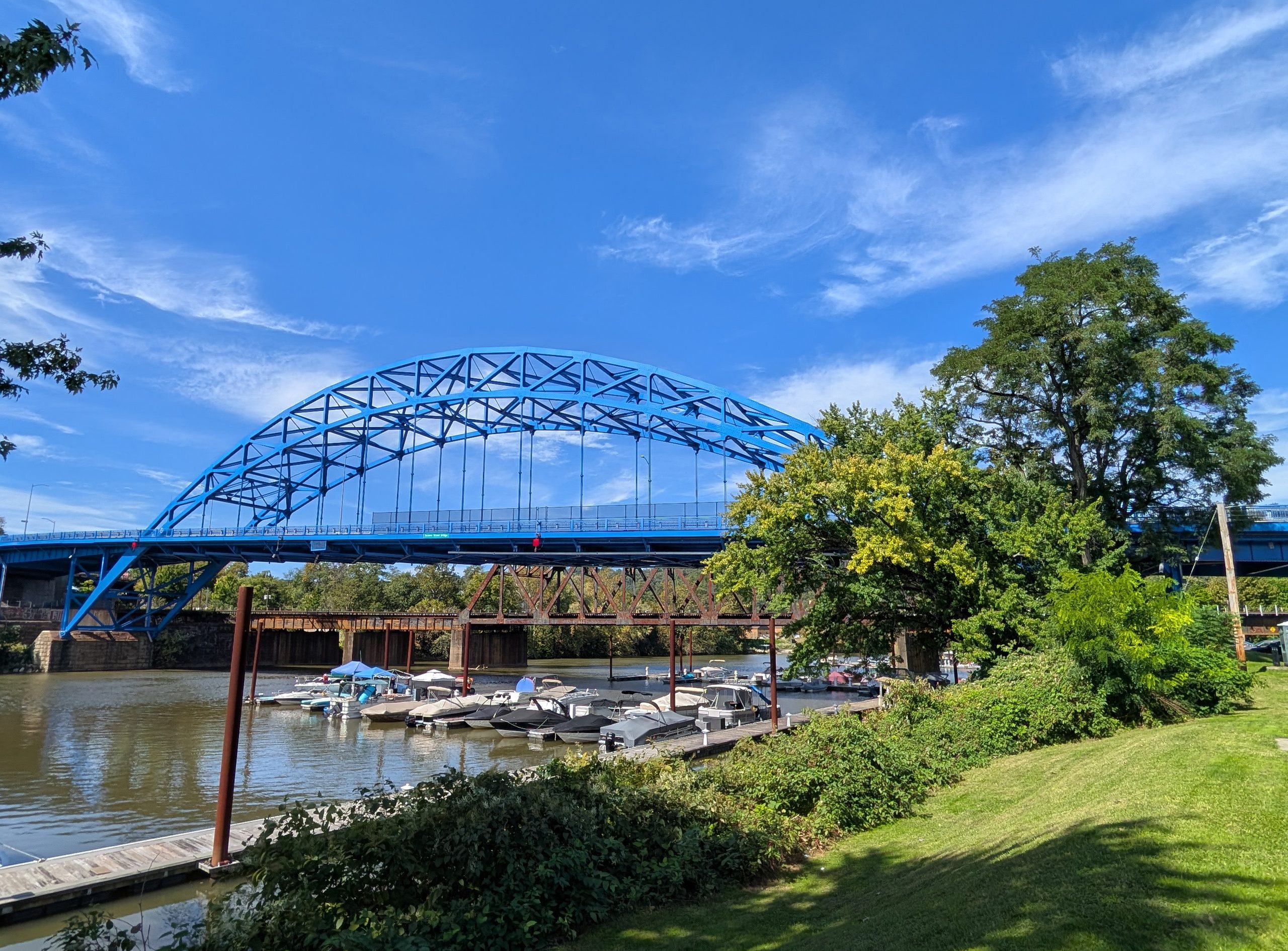
Stand on the grass by the little marina at McKees Point and look up. A blue arch curves overhead like a rainbow made of riveted steel. Under it, at an angle, a rust-brown railroad truss crosses the same water, the old Pittsburgh & Lake Erie line that fed the mills, now run by CSX. The two bridges sit almost on top of each other, each with its own answer to how you get across a river.
The blue one is the Jerome Street Bridge. It opened in 1938 and carries George Lysle Boulevard over the Youghiogheny a few hundred yards before the Yough runs into the Monongahela. In a region that collects bridges the way Rome collects churches, this one has a rare shape.
The shape of a moon
Look at the arch and you’ll see two curves. The upper and lower edges start together at each end, spread apart toward the middle, and meet again at the far side. Engineers call this a crescent arch. The space between the two curves is filled with steel triangles, so the whole thing is a truss bent into a bow, and near each end it narrows to a single solid rib.
The shape follows the work. An arch carries weight by pushing. Load on the roadway travels up the hangers into the arch, and the arch carries it down and outward into its foundations, the way two playing cards leaned together hold each other up. Steel handles squeezing easily. Bending is harder. An arch bends when the load is uneven, say a loaded dump truck on one half of the span and an empty lane on the other, and that bending is greatest out in the span and smallest at the feet. So the designers put the depth where the bending happens. The ribs spread wide where the arch needs to be stiff and narrow down where it doesn’t.
Those narrow ends sit on hinges, big steel pins the arch can rock on. This is a two-hinged arch. On a hot August afternoon the main span, about 315 feet of steel, grows a little longer, and on a January night it shrinks. An arch locked solid at its feet would fight that movement and store it as stress. A hinged arch lets its feet rock, the way a door swings on its hinges instead of being forced shut with a shoulder.
Half through
Now look at where the road meets the arch. In the middle, the deck hangs below the arch on thin vertical hangers. Toward the ends, the arch drops below the road and lands on piers near the water. This is a half-through arch, with the roadway running partway up the bow. It let the builders keep the road at street level on both banks while giving the arch a tall rise. Rise matters. A shallow arch pushes sideways hard on its foundations, like a cook pressing on a cutting board. A taller one sends more of its load straight down.
The whole crossing runs about 762 feet, ramps included. It carries four lanes over Water Street, the river, the CSX tracks, and River Road, with 39 feet of clearance for boats underneath.
Why it’s here
Before the arch, a narrow truss from the streetcar era stood on this spot. The Fifth Avenue Bridge mostly carried trolleys and couldn’t handle growing automobile traffic. Downstream stood the Third Avenue Bridge, an 1884 suspension span that was also judged unsafe for cars.
The Depression supplied the means to replace them. The new bridge was Federal Emergency Administration of Public Works Project No. 2976-PA, planned through the Allegheny County Authority, a body whose 1936 roster included the architect Henry Hornbostel. George S. Richardson engineered it (the historian Carl Condit credits Vernon Covell instead), and T.T. Morehouse and the Fort Pitt Bridge Works built it. Construction cost $575,033, and the full project came to $783,124.
Then came the naming. McKeesport had renamed the street leading to the bridge after its sitting mayor, George Lysle, and the city wanted the bridge named for him too. The Roosevelt administration said no, because public works money couldn’t honor a living officeholder. So the bridge took the name of Jerome Street, which had been a narrow alley between Fourth and Fifth Avenues. The bridge doesn’t carry Jerome Street and doesn’t connect to it. It’s named for an alley, and most people call it the Lysle Boulevard Bridge anyway.
The bridge was dedicated on May 3, 1938, with thousands of people and a parade, and it opened to traffic the next day. The county planned to tear down the old Third Avenue suspension bridge once the arch opened, but 5,000 residents signed a petition to keep it. It stayed open for pedestrians until 1960.
The arch was listed on the National Register of Historic Places in 1988, and Pittsburgh History & Landmarks named it a landmark in 2004. PennDOT rehabilitated it from 2020 through November 2022, replacing the deck with polyester polymer concrete, repairing the concrete substructure, and putting in new bearings.
Today the Great Allegheny Passage trail runs underneath. Cyclists heading for Washington, D.C. pass under the hinged feet of a Depression-era crescent, beside a freight line that hauled steel, next to a marina full of pontoon boats on a Sunday afternoon.