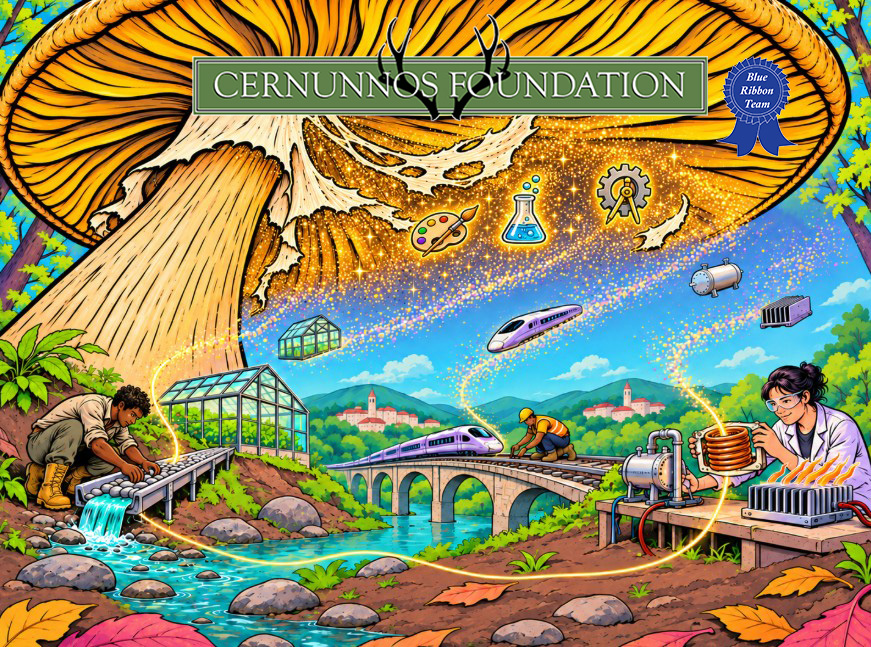
Turn a mushroom cap over and look at the gills. Thin pleated walls run from stem to rim, and from them falls a dust too fine to see one grain at a time. A single cap can release spores by the billions over a few days. Wind carries them off. Rain knocks them into the soil. Far more of them land on stone, pavement, and dry leaf than on anything that will feed them. The fungus spends them freely anyway, because the few that settle into damp, rich ground are enough to begin a colony that can spread across a forest floor.
The Cernunnos Foundation publishes the same way. We call it sporing.
The Freedom to Be Wrong
Recently, while red-teaming one of our own premises and attacking it from as many angles as we could find, we were reminded of one of the pleasures of self-publishing and open-source work. We get to be wrong, sometimes in ridiculous ways, and the error still contributes.
A design published openly is a claim someone can measure, test, and argue with. The argument produces an experiment, the experiment produces data, and the data moves the work forward whether it confirms our premise or tears it down. A mistake made in public, with the reasoning shown, becomes a stepping stone for the next person who comes along. Error kept in a drawer teaches only its owner.
A Floor to Stand On
We want more people to have this freedom. Being wrong in public works when the fall is survivable. A failed experiment published by someone with a steady income and a roof overhead becomes a contribution. The same failure, for someone who bet the house on it, becomes a reason to stop trying. The talent to try something new is spread widely across the population. The permission to fail has been spread far more thinly.
A stabilized society gives people a floor to stand on while they experiment, the way a lab bench gives a chemist a place to set down the flask that didn’t work and reach for the next one. We believe the true potential of humanity waits on the far side of that stability.
The Gates Have Opened
By historic measures, the tools for widespread wealth have arrived. A farmhand in 1750 had no antibiotics, no light after dark that didn’t cost him money, and no way to learn beyond what the nearest literate neighbor could teach him. Today a person with an inexpensive phone can publish to the world, consult a patient tutor in the middle of the night, and read research that once required a university library card.
The internet and large language models have opened the gates on publishing and expertise. The old gatekeepers are losing their grip. What stands between people and a life of abundance is, more and more, our desire to control one another.
Keeping the Gates Open
Open tools do not stay open on their own. Gates have a habit of moving. Publishing opened up, and search rankings and feed algorithms became the new doormen. Language models open up expertise, and whoever holds the compute and the training data holds a new set of keys. Plain friction adds its own drag as well: materials must be mined, energy generated, and strangers must trust one another enough to trade.
The work ahead is to keep the open tools open long enough for the floor beneath people to rise and meet them. That takes deliberate design, the same way a degraded river needs a shaped channel and a bed of clean gravel before it can begin cleaning itself.
Finding a Match
The spore is half the story. In many mushroom species, a spore that lands well sprouts a single thread of mycelium that can feed and spread but can’t fruit by itself. It has to meet a thread grown from another spore of a compatible mating type. When the two fuse, the joined mycelium carries both sets of genes, and that partnership is what eventually raises mushrooms out of the leaf litter.
Our designs behave the same way. A white paper sitting on a server can feed a curious reader for an afternoon. It fruits when it meets someone carrying what we lack: a landowner with a tired creek, an engineer who has run a reactor at pressure, a township supervisor with a stormwater problem, a foundation holding money and looking for a pilot. We publish so those people can find us, and we publish in full so they have enough to judge whether the match is worth making. If you are one of them, the return address is below.
Credit and the Return Address
Sporing means giving away possession. Our River Refugium Project proposes gravel contact oxidation as a way to let rivers clean themselves, and our waste processing work pairs that approach with water and hydrothermal liquefaction to recover and recycle what our communities throw away. If those designs work, if someone with a gravel pit and a grant builds a test reach and the water runs clearer, the river does not care whose name sits on the white paper. Neither do we. A world with cleaner water and a closed loop on waste is worth more to us than any amount of credit.
We keep our name on the work for one reason. A name on an idea works as a return address. When a builder in Ohio tries an RRP-style channel and their HTL unit chokes on high-moisture sludge, they need to know where to send the report, and we need to receive it to improve the design. Attribution keeps the loop of argument and experiment connected to its source. We give away the ownership and keep the mailbox open.
Releasing the Spores
Much of what we release will land on rock. Some designs will fail. Some premises will fall to the first good critique. That is the cost of sporing, and fungi have paid it without complaint for hundreds of millions of years. We will keep releasing our designs widely, publishing our reasoning in full, and trusting the damp ground to find them, and the right threads to find each other.