The bees went into their winter cluster this week. I stood by the hive with my coffee going cold and listened to the hum through the boards, thousands of small bodies shivering together around one queen to keep her warm until spring. They don’t hold a vote on it. They hold the center and wait out the weather. I envied them a little. Then I went inside and read the news, and I envied them a good deal more.
The ballots have spoken, and in a voice that rattled windows in counties that hadn’t leaned that way in a generation. Both houses of Congress now pass to the party out of power. The executive has answered that he intends to hold his course with the veto pen close at hand. When the 120th Congress takes its oath on the third of January, the republic will have a helm and a crew in open disagreement over the heading, with two years of open water ahead.
Sailors have a name for a stretch like this. They call it a sea trial, and a ship earns her name in one.
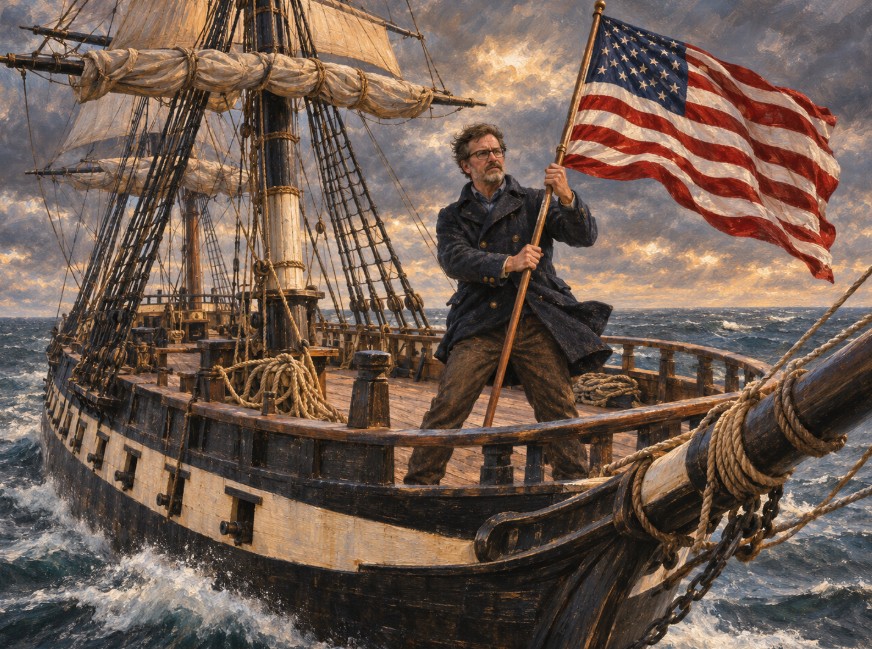
Consider the ship we named for our founding law. In August of 1812, off the coast of Nova Scotia, the frigate Constitution closed with HMS Guerriere, and British round shot struck her flank and dropped into the sea. A sailor on her deck is said to have shouted that her sides were made of iron, and the name stuck. They were made of southern live oak, cut on the Georgia coast and laid in layers so thick a cannonball had to argue its way through. Joshua Humphreys designed her heavier than her rating called for, because the young country could afford only a few ships and needed each one to take punishment and come home. That is Madison’s thinking rendered in timber: build few things, build them dense, and expect them to be shot at.
Eighteen years later, word went out that the Navy meant to break her up. A young poet named Oliver Wendell Holmes wrote a few angry stanzas, the newspapers printed them, and the public refused to let her go. She was rebuilt instead. She floats today in Boston, the oldest commissioned warship afloat, still crewed by sailors on active duty.
A friend asked me whether our republic is the two-hundred-fifty-year-old ship. I did the arithmetic twice, because Grammina taught me to count my change. The ship is 229. The Constitution she is named for is 239. The nation they both serve turned 250 this July. Three ages, one vessel, and none of them young enough to excuse us from knowing how she was built.
The framers built Congress the way Humphreys built that hull. The purse, the subpoena, the confirmation vote, the override: heavy timbers, laid in layers, meant to absorb a blow and return it. For some years those timbers sat dry in the yard. Dry wood shrinks; seams open. Now they go back in the water, and we will learn soon enough whether they swell tight or let the sea in.
The turn will be slow. The new majority holds no two-thirds to override a veto, so it cannot seize the wheel. It can hold the stores, ask its questions on the record, and decline to pay for courses it was elected to reverse. A frigate comes about slowly, and the slowness is the design. A republic, Grammina liked to say, misquoting someone better educated, is democracy with brakes.
I’ll indulge in some pride here, and Grammina can scold me later. The next two years will set the charts for the next hundred. Whether a subpoena gets answered, whether money appropriated gets spent as written, whether a court order gets obeyed when obeying it is inconvenient: these become the soundings our great-grandchildren will steer by. The rebuilding of 1830 kept Old Ironsides sailing for two more centuries. The precedents of 2027 will do that same work, for good or ill, on the ship of state. Few nations have kept a written frame this long. Fewer still have had the chance to prove it under fire with the whole world watching from the rail. We have that chance. I am proud, perhaps unbecomingly so, to be aboard for it.
And yet. Late on election night I caught myself cheering a result in a district I couldn’t find on a map, and I felt the old pull of faction rise in me like heat off a woodstove. I want to be honest about that. The appetite to see a rival brought low is the smallest seed of the thing that burns cities. Rome had an emperor who, the story goes, sang while his city burned, then raised a golden palace on the ashes and pinned the fire on the powerless. Historians argue over the singing. The palace is beyond argument.
That emperor lives in any executive who would rather rule ash than share a city. He also lives in a Congress tempted to burn the house to prove a point, in a press that sells smoke by the pound, and in a columnist at his kitchen table cheering a district he can’t place. Each of us keeps a little Nero below decks. The republic holds when enough of us keep him there.
Grammina, born the year the Great War ended, knew Franklin’s line about the republic better than Franklin did. “It’s a republic, Nate, if you can keep it,” she’d say. “The keeping is the chore part, and chores don’t pay.”
So I’ll end where she would have, with my hat off.
Lord of wind and water, keep the hull sound. Give the helm humility and the crew courage, and give both the grace to remember they sail the same ship. Where our timbers have gone dry, let them take on water and swell tight. Where we have grown proud, correct us before we are wrecked. Stay the hand that would burn the city to rule its ashes, whoever’s hand it is, mine included. Bring her through these two years whole, so that a hundred years on, some citizen at a kitchen table can read the charts we left and find the passage marked safe. Amen.
-N