Four Laws for a Growing Republic – Why the Republic Must Grow
In 1831 a young French magistrate named Alexis de Tocqueville came to the United States to study its prisons and went home with a portrait of its soul. What struck him first was a habit. Americans, he wrote, “of all ages, all conditions, and all dispositions, constantly form associations.” If a road needed building, a school founding or a church raising, they didn’t petition a duke or wait on a ministry. They met, chose someone to keep the minutes, took up a collection and got it done. To a man raised under a French monarchy, it looked like a country running itself from the bottom up.
He saw the same thing in the land. Traveling down the Ohio River, Tocqueville looked from one bank to the other. On the Kentucky side, where slavery held, he found fields half worked and a population that seemed to treat labor as something beneath it. On the Ohio side, where the Northwest Ordinance had kept slavery out, he found towns going up, mills turning and farms pushed hard by men who owned the profit of their own sweat. The same river, the same soil, the same sky, and two different economies running on either side of it. Free people working for themselves built faster, and Tocqueville wrote it down as plainly as a surveyor marks a corner.
Sixty years later a Wisconsin historian named Frederick Jackson Turner stood up at the 1893 Chicago World’s Fair and gave that energy a name. “The existence of an area of free land, its continuous recession, and the advance of American settlement westward, explain American development,” he said. Turner argued that the frontier shaped the American character itself: the self-reliance, the impatience with old hierarchies, the instinct to pick up and start over somewhere with more room. He gave his paper at a pointed moment. The census of 1890 had just announced that the frontier line was gone.
Turner’s thesis has earned its critics. The frontier he celebrated was land already lived on, and the advance he described came at a terrible cost to the nations who were there first. Any honest account of American growth has to carry that weight. But his central observation has held up for well over a century: this is a country that does best when it has somewhere to grow, and that grows restless and quarrelsome when it doesn’t.
Look around. We are a people built for building, crowded into a fixed frame and turning on one another. Our politics has become a fight over slices of a pie we’ve stopped baking larger. Each election feels like a custody battle, and each side treats a gain for the other as a loss for itself. A family packed too long into a house it has outgrown starts fighting over the bathroom; nobody’s character has changed, but the walls have closed in.
Our Constitution needs work. A good deal of it was written for a country of four million people on the Atlantic coast, and there are seams in it that a nation of three hundred and forty million feels every day. As we mature as a people, we may rise to that task and carry that burden, and I hope we do. For now, though, the work in front of us is simpler and older. We have to be true to our nature and grow, so that we can fully live as what we are.
The way to do that is the way we’ve done it before: build legal structures and then follow them. The Northwest Ordinance of 1787 is the proof. Before a single state was carved out of the Ohio country, the Confederation Congress wrote down the stages, the population counts and the promise of equal footing. Settlers could read the rules and plan their lives around them. Five states came out of that one document, and the country that crossed the Ohio River was the one Tocqueville found so busy he could hardly describe it.
That is what this series proposes: four laws that give the republic a working growth mechanism again, written in advance and kept in good faith.
- DC and Puerto Rico on Day One. Two places that have already asked, seated by the new Congress as its first order of business.
- The Territory Pathway Law. A modern Northwest Ordinance, with stages, a population floor, federal terms and a clock, so the next territory that asks finds a marked trail.
- Growing the Republic by Invitation. A published, consent-based process for nations that want to join, so no one can be brought in by force and anyone can come in by choice.
- Immigration and Republican Principles. A path for people who want in, one family at a time, measured in months and years instead of decades.
Each law opens a door, and each one asks something of the people who walk through it: a vote, a constitution, an oath, a share of the taxes. Growth under these laws comes by invitation and on equal terms. The new state, the new territory and the new citizen each get a seat at the table, and the table gets bigger.
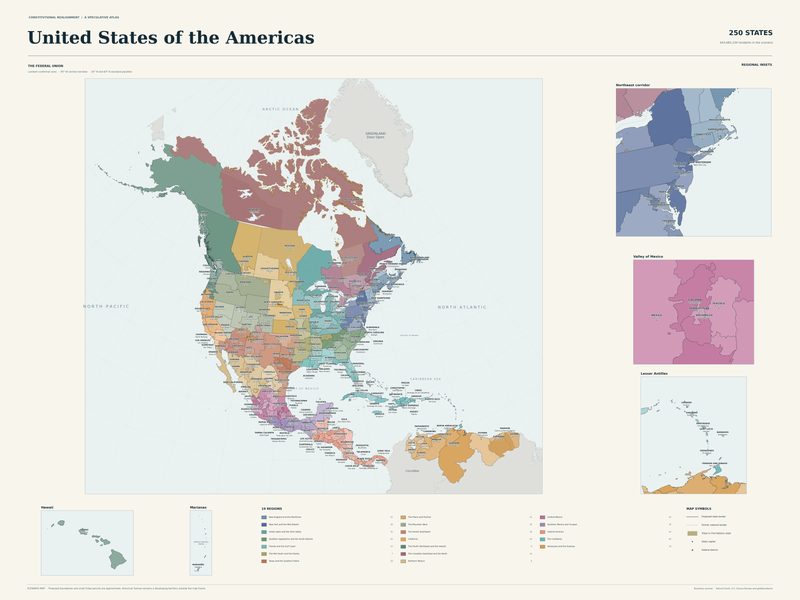
Imagine where that leads. Within a generation, the door could stand open from the Arctic to Tierra del Fuego. There are nations in this hemisphere with deep pride and long histories that look at American self-government and want a share in it, and they would want that share as equals with a voice and a vote. If we build the door and publish the terms, the choice of whether to walk through it stays where it belongs, with them.
I believe that if we repair the growth mechanism, a good deal of what ails us will begin to sort itself out. People who are building something together have less time to tear each other down. A republic that keeps adding partners has a reason to keep its promises.
The idea of a republic, a people governing themselves under laws they write and keep, has marched forward for the better part of three thousand years, from the councils of the Greek cities to the Roman Senate to a hall in Philadelphia. It has outlasted kings, empires and the people who swore it couldn’t work. It will carry our civilization and our nation just as long, if we let it. All we have to do is what Tocqueville saw us doing on the banks of the Ohio: decide what needs building, write down how we’ll do it, and get to work.
Sources
- Alexis de Tocqueville, Democracy in America (1835 and 1840), Henry Reeve translation
- Frederick Jackson Turner, “The Significance of the Frontier in American History” (1893)
- Northwest Ordinance of 1787, National Archives
- US Census Bureau, 1890 Census, superintendent’s statement on the frontier line