I have a confession to make, and I am going to make it gently because that is still my nature, even when I am annoyed enough to put my coffee down too hard.
I use AI.
There. I said it.
Not to replace my thinking. Not to become one of those people who asks a machine to generate a soul and then posts it with a watercolor background and a sunset emoji. I use it the way some people use a patient friend with a red pen. I use it to pre-edit my columns. I use it to catch my repetitions, smooth the awkward spots, suggest a better title, and sometimes tell me that the paragraph I thought was adorable is actually just three sentences in a scarf trying to become an argument.
I am not embarrassed by this.
I am pro-technology. I am pro-machine learning. I am pro-AI, pro-LLM, pro-using-the-tool-that-helps. I think these systems are extraordinary. I think there is real beauty in a machine that can help a tired person organize a thought at the end of a long day. I think there is dignity in assistive tools. I think there is public good in helping more people write, code, learn, translate, plan, and understand things that used to sit behind gates.
That is exactly why I am so irritated.
Because the tool is beautiful.
The business model is not.
I subscribe to more than one AI service because I write, edit, test things, and compare outputs. I am the sort of ordinary person these companies claim to be empowering. I am not trying to build a robot army in my kitchen. I am trying to make a column read better and maybe find the sentence where I used “cozy” four times because apparently I have a brand and a problem.
And after enough use, you start noticing the seams.
You notice who is smooth and who is fussy. You notice who is generous and who is stingy. You notice who lets you recover from a mistake and who makes you pay for the mistake twice. You notice when a model misunderstands something, wanders down the wrong hallway, burns through the conversation budget, and then looks at you with the digital equivalent of a blank face while the meter keeps running.
The worst version of this, in my experience, has been Claude.
And the moment I really noticed was not dramatic.
It was not a whistleblower memo or a leaked boardroom slide or some cyberpunk thing involving a black screen and green code. It was a PDF.
A very ordinary PDF.
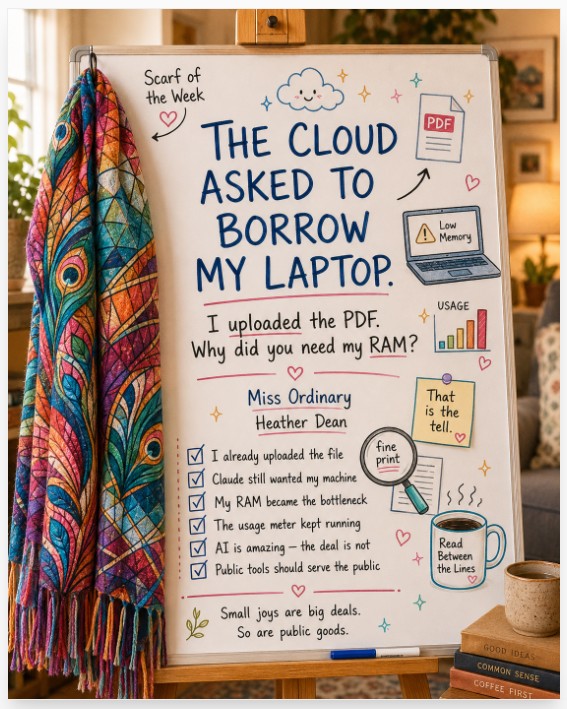
I had uploaded it to Claude because I wanted help re-editing it. That was the whole point. I gave the document to the system. In my normal-person understanding, that means the system has the document. The expensive cloud brain should read the thing I handed it, think about it in whatever mysterious server cathedral it lives in, and then help me make the paragraphs less wobbly.
Instead, Claude could not read it.
Not because the file was missing. Not because I had forgotten to upload it. Not because the PDF was locked behind a password or written in ancient Sumerian.
The explanation was that my own computer did not have enough memory free to run the program it wanted to use to open the PDF.
I actually sat there for a second with my coffee halfway to my mouth.
Because excuse me?
I had already uploaded the file.
Why did my laptop need to be strong enough to open it? Why was my local machine suddenly the bottleneck for a document I had handed to a paid AI service? Why was the thing I was paying to use now leaning back on my hardware, my memory, my electricity, my little tired computer, and then telling me the problem was on my end?
That was the moment the curtain moved.
Not all the way. I am not pretending I suddenly saw the full machinery of the universe. But I saw enough.
The pitch is: pay us for access to the intelligence.
The experience was: pay us for access to the intelligence, then also provide the machine environment, then also absorb the failure when our system decides it needs your computer to do a job you thought you had moved into the cloud.
That is not a small distinction.
That is the whole moral shape of the thing.
I want to be careful here, because “careful” is what keeps a rant from turning into soup.
I am not saying the whole Claude brain is secretly living inside my laptop like a raccoon in the wall. The big model work is still cloud AI. That is the part they advertise. That is the part they sell. That is the part with the giant infrastructure and the shiny valuation and the statements about safety and civilization and the future of intelligence.
But with Claude’s desktop and coding tools, there is another layer to the bargain. The product can run locally. It can use your machine as the worksite. It can read local project files, run commands, interact with tools, open apps, and, with permissions, control your actual screen. Your computer becomes part of the operating environment.
And when that local environment fails, the user is the one standing there holding the error message.
Then they meter you anyway.
That is the tell.
Because now the transaction is not as simple as “I pay you to run your expensive software on your expensive servers.” It becomes something stranger and more intimate. I provide the subscription fee. I provide the files. I provide the project folder. I provide the local environment. I provide the electricity, the device wear, the bandwidth, the browser memory, the permissions, the attention, and the cleanup when the machine confidently misunderstands the assignment.
Then, after all of that, the company says: thank you for using your own machine inside our fenced garden; your usage is limited.
There is something almost impressive about the nerve.
It is like being charged admission to cook dinner in your own kitchen because a famous chef mailed you a recipe card and occasionally knocks on the window.
And yes, I understand that Anthropic is still providing a valuable service. I understand that the model access costs money. I understand that inference is expensive. I understand that engineers, researchers, safety teams, servers, data centers, support systems, and all the rest are not paid in compliments and pumpkin muffins.
But we need to stop pretending this is a normal consumer software relationship.
These companies are not selling a word processor. They are selling access to an intelligence layer trained on the public internet, public writing, public code, public conversations, public documents, public habits, public culture, and the accumulated scraps of human expression that billions of people created without ever sitting down at a bargaining table.
Then they wrap it in subscriptions.
Then they limit it.
Then they upsell the limits.
Then, when the model makes a mistake, the user pays to correct it.
That last part is what really gets me.
If I ask a model to help tighten a column and it misunderstands the tone, that is not always my failure. If it hallucinates a claim, invents a source, ignores an instruction, bloats a paragraph, or creates a mess I now have to spend ten more prompts untangling, the meter does not pause out of fairness. The system does not say, “Oops, that one was on us.” It just keeps counting.
That is not a partnership.
That is a casino with grammar.
And I say this as someone who likes the machine.
That matters. I am not standing outside the factory yelling that looms are evil. I like the loom. I want the loom. I think the loom can make beautiful fabric. I just do not think the loom owner should get to say that every piece of cloth in the world belongs to him because he figured out how to weave faster after studying everyone else’s shirts.
The AI companies want us to accept a very strange moral arrangement.
They want public knowledge to be raw material.
They want private ownership to be sacred.
They want users to provide data, feedback, correction, testing, workflows, use cases, and sometimes even local compute and local machine access.
They want workers to be “augmented” until they are no longer needed.
They want artists and writers to be told that influence is not theft, unless someone influences them back.
They want students, programmers, small businesses, researchers, and ordinary users to become dependent on the tool.
Then they want to meter dependency like a utility and own it like a kingdom.
No.
I am sorry, but no.
That is where Miss Ordinary takes off the soft scarf, folds it neatly, sets it on the chair, and gives Claude a polite little slap directly in the mouth.
Not because AI is bad.
Because the deal is bad.
Because this is how extraction always dresses itself when it wants to look like progress. It arrives with clean branding, kind language, a pleasant interface, and a promise to help. Then, slowly, the help becomes dependence. The dependence becomes leverage. The leverage becomes pricing. The pricing becomes policy. And eventually everyone is standing around acting like it is natural for a handful of private companies to own the faucet on human thought.
It is not natural.
It is a choice.
And choices can be unmade.
If AI is going to become civic infrastructure, then it needs civic ownership. Not just regulation. Not just a safety memo. Not just a checkbox that says the company cares deeply about humanity while charging humanity by the sip for water drawn from humanity’s own well.
Senator Bernie Sanders has floated the idea that the public should own 50 percent of the major AI companies through a sovereign wealth fund. I know this is where Miss Ordinary is supposed to get nervous and go back to talking about seasonal candles.
But honestly?
Fifty percent sounds generous to the companies.
If an oil field belongs under public land, we understand that the public has an interest. If a road is needed for the public good, we understand eminent domain, compensation, and transfer. If a utility becomes essential to ordinary life, we do not let one private owner decide who gets heat, light, and water based solely on what produces the most shareholder value.
AI is heading toward that category.
Not because it is magic. Because it is becoming infrastructure.
It is becoming the layer between people and work, people and knowledge, people and government forms, people and education, people and health information, people and law, people and language itself. When a private company owns that layer, the company does not just own a product. It owns a tollbooth on cognition.
That is too much power.
It should be taken into true public ownership.
Not stolen. Not smashed. Not punished out of spite. Compensated. Lawfully. Transparently. Under the same broad principle we already use when private property must yield to public necessity: public purpose, due process, just compensation.
Pay the founders and investors what the law determines is fair.
Thank the engineers.
Preserve the research.
Keep the good tools.
Then put the infrastructure where it belongs.
In public hands.
And before anyone says, “But government will ruin it,” let me gently point toward the current private arrangement, where billion-dollar companies are scraping civilization, burning rivers of electricity, training on the world, replacing workers, charging users, limiting access, leaning on local machines when convenient, and asking us to applaud because the loading animation is soothing.
We can do better than that.
Public ownership does not have to mean dull, dead, gray software with a form number and a waiting room. It could mean open standards. Public auditability. Worker representation. Real privacy rules. Access for schools and libraries. Transparent pricing. Research that serves people instead of valuations. Local deployment where possible. Disability access. Rural access. Public-interest models. Community tools. Strong limits on surveillance. Strong limits on manipulation. A system designed around citizens instead of extraction.
That is not anti-tech.
That is the most pro-tech position there is.
Because technology this powerful should not be reduced to a subscription trap.
I want AI to help the nurse chart faster and go home on time. I want it to help the small-town mechanic write a grant application. I want it to help the dyslexic kid draft an essay without feeling stupid. I want it to help the veteran navigate benefits paperwork. I want it to help the local farm model water use, the public defender summarize records, the teacher build materials, the grandmother translate a letter, and the tired columnist find the cleanest version of the sentence she already meant.
That future is worth building.
But not if the price is letting a handful of companies own the thinking layer of ordinary life.
So yes, I use AI.
I will probably use it again before this week is over, because I am not a purist and I am not interested in pretending the tool is not useful. It is useful. Sometimes it is wonderful. Sometimes it is a cup of coffee for the part of the brain that has been staring at a blinking cursor too long.
But I am done confusing useful with fair.
I am done confusing innovation with ownership.
I am done confusing “the future” with “whatever terms of service the richest company can get away with this quarter.”
And I am very done paying a company to borrow my own computer, fail on my own computer, blame my own computer, and then count the whole little circus against my limit.
Small joys are big deals. So are public goods.
And if these machines were built from all of us, trained on all of us, corrected by all of us, tested by all of us, and increasingly run through the devices, labor, habits, and lives of all of us, then maybe the answer is not a better subscription tier.
Maybe the answer is a receipt.
Maybe the answer is ownership.
Maybe the answer is that the public should stop renting back its own reflection.