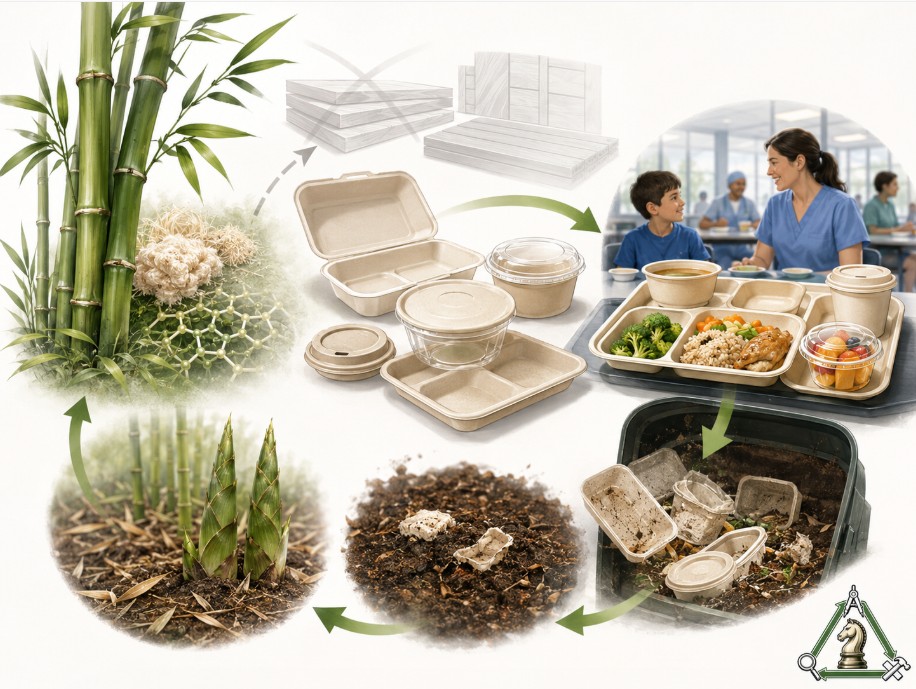
Material That Wants to Disappear
A Bright Meadow Group Technology Assessment
Observe.
A research group at Northeast Forestry University has published a route to a bamboo-derived plastic that breaks the usual bioplastic compromise.
That is the headline. The chemistry is the story.
Native bamboo cellulose is strong, but it is structurally locked. Its molecules are held in a rigid hydrogen-bond network, which is why earlier bamboo plastics tended to be brittle, stubborn, and difficult to mold. This new process loosens that structure in a zinc-chloride-and-formic-acid solvent at room temperature, modifies the cellulose chemistry in passing, then uses ethanol to drive the chains back together into a denser and more orderly bond network.
The result is a material with serious numbers behind it: tensile strength near 110 MPa, thermal stability past 180°C, standard molding processability, soil biodegradation inside fifty days, and chemical recyclability that retains roughly 90 percent of its strength.
That is enough to make people reach immediately for big applications.
Decking. Panels. Structural board. Outdoor goods. The permanent object that somehow disappears politely when we are finished with it.
That instinct is understandable. It is also the first mistake.
The first observation this material requires is not about bamboo. It is about us. We tend to see a strong, biodegradable plastic and try to force it into the role played by durable plastic. But biodegradability and durability are not separate knobs that can be turned independently. They are the same property seen from opposite ends.
A material soil organisms can consume in fifty days is also a material that water, weather, fungi, and microbes can enter across its service life. The bond an enzyme can sever is the bond rain can begin to exploit. Untreated wood rots for the same reason it composts.
There is no version of the same uncoated material that both endures outdoors indefinitely and returns cleanly to soil on command.
The standard fix is sealing. But sealing does not resolve the contradiction. It only moves it.
A soft coating preserves compostability but gives little real durability. The coating wears, the substrate wicks, and decay arrives late rather than never.
A durable coating delivers durability, but it forfeits the very environmental advantage that made the material interesting. It turns the product into a laminate: a biodegradable core bonded to a skin that prevents composting and complicates recycling.
That is not a theoretical failure. It is the bamboo-melamine tableware problem already seen in the market: products sold as natural, but functionally dependent on conventional resin chemistry to perform like plastic. The coating is the tell. Wherever a material that wants to decay is asked to endure, it gets laminated. And lamination is the moment both of its advantages begin to disappear.
Design.
Once the observer bias is removed, the contradiction clears.
The mistake was asking the material to solve the problem we brought with us. The better question is: what job is this material already built to do?
There is a large category of objects whose entire design requirement is to exist briefly, perform cleanly, and leave with the waste stream.
Single-use food service is that category.
The clamshell. The deli container. The lidded bowl. The tray. The cup.
For these objects, long-term durability was never the requirement. Recyclability was never really available either. A food-contaminated container is effectively landfill under most existing recovery systems, regardless of polymer, because food residue disqualifies it from conventional recycling.
That contamination is not a side condition. It is the operating environment.
Composting was always the honest end-of-life path for food packaging. The problem has been finding a material that can behave like plastic while in use and behave like organic waste when the meal is over.
That is where this bamboo plastic becomes interesting.
The performance gap against the current incumbent is the key. Corn-based PLA, the default “compostable” substitute, softens at temperatures low enough to make it unreliable around hot food. PLA cutlery fails in soup. PLA lids warp on coffee. PLA containers can feel like a promise made by a material that never really wanted the job.
A cellulose-based material stable past 180°C changes that equation.
The moisture sensitivity that would disqualify it as a building product barely matters across the service life of a takeout container. The design requirement is not to survive a winter outside. It is to survive lunch.
That is the proper frame.
Not a weaker plastic.
Not a miracle wood.
A high-performance disposable food-service material with a credible path back into the organic waste stream.
The manufacturing fit may be the most important feature of all. This material can be processed on standard molding equipment already installed across the converter base. That matters. Environmental materials do not scale because they are morally attractive. They scale when they can enter existing factories without demanding a religious conversion from manufacturing.
The ask is not a new industrial system.
It is a substituted pellet.
That single fact may do more for adoption than any number on the spec sheet.
Intervene.
The deployment question is not whether the material works. The deployment question is where to introduce it.
The obvious market is also the weaker one.
Premium fast casual will see this immediately. Bowl shops, salad chains, hotel cafés, taprooms, and high-margin prepared-food brands will want the container that lets them say: molds like plastic, performs under heat, returns to soil.
That channel is real. It is also fragile.
Premium packaging rides on premium spending. When households are under pressure, the customer who would pay extra for a greener container is often the same customer cutting back on the meal itself. In a barbelled economy — with one group able to absorb any premium, another priced out entirely, and the middle thinning — the green container becomes the first line item an operator value-engineers back to foam or polypropylene.
That makes adoption hostage to the consumer cycle.
The stronger intervention is institutional food service.
Hospitals. Schools. Universities. Military dining. Corrections. Closed-campus cafeterias. Corporate commissaries.
These buyers purchase through policy, contract, and system design rather than impulse. More importantly, their waste streams are captive. That changes everything.
In open consumer markets, “compostable” often means “theoretically compostable somewhere else.” The package leaves the restaurant, enters a municipal waste stream, and is sorted by hope.
Institutional food service is different. The same operator that buys the container can control the bin. The food waste, tray waste, and packaging waste can be routed together. That turns composting from a civic aspiration into a logistics problem.
And logistics problems can be solved.
Institutional demand is also structurally more durable. People in hospitals, schools, cafeterias, and public facilities are fed regardless of the consumer cycle. Volume may fluctuate, but it does not vanish the way discretionary fast-casual traffic can.
This is the less glamorous channel. It is also the better one.
The material’s end-of-life promise becomes credible only where the end-of-life pathway is controlled. That makes institutional procurement the proper early signal, not retail novelty.
Risk Register.
Three contingencies govern the assessment.
First: solvent recovery.
The cost and environmental case depend on recovering and reusing the zinc-chloride/formic-acid system at high efficiency. Academic techno-economics often treat this step optimistically. The chemistry may be sound, but scale will decide whether the process is commercially serious.
Second: organics infrastructure.
“Biodegradable” does not mean much in a sealed anaerobic landfill. Buried cellulose can decay slowly and produce methane. The value is captured only where the material reaches a managed organics stream. This is why institutional food service de-risks the proposition. The closed bin matters as much as the material.
Third: food-contact clearance.
The material avoids the melamine and formaldehyde problem, but regulators will still require migration data. Residual zinc, formic acid, and formate ester groups will need to be tested against hot, wet, oily, and acidic foods. That hurdle is likely manageable, but it is not optional.
None of these risks invalidate the material.
All of them decide whether it becomes a product.
Assessment.
This material appears to be what it claims to be.
The error to avoid is recruiting it for permanence. Its chemistry does not want to become decking, siding, or structural board. Force it into that role and it will need coatings, laminates, and compromises that erase the advantage.
Read correctly, its value lands in the humblest object on the tray: the container designed from the beginning to be discarded well.
That is not a small market. It is a global one.
If solvent recovery holds, if unit cost approaches polypropylene closely enough, and if deployment begins where organics handling can actually be controlled, bamboo molecular plastic could become one of the rare environmental materials that wins by fitting the system instead of asking the system to admire it.
Bright Meadow Group’s recommendation is straightforward:
Watch the scale-up metrics. Track solvent recovery rate. Track per-unit cost against polypropylene. Track food-contact approvals. But above all, watch institutional procurement.
Not the boutique salad bowl.
Not the branded green lid.
The hospital tray.
The school lunch container.
The closed-campus cafeteria.
That is where the transition starts to look real.