My father kept a small notebook in his porter’s jacket. Names, mostly. Men he’d worked the cars with who didn’t come back to the line — some of them retired, some of them buried, and he didn’t make much distinction in how he wrote them down. When I asked him why he bothered, he said a man who isn’t written down anywhere has to be carried in somebody’s head, and heads get tired.
So this week I’m doing the writing down.
August is a hard month in the record. I don’t know why the killing clustered where it did — heat, harvest, the season when a company’s books come due and a man’s patience runs out at the same time. But if you lay the first week of August end to end across a hundred years, you get a roll call. And a steward calls the roll.
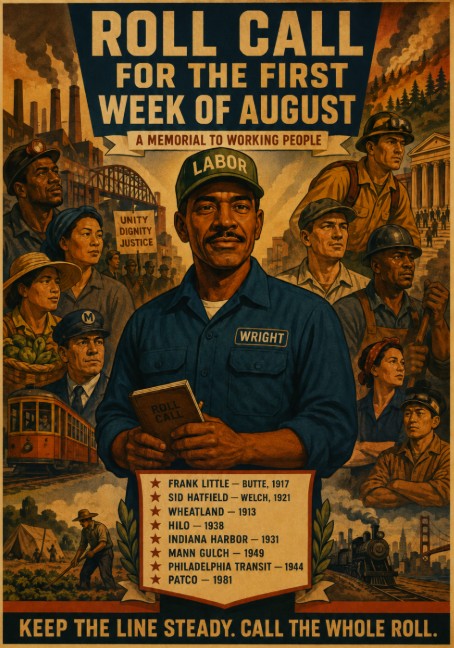
August 1, 1917. Butte, Montana. Frank Little came to organize the metal miners against Anaconda after the Speculator fire cooked a hundred and sixty-odd men in the shafts. He had one good eye and a bad leg and he was in a hotel bed when six masked men came through the door. They dragged him out and hanged him from a railroad trestle. Nobody was ever tried. Years later a Pinkerton man wrote that a company representative had offered him five thousand dollars to do the job himself, and that he’d quit the business that night.
Understand the arithmetic there, Jack. Five thousand dollars, in 1917, for a man’s life. That was the market rate. Somebody set it. Somebody approved it. Somebody wrote it down in a ledger under another heading.
August 1, 1921. Welch, West Virginia. Sid Hatfield walked up the courthouse steps unarmed, with his wife on his arm, and Baldwin-Felts men shot him down where he stood. Sid was the police chief at Matewan who’d stood between the detectives and the miners’ families when the evictions came. He was going in to answer a charge. He never got through the door. Three weeks later, ten thousand men marched on Blair Mountain, and the government dropped bombs on American miners from American airplanes.
August 1, 1938. Hilo, Hawai’i. Two hundred people came to the pier in support of striking waterfront workers. Police met them with gas, bayonets, and buckshot. Dozens went down wounded, some of them shot in the back while they were leaving. They called it the Hilo Massacre because it was one.
August 3, 1913. Wheatland, California. Twenty-eight hundred hop pickers camped in a field with nine toilets among them and one well, working for a wage the ranch had advertised high and paid low. When the deputies came to arrest the man who was speaking, somebody fired, and four people died — a district attorney, a deputy, and two workers whose names most books don’t carry. The two organizers went to prison for murder on the testimony of a jury with eight farmers seated on it.
August 5, 1931. Indiana Harbor, Indiana. Fifteen hundred men with no work and no prospect of it walked up to the gate of a plant and asked for jobs. Police routed them with clubs. That’s the whole story. There’s nothing more to it. Men asked to work and were beaten for asking.
Now, some of the roll isn’t gunmen. Some of it is the job.
August 5, 1949. Mann Gulch, Montana. Thirteen men died on a fire, twelve of them smokejumpers who went out of a plane into a canyon because that was the work and somebody had to do it. No villain in that one. Just wind and terrain and young men who trusted the plan they were given.
I put them on the same page as Frank Little on purpose. The mine that burned in Butte was a company’s decision. The canyon that burned in Montana was weather. But the men who went into both of them went in because working people go where the work is, and the difference between a hazard and a homicide is whether somebody upstairs did the math and decided your life came in under budget.
Respect is the first safety rule. I’ve said it a thousand times to men who thought it was a nice sentiment. It isn’t a sentiment. It’s the load-bearing wall. Every one of these deaths sits somewhere on a line that starts with a man in an office deciding that the people downstairs are a cost.
There’s one more entry, and it’s the one that costs us something to read.
August 1, 1944. Philadelphia. The transit company promoted eight Black men to operator positions. Eight. And white transit workers walked off the job to stop it — shut down the whole city, six days, in the middle of a war, so that eight men would not be permitted to drive a streetcar. It took five thousand federal troops to move those trolleys again.
Here’s the part I want you to hold onto: the union men stayed on the job. The Transport Workers stood with the eight. The walkout was a hate strike, and it was organized against the union as much as against those men.
But it happened. Working people did that. Men who punched the same clock, breathed the same brake dust, went home with the same ache in the same shoulder — they put all of it down and picked up something smaller, and they held it up like it was worth more than their own contract.
It never was. It never has been. Not once in the whole record.
August 3, 1981. Fifteen thousand air traffic controllers walked out. Two days later the President stood at the podium and told them they had forfeited their jobs. Eleven thousand three hundred and forty-five people fired in a morning, barred from federal service for life.
That was union-busting. Plain, deliberate, and effective. No hood, no trestle, no company gun — just a man with the biggest desk in the country demonstrating on television that a union could be erased before lunch. Every employer in America took the meeting. You can draw a straight line from that podium to the permanent-replacement letters that showed up in mailboxes all through the eighties, and to the shops that never got organized at all because everybody had seen what happens.
And here’s the detail I want in the notebook: that union endorsed him. In 1980, PATCO looked at the field and picked him. Their own people helped put him behind that podium, and eleven months later he used it on them.
I don’t tell that as a joke at their expense. I tell it because it’s the pattern, and the pattern didn’t end in 1981.
I’ve been in halls where a man could recite his contract from memory. Every article. Knew exactly what the grievance procedure cost to build and cared about who bled for it. And that same man would walk into a booth in November and vote for a Republican that had already told him, in writing, what it intended to do to the board that enforces his contract, the rule that pays his overtime, the fund that guarantees his pension.
Ask him why and he won’t talk about any of that. He’ll talk about the border. He’ll talk about who’s coming in, who’s getting something he isn’t, who’s cutting the line. Somebody spent a long time and a good deal of money teaching him to look sideways at the man on the other end of the same job, and it took.
That’s the whole trick. It’s the oldest tool on the wall — older than the Pinkertons, older than Baldwin-Felts, older than the machine gun. If the fellow who wants your contract can get you to spend your one vote on somebody else’s face, he doesn’t have to spend a dime on gunmen. You’ll hand him the scissors and hold the fabric steady.
Now, I’ve heard the objection. Wright, a man’s got more than one thing on his mind. He surely does. But I’d ask him to run the numbers the way he’d run them on a bid. What did the vote cost, and what did it buy? Because I have watched men trade away the wage, the pension, the safety inspector, and the right to sit at a table at all — and get in return the satisfaction of knowing somebody they’d never met got treated worse than they did.
That’s not a bargain. My father would have called it paying scale for scrap.
Every man on this week’s list died in a fight where the sides were clear. Frank Little knew who was in the room. Sid Hatfield knew who was on those steps. The pickers at Wheatland could see the deputies coming across the field. What we’ve got now is a fight where a great many working people can’t tell which side of the line they’re standing on, because somebody redrew it while they were watching something else.
The owners never had to beat all of us. They only ever had to beat some of us, and convince the rest it was a different fight.
It has always been one line, one gate, one roll.
Keep the line steady. Call the whole roll.
Well — now you know, Jack.